The Dirac equation is a mathematical instruction that describes the behavior of electrons at very high speeds, close to the speed of light. If the ordinary Schrödinger equation works for slow particles, the Dirac equation is like a racing car, capable of taking into account both the speed and the spin of particles. It predicted that every particle has a counterpart from the anti-world — an antiparticle. That is how physicists learned about the existence of positrons.
History
Paul Dirac proposed the equation in 1928, trying to overcome the limitations of the Klein–Gordon equation, which gave negative probabilities. He demanded that the equation be first order in time, like the Schrödinger equation, while also being relativistically invariant. The use of matrices made it possible to obtain an equation linear in momentum. Initially, negative energies were a problem, which Dirac interpreted as a filled "sea" of electrons, and holes in that sea as positrons, thus predicting antimatter. The positron was discovered by Carl Anderson in 1932, confirming the theory.
How it works
The Dirac equation is applied in quantum electrodynamics, solid-state physics to describe Dirac fermions in graphene, in neutrino theory (Wolfgang Pauli predicted the neutrino based on the Dirac equation), and in all processes with relativistic electrons. Limits of applicability: the equation describes free particles; interactions are introduced by gauge addition of fields. At energies comparable to the particle mass, quantum field corrections must be taken into account. The equation does not account for strong and weak interactions.
Fun fact
Dirac initially did not believe in antiparticles, but when a few years later the positron was discovered in cosmic rays, he was called "genius madness." Dirac himself said that the equation turned out to be smarter than its creator.
A thrown stone arcs through the air and falls. A planet orbiting a star is the same stone, but it falls forever, looping around the star in a closed curve. In Newton's world, that curve is a perfect ellipse, and the planet returns to the same point each orbit. In reality, the orbit slowly rotates: its closest point to the star, the perihelion, shifts.
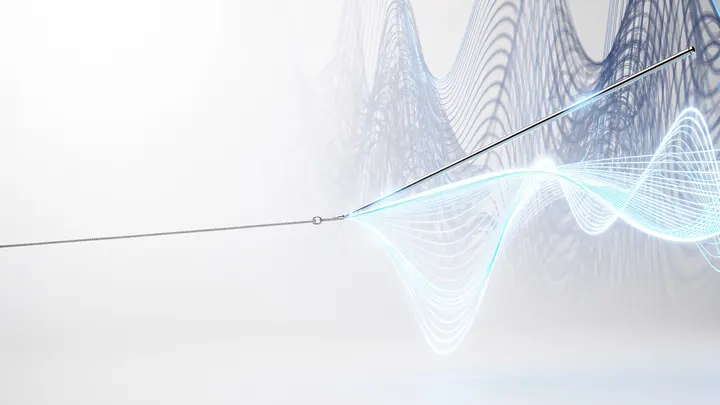
A tightrope walker steps onto the wire. Every move is a calculation: shift your weight just right, or you’ll fall. In the world of quantum particles described by the Dirac equation, there’s a different kind of abyss — the wave function’s furious oscillations.
Spacetime is not empty: it shivers. After the Big Bang, the universe was filled with a hum of gravitational waves, like the low rumble of a giant bell. In this ripple, as it turns out, particles of dark matter, the invisible substance that holds galaxies together, can be born.
But the previous idea had a snag.
Every quantum particle has spin — an intrinsic magnetic property, like a tiny arrow. In an experiment, a beam of such particles passing through a magnet splits in two, like a coin that lands either heads or tails. That’s exactly how particles like a hydrogen atom behave.
The end of the Universe is not just the fading of light. If dark energy, the mysterious substance accelerating cosmic expansion, tears it apart in a Big Rip scenario, or if expansion reverses into a contraction that pulls everything back to a point like a big bang in reverse, a…
A balloon in your hand springs back equally in all directions. But a bottle of soda behaves differently: along the neck it is stiff, while across it is easily squeezed. This is roughly how pressure works inside some stars: it can be unequal in different directions. Such stars are called anisotropic, and their behavior has so far been described by disparate methods.
The void can produce particles if a strong enough field is applied. Physicists call this the Dirac–Klein paradox. Previously, explaining it required the most complex calculations of quantum field theory. But we can make do with a visual image: a tightly stretched rubber band with a knot. The knot is a particle.
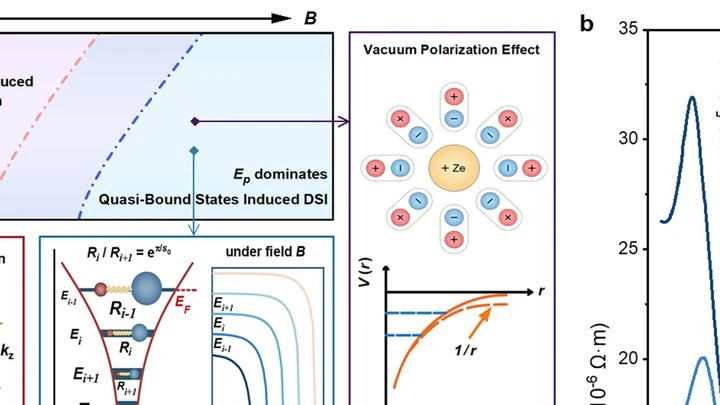
In the crystal HfTe5, electrons behave almost like light: their mass is so small that they obey the laws of relativity. If you place such a crystal in a strong magnetic field, the electrons start to circle in tiny orbits. Their energy then changes not smoothly but in steps, like floors in a building.
The proton is not a solid ball but a seething cloud of quarks and gluons. Each particle carries its own bit of rotation, but if you add up all the bits, you don't get the full proton spin. Part of the rotation seems to hide in the cloud's slowest inhabitants: those carrying only a tiny share of the total motion.
A sheet of graphene one atom thick is like a perfectly smooth tablecloth on which electron marbles roll. Place an electric barrier in their path, and usually they'll bounce back. But in graphene, it's different: under certain conditions, electrons pass through the barrier without even noticing it, as if the wall were made of mist.
An ordinary superconductor works like a perfect conductor: electrons pair up and flow without resistance. In the new material TaPtSi, the pairs are arranged differently: their internal symmetry is skewed, and when cooled below the critical temperature, tiny magnetic fields spontaneously emerge inside the crystal.
Physicists took 114 rubidium atoms, cooled them to near absolute zero (as in experiments with liquid helium), and neatly arranged them in a honeycomb pattern. They then smoothly adjusted the interaction strength, as if slowly turning up the heat under a pot.
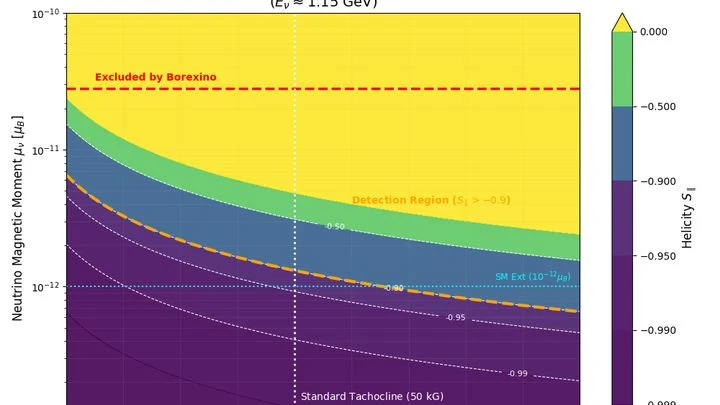
The Sun doesn't just shine: it continuously emits streams of tiny particles, neutrinos. They are born in thermonuclear reactions in the core and pass through the star almost unhindered. But inside the Sun, there are magnetic fields that can influence these particles, like invisible corridors that slightly bend their path.
A flat sheet of material just one atom thick can conduct current only along its edges, like water flowing along the rims of a tray rather than across its middle. In a new study, physicists showed that such edge "channels" can be rearranged simply by rotating an invisible magnetic axis within the sheet.
The EuAuBi crystal is like a layered cake of europium, gold, and bismuth atoms. When cooled to near absolute zero, three different magnetic patterns appear in sequence, like a kaleidoscope pattern shifting with a slight turn. First, the magnetic atoms align strictly in antiphase, then they tilt slightly, and at even lower temperatures, a third order emerges.
According to the laws of the microworld, an electron obeying the Dirac equation trembles even at complete rest. This is Zitterbewegung — an oscillation with an amplitude of trillionths of a millimeter, like a spinning top on an invisible axis.
We’re used to time flowing only forward. But quantum laws let it become like a coin showing heads and tails at once.
Take a particle with its own spin — its intrinsic rotation. In a magnetic field, it spins like a top. Send this particle through a device where two opposing magnetic flows fight each other — and it will start moving into the future and the past at the same time.
Two translators listen to the same symphony. One hears only the fundamental tone: a clean, predictable melody. The other catches the overtones that color every note.
Two translators listen to the same symphony. One hears only the fundamental tone: a clean, predictable melody. The other catches the overtones that color every note.