Solar neutrino oscillation is the phenomenon where neutrinos produced in the Sun's core change their flavor (electron, muon, or tau) as they travel through the Sun and to Earth. This effect, known as the Mikheyev–Smirnov–Wolfenstein (MSW) mechanism, arises because neutrinos interact with the dense solar matter, which alters their effective masses and causes them to oscillate between flavors. It explains the long-standing 'solar neutrino problem' — the observed deficit of electron neutrinos from the Sun compared to theoretical predictions.
History
The MSW effect was proposed independently by Lincoln Wolfenstein in 1978 and Stanislav Mikheyev and Alexei Smirnov in 1985. It was confirmed by the Sudbury Neutrino Observatory (SNO) in 2001, which measured the total neutrino flux from all flavors and found it matched solar model predictions.
How it works
Neutrinos are produced in the Sun as electron neutrinos via nuclear fusion. As they pass through solar matter, they experience a potential energy shift due to coherent forward scattering with electrons. This interaction is flavor-dependent, so it changes the mixing angles between neutrino mass states. When the neutrino density is high, the oscillation probability is resonantly enhanced, converting a large fraction of electron neutrinos into muon and tau neutrinos. By the time they reach Earth, detectors see roughly one-third of the original electron neutrino flux, matching observations.
In practice
Understanding solar neutrino oscillations allows precise tests of the Standard Model of particle physics and provides a probe of the Sun's internal conditions, including its temperature and density profile.
Fun fact
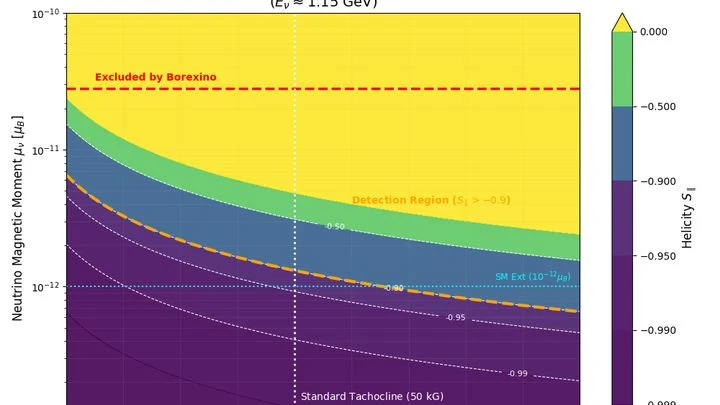
The MSW effect is sensitive to the Sun's magnetic field, which can create additional flavor conversion pathways, a topic explored in recent research on 'magnetic corridors' in the solar interior.
A hot infant and a cold adult — the same neutron star looks different. Just born in a supernova explosion, it is scorching hot at tens of billions of degrees. But as time passes, it cools, contracting like cooling metal. For the star PSR J1012+5307, this transition means an almost twofold reduction in radius.
The Sun is not just a source of light but a giant laboratory where ghostly particles are born. Every second, billions of neutrinos fly through your body, barely noticing you. But inside the Sun, these particles behave differently: they change their type on the fly, like an actor playing three roles in a single play.
A spinning top whirls so fast it's about to fly apart. Add to it a super-strong magnet — one that, if placed on the Moon, would wipe data from every credit card on Earth. That's a magnetar: an ultra-dense remnant of an exploded star, a lump of matter where a teaspoon weighs as much as a mountain.
When a massive star dies, its core collapses, and a neutrino storm is born. These ghostly particles fly outward, changing their flavor along the way, like a chameleon changes color. This dance of flavors can either boost the explosion or, conversely, dampen it.
But this dance has a choreographer — the density gradients of matter.
Two teams of radio telescopes pointed their antennas at two gas clouds: one at the very center of the Milky Way, the other in its quiet outskirts. Both clouds contain methanol molecules — an alcohol that acts as a tiny pendulum in space: it absorbs and emits radio waves at strictly defined frequencies.
The Sun doesn't just shine: it continuously emits streams of tiny particles, neutrinos. They are born in thermonuclear reactions in the core and pass through the star almost unhindered. But inside the Sun, there are magnetic fields that can influence these particles, like invisible corridors that slightly bend their path.
Our Sun emits streams of neutrinos — particles that barely interact with matter. Passing through the dense solar material, they change their type — scientists call this 'flavor.' It's like a voice that changes as it moves through a crowd: the thicker the crowd, the more it gets distorted.