Solar Neutrinos and Magnetic Corridors express
The Sun doesn't just shine: it continuously emits streams of tiny particles, neutrinos. They are born in thermonuclear reactions in the core and pass through the star almost unhindered. But inside the Sun, there are magnetic fields that can influence these particles, like invisible corridors that slightly bend their path.
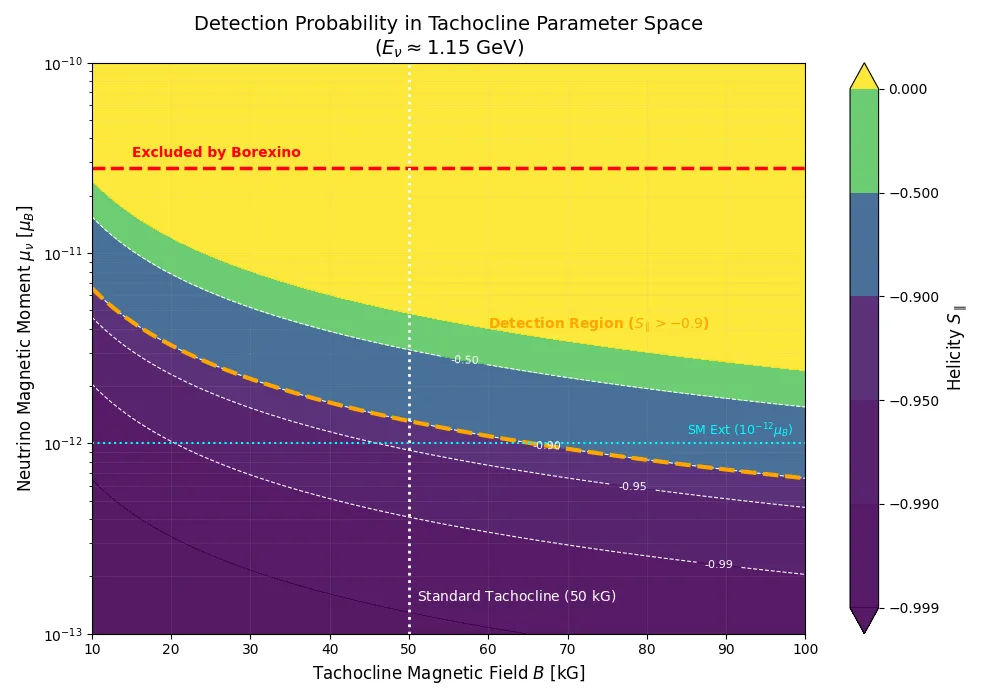
In the new work, physicists calculated exactly how the Sun's magnetic field changes the behavior of neutrinos of different energies. It turns out that for neutrinos with energy around 10 MeV (typical for solar reactions), the resonant transformation occurs only in the very center — at a distance less than one-fifth of the solar radius. But for neutrinos from powerful solar flares with energies above 1 GeV, the resonance shifts to the outer layers, where magnetic fields reach 50 kilogauss — thousands of times stronger than Earth's field. There, particles actively change their type.
The authors showed that such transformation affects neutrino scattering on electrons and atomic nuclei. If we can register a difference in signals from neutrinos of different energies, we can determine whether neutrinos are Dirac particles (like electrons) or Majorana particles (where the particle equals its antiparticle). This is one of the key questions in particle physics. Even if no signal is found, the method will improve the limit on the neutrino magnetic moment by a factor of ten compared to current experiments.
The Sun turns out to be not only a source of light and heat, but also a natural laboratory where magnetic fields help distinguish fundamental properties of particles.
Neutrinos interact so weakly with matter that they can pass through a light-year-thick layer of lead without hitting a single nucleus.
In Stanislaw Lem's novel "Solaris," the planet's ocean influences visitors by changing their perception of reality — somewhat like how the Sun's magnetic field subtly changes the nature of passing neutrinos.