Sterile neutrinos are hypothetical particles that interact only via gravity and, possibly, very weak mixing with active neutrinos. They are called 'sterile' because they do not participate in the weak nuclear force, unlike the three known neutrino flavors. If they exist, they could explain several puzzles in physics, most notably the nature of dark matter. Sterile neutrinos with masses in the keV range are a leading warm dark matter candidate, potentially solving the 'missing satellites' problem of cold dark matter simulations by suppressing small-scale structure formation.
History
The concept of sterile neutrinos was introduced in the 1990s by Dodelson and Widrow, and later refined by Shi and Fuller, who proposed the resonant production mechanism. The idea gained traction as a dark matter candidate in the early 2000s, with the discovery of the 3.5 keV X-ray line in galaxy clusters, though this detection remains controversial.
How it works
Sterile neutrinos could be produced in the early universe through oscillations with active neutrinos. The production mechanism depends on the mixing angle and mass. For dark matter, a keV-scale sterile neutrino would be produced resonantly in the presence of a lepton asymmetry, yielding the correct relic abundance. They would be extremely long-lived, with lifetimes exceeding the age of the universe, and would decay slowly into active neutrinos and photons, producing a faint X-ray line that could be detected.
In practice
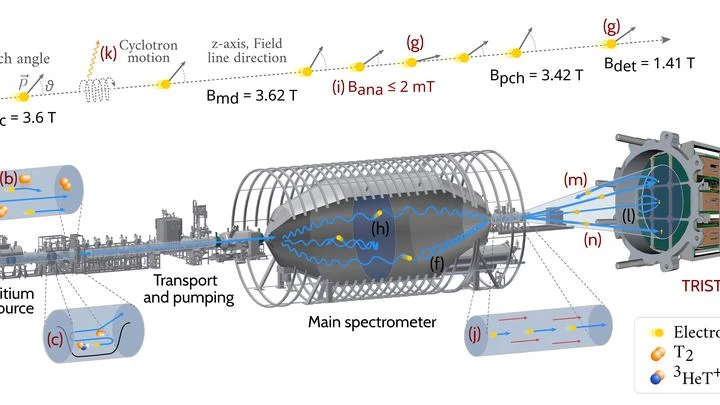
Sterile neutrinos are searched for in laboratory experiments, such as KATRIN and Troitsk nu-mass, which look for kinks in beta decay spectra. They are also probed via astrophysical observations, including X-ray telescopes like XMM-Newton and NuSTAR, which search for decay lines from dark matter halos.
Fun fact
The 3.5 keV X-ray line, first reported in 2014, has been seen in some galaxy clusters but not in others, leaving the sterile neutrino interpretation unresolved and fueling ongoing debate.
In a tank holding three tons of liquid xenon, buried deep underground, something stirred one day. Not the xenon itself, but one of its atomic nuclei: it received a kick with an energy of 248 thousand electronvolts and recoiled like a billiard ball struck by an invisible cue ball.
The neutron is a particle that usually sits in the atomic nucleus and doesn't disappear. But some theories suggest that occasionally it might transform into its invisible twin — a particle that ordinary detectors can't catch.
No one has ever seen dark matter, but it should pass through detectors like wind through leaves. Sometimes, very rarely, a dark matter particle bumps into an atomic nucleus, and then the detector must catch that jolt. The trouble is that light dark matter particles can hardly move heavy nuclei: it's like trying to knock down a bowling pin by throwing a feather at it.
Dark matter remains the inaudible bass line of the cosmic symphony — it emits no light, but its gravitational pull shapes galaxies. Vera Rubin first caught this rhythm in the 1970s by observing the rotation of stars.
A teaspoon of neutron star matter weighs as much as a mountain. But this mountain may have an invisible twin.
Deep inside a neutron star, ordinary matter is compressed to unimaginable densities. There, protons and neutrons can dissolve into a quark soup.
Two stones fall into a pond. Ripples spread from each, but when they collide, there's a splash and a short, sharp clap. That's roughly what the merger of two neutron stars sounds like: those ultra-dense remnants of exploded stars.
Deep underground in Japan, a huge tank of ultrapure water waits for rare visitors — neutrinos arriving from distant stellar explosions. Such guests are few and far between: over years of observation, Super-Kamiokande registers only a handful of events.
An architect checks the blueprint when building a house. For cosmologists, the blueprint is the Standard Model, and the measuring tape is the light from distant galaxies. Recently, a new 'tape measure,' the DESI instrument, measured distances to millions of galaxies with unprecedented precision. And the numbers didn't match the blueprint.
A pot of boiling water bubbles and churns, mixing everything inside. Take it off the heat, and the motion subsides as the water slowly cools. The Universe is like that: right after the Big Bang, it was a searing 'soup' of particles that constantly collided and transformed into one another. But as space expanded, the cosmos cooled, and particles met each other less and less often.
Radioactive tritium decays, emitting an electron. Its energy is almost always the same, but sometimes, just a little less. This shortfall could mean that alongside the ordinary neutrino, another, hidden particle was born.
The Standard Model describes three types of neutrinos, but scientists suspect there is a fourth — the sterile one.
In the first moments after the Big Bang, the universe was a hot soup of particles. Among them could have been neutrinos — very light and nearly elusive particles. Some of them might have been 'sterile': they barely interact with the rest of matter, like a quiet guest at a loud party.
Deep inside an underground laboratory, a room-sized detector waits for an event that might happen once in a hundred million billion years. That event is neutrinoless double beta decay — a process that would break one of physics' fundamental laws. To catch it, you need perfect silence: not a single stray radioactive atom in the detector's materials.
Visible matter is a drop in the sea of cosmic soup. The foundation of the Universe is made of invisible dark matter, whose gravity keeps galaxies from flying apart. The best candidate for this role is sterile neutrinos, ghost particles connected to us only by the thinnest of bridges.
An electron flies out of a tritium nucleus with an energy of 18.57 keV, leaving behind an invisible partner: a neutrino. If that neutrino has access to a fifth dimension, its mass splits into a whole tower of states, and each one takes its own bite out of the spectrum.