A sterile neutrino is a hypothetical particle that would interact with ordinary matter only through gravity, not through the weak nuclear force like the three known neutrino types. It is called 'sterile' because it would be invisible to all standard particle detectors. Sterile neutrinos are a leading candidate for dark matter, the invisible substance that makes up about 27% of the universe's mass-energy content.
History
The sterile neutrino was first proposed in 1994 by Dodelson and Widrow as a dark matter candidate, building on earlier work on neutrino oscillations. The idea gained traction in the 2000s when anomalies in neutrino experiments hinted at a possible fourth neutrino flavor, though no direct detection has been confirmed.
How it works
Sterile neutrinos would be produced in the early universe through oscillations with ordinary neutrinos, a quantum mechanical process where neutrinos change flavor. If they have a mass in the keV range (thousands of electron volts), they would have been produced with the right abundance and velocity to form dark matter structures. They would decay very slowly, possibly emitting a faint X-ray line that astronomers search for in galaxy clusters and other dark matter-rich regions.
In practice
Sterile neutrinos are not used in technology, but they are a major focus of experimental searches for dark matter, with missions like XMM-Newton and NuSTAR looking for their decay signature in X-ray spectra.
Fun fact
If sterile neutrinos exist, they could also explain the observed 'pulsar kicks' — the unexpectedly high velocities of some neutron stars — by being emitted asymmetrically during a supernova explosion.
In an underground laboratory in South Dakota sits a tank of liquid xenon. It catches rare events: particles pass through the Earth, strike xenon nuclei, and those recoil like billiard balls after a hit. One such recoil was recorded at an energy of 248 keV, and it turned out to be as lonely as a loud bell strike on a quiet night.
The neutron is a particle that usually sits in the atomic nucleus and doesn't disappear. But some theories suggest that occasionally it might transform into its invisible twin — a particle that ordinary detectors can't catch.
The cosmological standard model is like a recipe for a cake where everything is strictly measured: dark matter is like flour without a single lump (zero pressure), and dark energy is like the perfect leavening agent (equation of state exactly minus one). But what if the flour is a bit damp and the leavening agent has lost its oomph?
In the first moments after the Big Bang, the universe was a searing 'soup' of particles. As it cooled, phase transitions occurred — much like water turning to ice. At one such moment, magnetic monopoles of dark matter could have been born: tiny clumps of field with a single magnetic pole.
The atomic nucleus is not just a jumble of protons and neutrons. The particles inside arrange themselves in layers, like spectators in a stadium: the lower rows are filled, and each new proton or neutron looks for a spot on a higher tier. When a row is completely filled, the nucleus becomes especially stable — physicists call this a magic number.
Neutron stars — remnants of supernovae — are among the densest objects in the Universe. Their central density exceeds nuclear density many times over, and gravity is surpassed only by black holes.
A teaspoon of neutron star matter weighs as much as a mountain. But this mountain may have an invisible twin.
Deep inside a neutron star, ordinary matter is compressed to unimaginable densities. There, protons and neutrons can dissolve into a quark soup.
Neutron stars are cosmic 'ice cubes' of unimaginable density: a tablespoon of their material would outweigh Mount Everest. It was a mystery what lay in their cores: ordinary neutron matter (a giant atomic nucleus) or exotic quark matter, where particles are not bound into neutrons.
An atomic nucleus is like a droplet with a thin coating — a neutron 'skin.' Inside the droplet, protons and neutrons are mixed evenly, but on the outside, like the froth on milk, a layer forms where neutrons are noticeably more abundant.
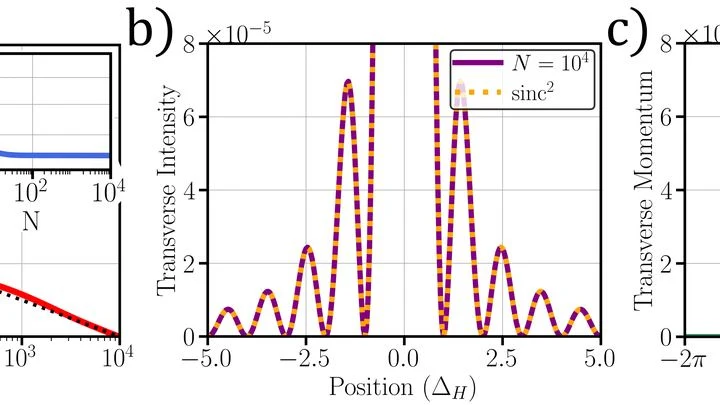
The neutron is a particle with no electric charge, making it tricky to catch: it slips through instruments like a bullet through fog. In typical experiments, it gets just one pass through a crystal, and all measurements must fit into that instant.
A new idea is to make the neutron loop inside a trap, like a ball bouncing between two walls.
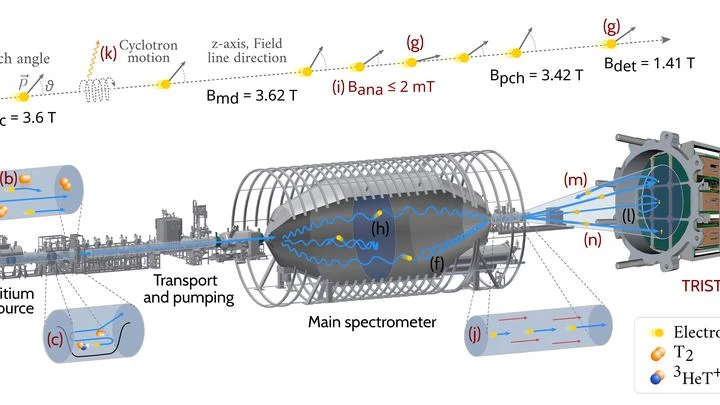
Radioactive tritium decays, emitting an electron. Its energy is almost always the same, but sometimes, just a little less. This shortfall could mean that alongside the ordinary neutrino, another, hidden particle was born.
The Standard Model describes three types of neutrinos, but scientists suspect there is a fourth — the sterile one.
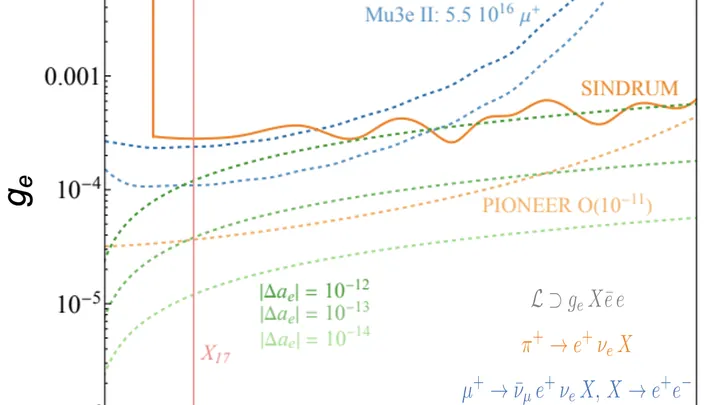
In nuclear transitions of beryllium-8, helium-4, and carbon-12, physicists from the ATOMKI collaboration have been seeing extra events since 2020—as if, when an excited nucleus decays, something else is sometimes born besides the usual photons. The energy of this "something" is always the same: about 17 million electron-volts.
In the first moments after the Big Bang, the universe was a hot soup of particles. Among them could have been neutrinos — very light and nearly elusive particles. Some of them might have been 'sterile': they barely interact with the rest of matter, like a quiet guest at a loud party.
A neutron star is the ultra-dense remnant of a supernova explosion, whose existence was predicted by Fritz Zwicky back in the 1930s. Later, Jocelyn Bell Burnell detected them as pulsars — rotating sources of strictly periodic radio signals.
Dark matter is the invisible glue that keeps galaxies from falling apart. Back in the 1930s, Fritz Zwicky suspected its existence, and in the 1970s Vera Rubin proved that without it, stars would fly apart.
An electron flies out of a tritium nucleus with an energy of 18.57 keV, leaving behind an invisible partner: a neutrino. If that neutrino has access to a fifth dimension, its mass splits into a whole tower of states, and each one takes its own bite out of the spectrum.
Two telescopes look at the same Universe and see different expansion rates. Local measurements from supernovae give 73.04 ± 1.04 km/s/Mpc, while cosmic microwave background data within the standard model predict 67.36 ± 0.54.