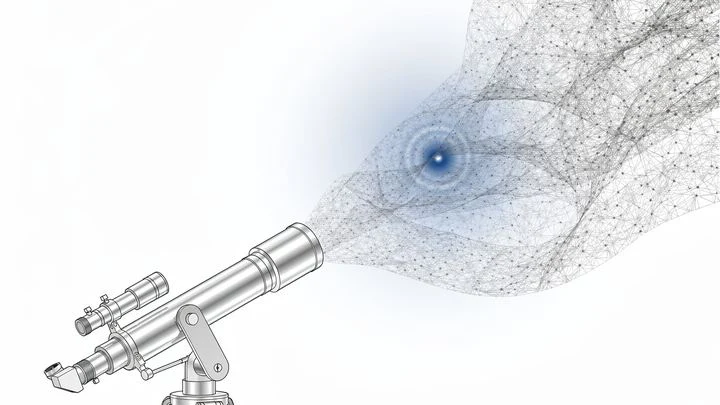
Cold dark matter (CDM) is the prevailing model of dark matter, positing that it consists of slow-moving, heavy particles that interact only weakly with ordinary matter and light. This model successfully explains the large-scale structure of the universe — galaxies, clusters, and the cosmic web — because the slow particles allow small density fluctuations to grow into clumps, which then merge into larger structures. CDM is a cornerstone of modern cosmology, fitting observations of the cosmic microwave background and galaxy formation.
History
The term 'cold dark matter' was introduced in the early 1980s by James Peebles and others, building on earlier dark matter proposals. The model gained prominence after the 1992 COBE satellite observations of the cosmic microwave background, which supported its predictions.
How it works
In the early universe, tiny quantum fluctuations were amplified by gravity. Because CDM particles are cold (non-relativistic), they can cluster efficiently on small scales, forming halos that later attract baryonic matter to create galaxies. The model predicts a hierarchical structure formation: small clumps form first, then merge into larger ones, a process that matches observations of galaxy distributions.
In practice
CDM is used in cosmological simulations to predict structure formation and to interpret data from galaxy surveys and gravitational lensing experiments.
Fun fact
Despite its name, cold dark matter particles have never been directly detected; their existence is inferred solely from gravitational effects.
Light from a distant galaxy reaches us through its own dust. This dust is not a smooth haze but ragged clouds, like wisps of cotton. Old models treated it as a uniform mist, and then the galaxy didn't add up energetically: too much light disappeared in the ultraviolet and too little came back in the infrared.
Astronomers did what a cook does when they dice a potato instead of tossing it in whole.
The five-hundred-meter FAST radio telescope picked up a signal at the 21-centimeter wavelength — the telltale glow of cold hydrogen. The signal came from a cloud named Cloud-9. It hangs in space near the galaxy M94, but it contains not a single star.
The night sky looks like a random scattering of stars. But zoom out to enormous distances, and the chaos disappears. Galaxies gather into long filaments and flat walls, with colossal voids gaping between them — cosmic voids. This structure is called the cosmic web.
The standard cosmological model ΛCDM (which includes dark energy and cold dark matter) is the score of a cosmic symphony. It describes how space expanded after the big bang. How dark matter clumped together. How galaxies ignited. For a long time, everything played flawlessly.
The universe is like a vast invisible scaffold. We don't see it directly, but we know it's there: galaxies and clusters hold together thanks to it. This scaffold is dark matter. The most popular version says it is "cold," made of heavy, slow-moving particles.
Through three minutes after the Big Bang, the Universe played its first symphony. It was the big bang nucleosynthesis — the formation of light nuclei, where each element sounded its own note, and the tempo was set by the expansion of space.
A cold, black mirror — that's what the sea of dark energy, the invisible substance driving the expansion of the universe, looked like for billions of years. But the DESI spectrograph has caught a faint ripple.
The universe is a grand orchestra, with dark energy conducting the expansion. Ten billion years ago, the conductor changed its gesture: the negative pressure that had been holding back galaxy assembly gave way to accelerating expansion — the very phenomenon discovered by [scientist:Saul…
When a giant planet grows, it pulls in gas. Some of that gas swirls around it into a small disk — called a circumplanetary disk. It is in such disks that moons are thought to form. For the planet PDS 70 c, located 370 light-years away, such a disk was directly observed using the ALMA antenna array in the millimeter range.
The cosmological kitchen is full of invisible ingredients. Dark matter, like an invisible scaffold, keeps galaxies from flying apart, while dark energy, like yeast in dough, makes space expand ever faster.
The universe is expanding at an accelerating rate, like dough that keeps rising faster even though the yeast ran out long ago. For twenty years, astronomers have been searching for the cause and call it dark energy. But what it is remains a mystery.
New work proposes an unexpected source: the vacuum inside the atomic nucleus.
A giant cloud of invisible matter acts like a funhouse mirror — distorting the light from a distant galaxy. From these distortions, astronomers can weigh the cloud and peer into its depths.
The Universe grows like a metropolis: galaxies skyscrapers are erected on an invisible scaffold of dark matter: its gravity pulling in construction material. Meanwhile, dark energy makes the city itself continuously expand.
The universe is expanding faster and faster thanks to dark energy. But measurements of the rate give contradictory results. A new explanation: in the past, dark energy acted as a brake, slowing the galaxies' recession, and then switched to acceleration. Like a car that first rolls backward and then lunges forward.
Through the ripples on the water, pebbles at the bottom of a pool look shifted and warped. In a similar way, the gravity of invisible dark matter bends the light of distant galaxies — a phenomenon known as weak lensing.
Just a few hundred million years after the Big Bang, in the ocean of invisible dark matter, giant black holes were already taking shape. They were born from the matter itself — without any help from stars. This mechanism, based on the equations of Lemaître, explains their early appearance.
A compressed spring can sit for years without moving. It seems frozen forever, but inside the metal, atoms slowly rearrange, and one day the spring clicks, settling into a new, more relaxed position.
The Universe is a vast city. In it, dark matter is the invisible framework of buildings, and dark energy is the force stretching the streets. For a long time they were considered independent, but new research has caught them in secret communication.
It all started with a tiny clump that grew faster than light could cross it. Inside this inflating bubble, our future Universe, reigned unimaginable heat. But one field, called the inflaton (the engine of inflation), behaved like a conductor: it controlled both the expansion and how other particles behaved.
For a long time, dark energy, the mysterious force prodding the expansion of the Universe, was considered eternal and unchanging, like yeast that never loses its activity. But explaining such constancy through the laws of the microcosm proved impossible, and scientists began to suspect that the “leaven” might be going flat.
Two clocks tell different times. One sits on our desk, the other lies far in the past, in the glow left over from the Big Bang. The first, looking at nearby galaxies, ticks off the expansion rate of the universe — about 73 kilometers per second per megaparsec of distance. The second, peering into ancient light, gives a noticeably lower value — roughly 67.
You are pacing a huge hall in complete darkness. You walk from wall to wall, counting your steps, and suddenly realize that the distances don't add up as they should. It seems as if the floor is not flat but bulging like a hump or hollowed like a bowl. That's roughly what astronomers found when studying distant galaxies and sound waves frozen in the early Universe.
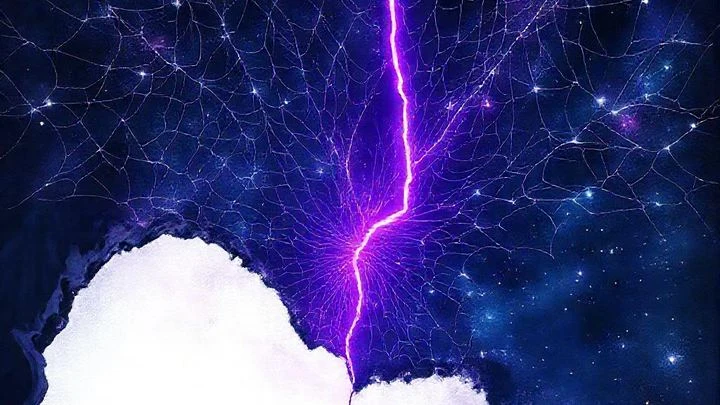
The cosmic web resembles a giant three-dimensional network: galaxies and clusters are connected by filaments of dark matter. These filaments act as invisible bridges along which matter flows toward major nodes. For a long time, scientists struggled to understand the density structure of these filaments, but results were contradictory.
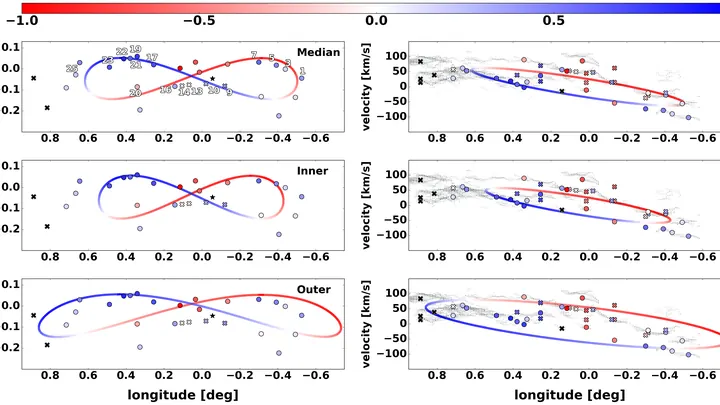
In the very center of the Milky Way, hidden behind a thick veil of dust, lies a giant accumulation of gas — the Central Molecular Zone. You can't see it with the naked eye: dust absorbs visible light, much like dense fog hides the lights of a city.
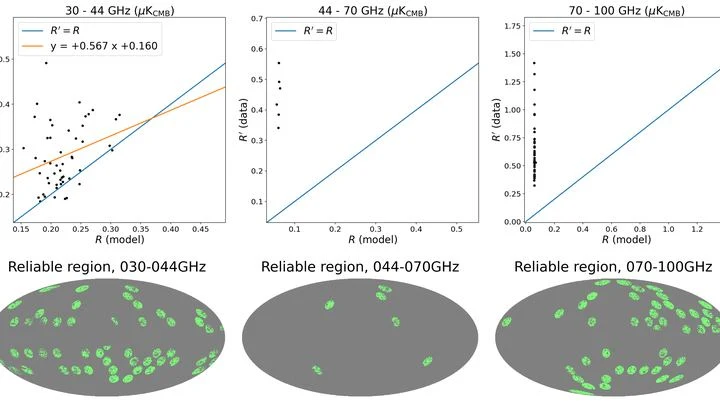
Astronomers are trying to capture the radio echo of the Big Bang — a faint glow that fills the entire universe. But the receiver is choking with noise: our Galaxy is packed with glowing interstellar dust, whose emission can easily be mistaken for a signal from the distant past.
The Universe is expanding faster and faster. We used to chalk that up to dark energy — a mysterious force working alone. But the latest measurements seem to have eavesdropped on a private conversation: it appears dark energy is not silent but whispering back and forth with dark matter.
Light from distant galaxies, passing through clusters of matter, gets distorted — much like the bottom of a pool breaks up into ripples of water. Astronomers measure these barely perceptible bends in shape and create a map of gravitational ‘ripples.’ This is weak lensing — a natural detector of invisible matter.
The enigma of dark matter was already studied by Fritz Zwicky and Vera Rubin. For decades, it was depicted as a cold, listless skeleton that only draws galaxies together.
The universe is a pie baked from a single recipe, but the teaspoon and the kitchen scale stubbornly show different amounts of sugar. That’s how it is with the expansion of the universe: measurements from nearby stars (the spoon) give one number, while those from the ancient light of the Big Bang (the scale) give a completely different one.
The James Webb telescope spotted “red dots” in the early Universe — dense objects tens of light-years across. Spectroscopic analysis of their light revealed the hue of hydrogen. Yet in X-rays they are nearly invisible, like a powerful spotlight wrapped in layers of gas curtains.
Astronomers read the history of galaxies by their portraits. Previously, they used either lengthy analysis of light by colors or quick filtered snapshots, losing the details of shape.
Dark matter is the invisible scaffold of the cosmos, its existence betrayed by whirls of galaxies to Fritz Zwicky and Vera Rubin. What it is made of remained a mystery for half a century.
A new hypothesis paints an unusual picture.
Particles of dark matter can behave like molasses: in one model they don't interfere with each other; in another, they gently jostle, creating viscosity. This determines how quickly giant black holes at the centers of galaxies fall into each other and merge.
The universe is putting on a show, and the lead role goes to dark energy. For a long time, the actor seemed unchanging: the cosmological constant (the vacuum energy that accelerates cosmic expansion) set the same tone throughout.