Neutron Star Mergers Ring in a Single Note express
Two stones fall into a pond. Ripples spread from each, but when they collide, there's a splash and a short, sharp clap. That's roughly what the merger of two neutron stars sounds like: those ultra-dense remnants of exploded stars. Except here the 'pond' is spacetime itself, and the 'clap' is the gravitational waves caught by giant detectors on Earth.
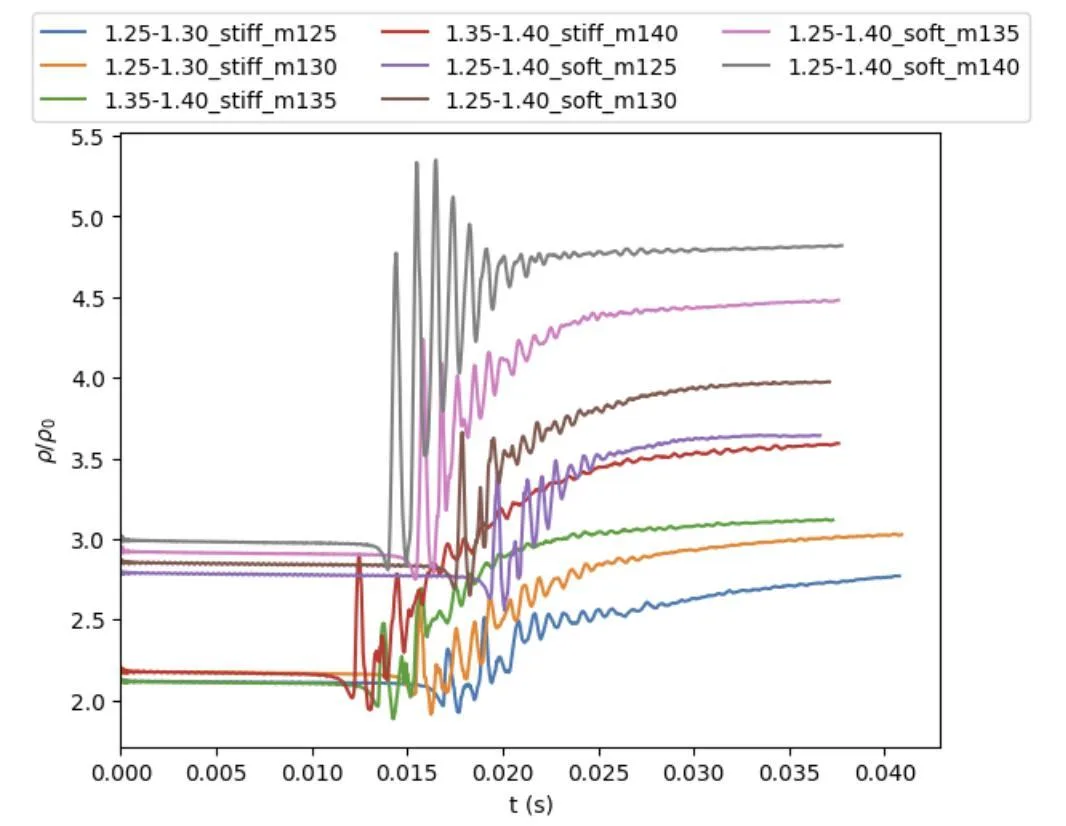
This ring is not random. Its pitch, the oscillation frequency, depends on how strongly the matter inside the star resists compression. You'd think that without knowing the exact recipe for matter at mind-boggling densities (a teaspoonful weighs billions of tons), the frequency could be anything. But the authors ran 82 computer simulations of collisions, covering all allowed 'stiffness' options for neutron stars. And they found something remarkable: if you know the pair's mass and its compactness (how small the star is for its weight), the post-merger dominant frequency varies very little — only about 100 Hz. For comparison, the frequency range from deliberately unrealistic models is five times wider.
This tight lock between frequency and mass and size turns the gravitational ring into a precision measuring instrument. If a future detector hears a frequency that falls outside the predicted narrow band, it means extra physics has kicked in inside the hot remnant. For instance, neutrons might have melted into their constituent quarks, softening the matter. Such a signal would be the first direct evidence of quark matter born not in the cold of isolated stars but in the fire of a cosmic catastrophe. So we come full circle to the stones in the pond: now their impact isn't just heard: it tells us what they're made of.
A neutron star the size of a city (about 20 km) weighs as much as one and a half Suns. A teaspoon of its matter on Earth would weigh as much as Mount Everest.
In Charles Stross's novel 'Quark Dawn', neutron stars serve as raw material for exotic technologies, and their collisions are key to understanding phase transitions in matter.