Ultralight dark matter refers to hypothetical particles with masses far smaller than the electron, often around 10^-22 eV, such as axions. Unlike heavy dark matter candidates like WIMPs, these particles behave more like waves than particles due to their enormous de Broglie wavelength, which can be as large as a galaxy. This wave-like behavior could leave distinct imprints on cosmic structures, such as suppressing small-scale clumping or creating solitonic cores in dark matter halos.
History
The axion was first proposed in 1977 by Roberto Peccei and Helen Quinn to solve the strong CP problem in quantum chromodynamics, and later recognized as a dark matter candidate. The ultralight scalar field dark matter idea gained traction in the 2000s with models like fuzzy dark matter.
How it works
Because of their tiny mass, ultralight dark matter particles are produced in huge numbers and form a coherent quantum state, like a Bose-Einstein condensate. Their wave interference can create patterns of density fluctuations, and they can form stable, oscillating configurations called solitons. Detection strategies often rely on their coupling to photons or other particles, using resonant cavities or atomic magnetometers to pick up faint signals from axion-photon conversion.
In practice
Ultralight dark matter searches drive the development of ultra-sensitive detectors, such as the Axion Dark Matter Experiment (ADMX), which uses a tunable microwave cavity to detect axion signals.
Fun fact
If dark matter is made of ultralight particles, a single 'particle' could have a wavelength spanning thousands of kilometers, making it behave more like a wave than a bullet.
A little monster hides in a dwarf galaxy, and its neighbor feeds it. The satellite galaxy is slowly merging with a massive companion, and gas from the outer regions falls toward the center, where a black hole sits. By cosmic standards, it is not large: only 800 to 5000 solar masses, but its appetite is ferocious.
In a tank holding three tons of liquid xenon, buried deep underground, something stirred one day. Not the xenon itself, but one of its atomic nuclei: it received a kick with an energy of 248 thousand electronvolts and recoiled like a billiard ball struck by an invisible cue ball.
The night forest is full of fireflies, but before, we only saw those that happened to be in the beam of a flashlight. That was the case with ultraluminous X-ray sources: points in other galaxies that shine in X-rays more brightly than a stellar-mass black hole can steadily emit. Telescopes looked at galaxies chosen for other purposes, missing most of the fireflies.
In a distant galaxy, light from hot gas should reveal its composition. The James Webb Telescope split that light into a spectrum, and astronomers saw: oxygen lines too weak.
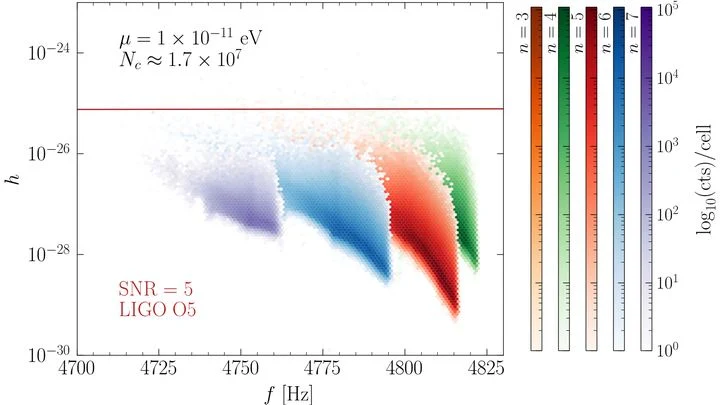
A black hole is like a spinning top that never stops on its own. But if a cloud of ultra-light particles, bosons, forms around it, the picture changes. This "fog" acts like an invisible brake: the particles drain the hole's spin, slowing it down.
The galaxy is not a smooth lake but a pond with ripples. These ripples are created by ultralight dark matter (particles billions of billions of times lighter than an electron).
At the centers of many galaxies, not only supermassive black holes lurk, but also vast clouds of invisible matter. If this matter consists of ultralight particles, it can gather into dense clumps — a kind of 'star' made of dark matter.
Dark matter remains the inaudible bass line of the cosmic symphony — it emits no light, but its gravitational pull shapes galaxies. Vera Rubin first caught this rhythm in the 1970s by observing the rotation of stars.
Within a field of view the size of a grain of sand held up to the eye, hundreds of galaxies lie hidden, smeared into arcs by the massive cluster Abell S1063.
Dark matter is the invisible scaffold that holds galaxies together. But how did it come to be? The standard answer: particles of dark matter once stopped colliding and "froze out" in the amount we see today. However, there's a trickier path — UFO, or ultra-fast freeze-out.
Here, everything is like coffee that cools down and then heats up again as you carry it through a cold corridor.
In the early Universe, tiny black holes could have been born — mountain-mass but atomic-nucleus-sized. Today they could serve as factories for dark matter. There are two mechanisms: the familiar evaporation (Hawking radiation) and the lesser-known superradiance.
The universe is permeated by invisible mass, dark matter, whose existence was first proposed by Fritz Zwicky in the 1930s, based on his observations of galaxies moving in clusters.
When a piano falls into an abyss, we think about the abyss. We don't think about the piano's cover. In much the same way, astrophysicists have for decades studied extreme close encounters between small bodies and massive black holes. They focused on the black hole itself and what orbits it. But what the 'bullet'—the small object heading toward doom — is wearing, almost no one asked.
An ocean permeates all of space, yet remains invisible to us. This ocean is dark matter, and the waves on its surface are particles called axions. They are so light and elusive that they pass through Earth without noticing it. But if these waves crash against a shore made of a special material, they might leave a trace — a tiny electric current.
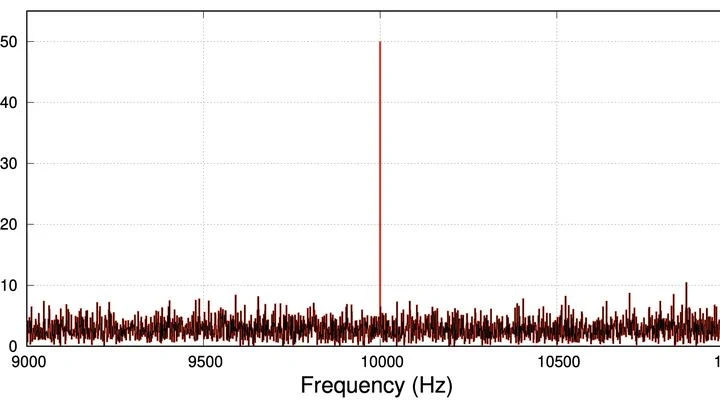
An ultra-sensitive microphone listens not to sound, but to the trembling of space itself. That's how gravitational wave detectors work — LIGO, Virgo, KAGRA.
At the SuperKEKB accelerator, electrons collide with positrons, and among the debris, B-mesons are found. These heavy particles live briefly and break apart into lighter ones. Recently, the Belle II detector recorded a suspiciously high number of cases where a B-meson transforms into a K-meson (kaon) and something invisible—2.7 sigma more than expected.
A giant tank of ultrapure water sits deep underground in Japan. Its walls are lined with thousands of light-sensitive sensors that catch faint flashes — the traces of ghostly particles passing through the water.
Frozen cake batter is dotted with tiny raisins. If the batter is uniform, all the raisins will puff up evenly, and the cake will be smooth. But if the batter has denser spots (some sweeter, some more bland) the raisins will be distributed unevenly: dense in some places, sparse in others.
If you shrank an ordinary black hole to the size of a grain of sand, it would shine like a tiny star and quickly vanish in a flash. That's Stephen Hawking's prediction: the event horizon acts like a hot surface emitting particles.
Two heavy balls orbit on the surface of a pond. Ripples spread from them: these are gravitational waves. As the balls spiral closer, the waves carry away energy, and the ripples become more frequent.
The universe is permeated by an invisible substance, dark matter, whose gravitational influence is obvious, but whose composition remains a mystery. One hypothesis suggests it consists of ultralight particles so light that they exhibit wave-like behavior, forming a kind of cosmic ripple.
In 1987, astronomers saw a supernova flare up in a neighboring galaxy — the Large Magellanic Cloud. It was a rare gift: the explosion was close enough to catch not just light but also neutrinos, those nearly undetectable particles that pass straight through Earth.
At night in a dark room, the human body emits a barely perceptible glow. This light is so faint that only highly sensitive detectors can catch it. Some researchers thought this glow from the head could tell us about brain activity — no scanners or wires needed.
But when put to the test, the story changed.
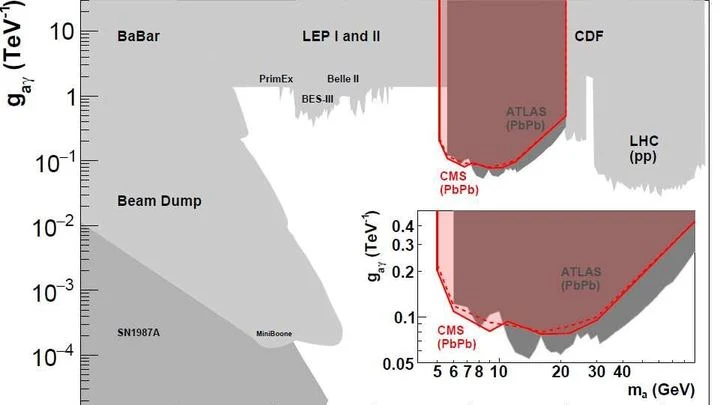
In the kitchen, two flashlight beams pass through each other without noticing. Light barely interacts with light. But if you accelerate particles to enormous energies, two photons can collide and give birth to something new.
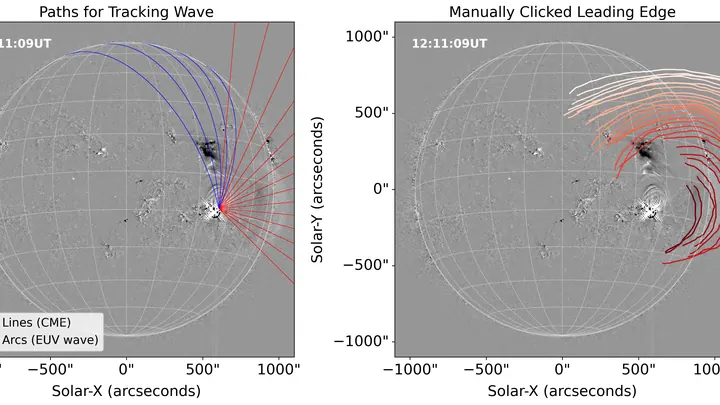
A shock wave in the Sun's corona is like the sonic boom from an airplane, except instead of air there is scorching plasma, and instead of sound there is a jump in density and magnetic field. On March 10, 2024, such a wave swept across the western part of the solar disk.
Black holes aren't silent abysses, but nature's tuning forks. Their rapid spin, predicted by Roger Penrose, makes spacetime itself sing, producing a stream of the lightest particles — axions. These accumulate around the hole, like sound in a concert hall, and begin to oscillate in unison.
A giant cosmic funnel sucks in gas from its surroundings. But not all of that gas falls in — some is spat back out, like splashes from boiling water. That's exactly what the ultraluminous X-ray source NGC 5204 X-1 does: a compact object (likely a black hole) feeds so voraciously that the excess escapes in powerful jets.
Deep in the Italian Apennines, under a thick layer of rock, sits a crystal that catches every decay of radioactive americium. Americium emits gamma rays with an energy of 59.5 kiloelectronvolts, like a very sharp bell that always sounds the same.
A pot on the stove rings when the water boils. An empty copper cup can also "ring"—at radio frequencies — if a dark matter particle is born inside it. These particles are called axions, and according to one hypothesis, they fill the entire galaxy as an invisible cloud.
Since Vera Rubin first convincingly showed that galaxies are surrounded by invisible matter, the quest to understand the nature of dark matter has remained one of physics' greatest challenges.
Dark matter is the invisible substance that holds galaxies together, yet it has so far escaped direct detection. The BULLKID-DM detector is designed to catch candidate particles with a mass around 1 GeV (roughly that of a proton) and an extremely weak interaction with ordinary matter — a…
In the dense, star-forming gas cloud W44, the ALMA telescope has spotted eight tiny clumps racing at enormous speeds. In position–velocity maps, each one looks like the letter V, just like the previously discovered 'Bullet'. This resemblance hints at a common origin.
Dark matter is five times more massive than ordinary matter, yet it emits no light. Its nature remains unknown. One candidate is the ultra-light axion particle. Axions could pierce right through the planet, barely noticing atoms.
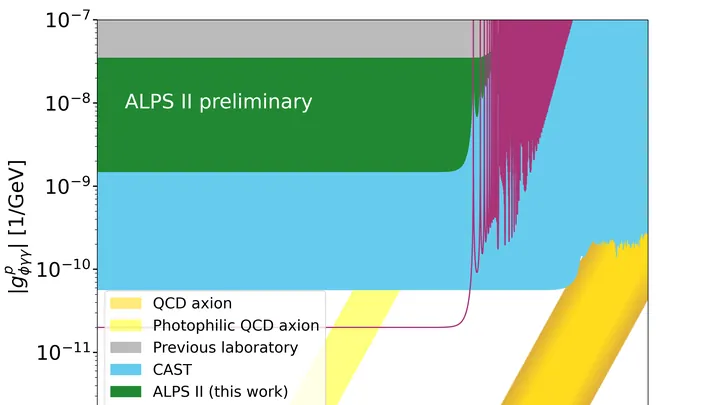
At the DESY lab, the ALPS II experiment was launched to hunt for axions — hypothetical ghost particles that might make up dark matter. This invisible mass acts like a skeleton, preventing galaxies from flying apart due to their spin.
The ARCADE2 radiometer on a high-altitude balloon detected an excess radio emission, while the ground-based EDGES experiment found an anomalously deep trough in the hydrogen spectrum at 21 cm. Both signals do not fit the standard cosmological model and point to an unknown source of soft photons.
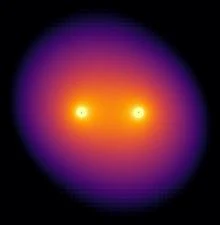
Two black holes circle in a tight dance, and around them something remarkable is born: a gravitational molecule. A cloud of ultralight bosons, particles with masses below an electronvolt, envelops the pair like the electron cloud in an H2+ ion.
Two houses with identical facades but different interior layouts: from the outside the V-shaped spectrum looks the same, but inside there are different light sources and different amounts of dust. That is exactly how the two populations of distant galaxies that astronomers have long confused appear.