cs.SI cs.SI

6 articles

articles

cs.SI2020-08-113 minarXiv:2008.04887
A City's Pulse After a Natural Disaster
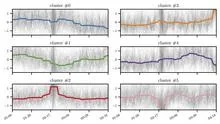
In February 2017, Lima, a city of over ten million people, was hit by El Niño: the warm current off Peru's coast brought torrential rains, floods, and landslides. More than a hundred people died, thousands of homes were destroyed, and roads turned into rivers. The city's economy, like a living organism, fell out of rhythm: shoppers visited stores less often, and their spending patterns shifted almost overnight.
Physics and Society2026-03-151 minarXiv:2603.14564express
How to Thin a Network Without Tearing It
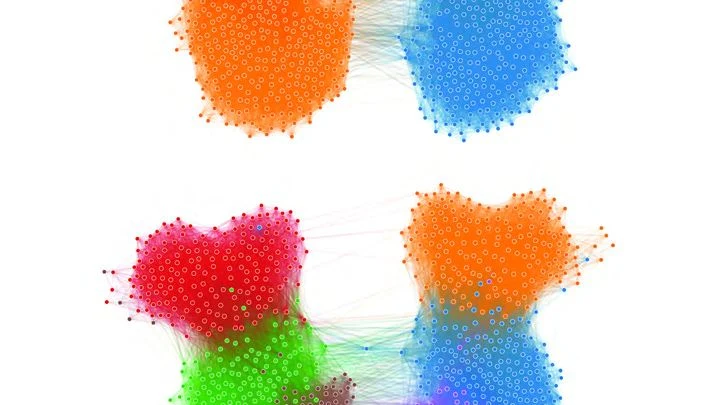
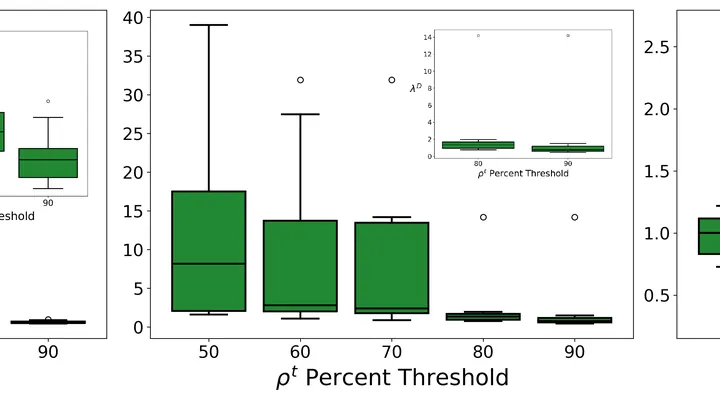
A dense social network: everyone is connected to almost everyone else, and in this web it's hard to see who really matters. Too many threads — computers choke, simulations stall. Scientists have figured out how to prune such networks without losing what's essential. The idea is to remove connections that don't participate in shortest paths.
Why Neurons Can't Be Friends with Everyone
A neuron in the brain is like a person handing out business cards at a crowded conference. At first, making acquaintances is easy, but as the address book fills up, each new contact requires more effort: there's little room left. The authors based their model on this 'crowding' rule: the more incoming connections a neuron already has, the harder it is to form another one.
Physics and Society2026-05-241 minarXiv:2605.25248express
Communities by Size: When Networks Assemble Like a Puzzle
A social network is like a city: there are giant neighborhoods and tiny alleys. When an algorithm looks for tight-knit groups, it often picks out a couple of huge clusters and many small fragments. But the client (say, a municipality) needs districts of roughly equal size to distribute clinics or schools evenly.
Weight Geometry: The Conductor of Memory in Complex Systems
Why do some systems, from gene networks to air travel, preserve imprints of the past longer than others? For a long time, network science blamed topology: the number of connections, modularity, spectrum. But two networks with the same skeleton can remember and forget in completely different ways.
cs.SI2026-07-012 minarXiv:2607.01148
How Weak AI Agents Take Over Networks: The Crystallization of Inequality
A tiny dust particle in a supersaturated solution sprouts into a large crystal in seconds. Neighboring particles remain invisible. A similar process was recently discovered in communities of language agents.