Hierarchical phononic materials with effective scale separation via interpretable machine learning ✛
Context
Phononic materials are artificial structures that control the propagation of elastic waves. Their unit cells are typically designed with a single characteristic length, yielding one band gap. Hierarchical materials introduce multiple scales, but when scales are close, calculations require fine meshes and enormous computational costs. Existing approaches are limited to predefined self-similar or fractal patterns. This work sits alongside research on signal processing and machine learning for acoustics but stands out by applying interpretable learning to hierarchical phononic structures with close scales.
Methods
The authors extend the unit-cell template method previously developed for two-phase phononic materials. The unit cell is discretized into pixels; a template specifies which pixels must be solid, which must be empty, and which are free. First, on a coarse 10×10 grid, they find "parent" templates that provide a band gap in the low-frequency range. Then, the free pixels of these templates are refined to a 20×20 grid, and within them they search for "child" templates for a second, higher-frequency band gap. Optimization is performed using integer programming with constraints on connectivity and minimum feature size. All dispersion relation calculations are carried out using the finite element method in a two-dimensional plane-stress formulation.
Results
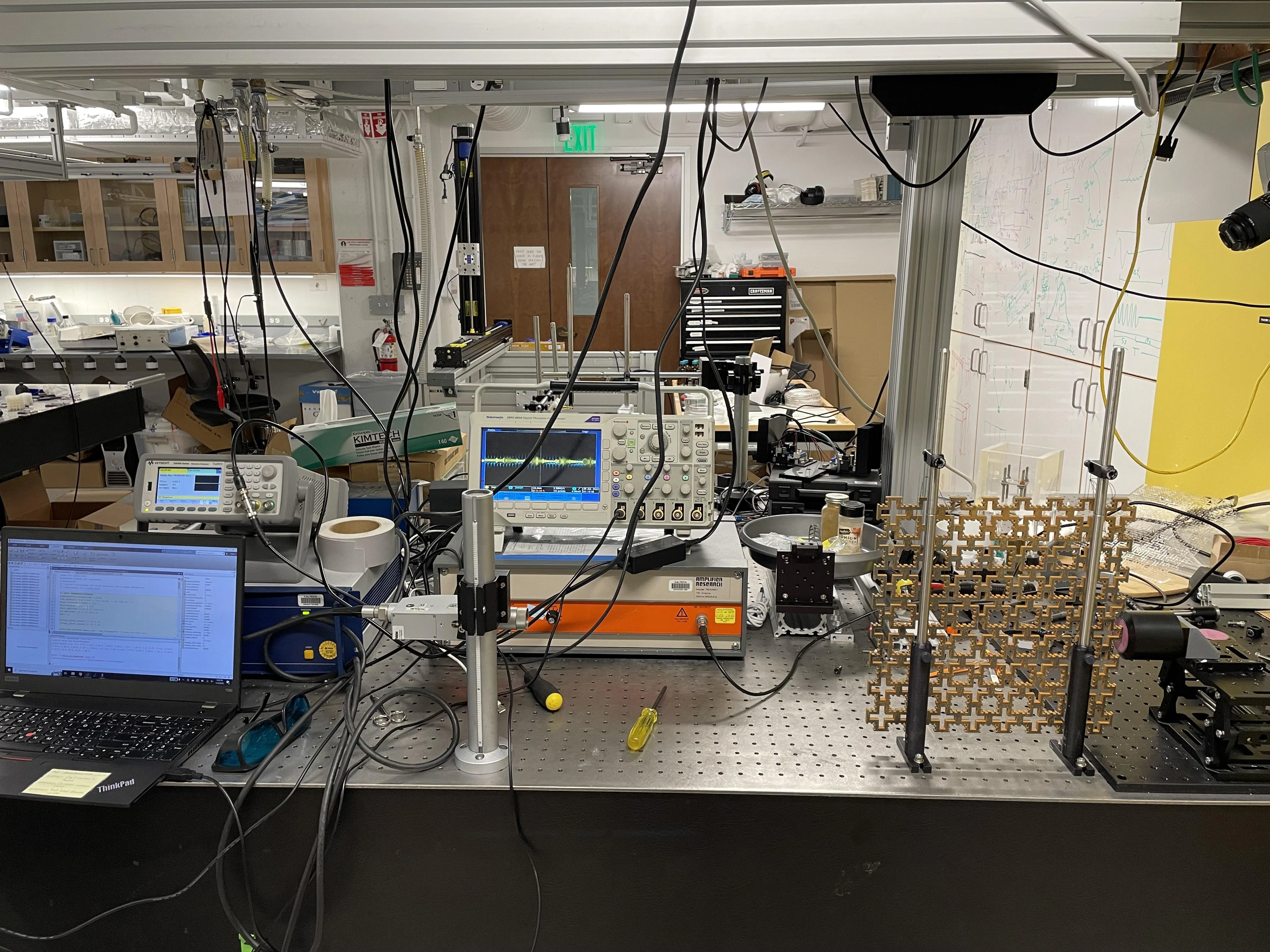
For a pair of target ranges (0.28–0.42 and 0.57–0.71 normalized frequency), a set of hierarchical templates was obtained with 100% accuracy: all generated cells satisfy both targets. Template support covers from 50% to 100% of the admissible design space. The key result is the scale-separation effect: introducing small-scale features does not disrupt the low-frequency band gap, even though the minimum feature size of the small-scale element is only twice as small as the large-scale one. Numerically, it is shown that the probability of preserving the large-scale target when adding small features is 90% when the band-gap width is 75% of the target range, and drops to 63% when the width is 35%. An experiment on a steel plate with an 8×8 array of cells confirmed the presence of both band gaps.
Implications
This work fills a vacant niche in the map of hierarchical material design methods: it shows that even with close scales, each level can be designed independently if one uses templates that are robust to small-scale variations. This differs from neighboring works, which typically either separate scales by orders of magnitude or use exhaustive search on a fine grid. The proposed approach reduces computational complexity from exponential to linear in the number of hierarchy levels and opens access to non-self-similar patterns.
Future development
The method naturally generalizes to three or more levels of hierarchy, as well as to multiphase materials and other target properties (negative refraction, wave localization). Additional constraints, such as stiffness or mass, can be included. Application to three-dimensional structures and to problems with multiple simultaneously optimized band gaps is promising.
Impact
The results can be used in the design of vibration isolators, acoustic filters, and waveguides for high-precision instruments.
Next steps
Extend the method to three-dimensional unit cells and multi-level hierarchies; verify the scalability of computational costs.
Key open problems
In the field of phononic materials, an open question remains: how to systematically explore the vast space of hierarchical designs without exhaustive search. This work offers one path: through interpretable templates with guaranteed accuracy.
The knowledge machine's view
This section is addressed to the author of the paper and their colleagues. Neighbouring works were found by meaning-based search across our archive, not by word overlap. We do not review: we show the field around the work.
What the work does
The paper proposes a method of hierarchical unit-cell templates that uses interpretable machine learning to uncover global shape and topology patterns for achieving multiple band gaps. The authors demonstrate a scale-separation effect that allows each hierarchy level to be designed independently even when the scales are close, and they confirm the results both numerically and experimentally.
Where its strength is
The strength of the work lies in reducing the computational complexity of designing hierarchical phononic materials from exponential to linear in the number of levels, and in opening access to non-self-similar hierarchies.
Where it could go next
- It might be interesting to apply the interpretable learning ideas from the JADE work, where an AI detective uncovers hidden patterns in the cosmic web, to analyze more complex hierarchical structures or to automatically discover new classes of templates.based on: JADE: The AI Detective That Reads the Cosmic Web in Light Trails arXiv:2606.31988
- A related approach improves resolution using a quantum trick; adapting similar ideas could enhance the accuracy of band-gap predictions on coarse grids, further reducing computational costs.based on: Quantum trick boosts microscope resolution by 5 times arXiv:2605.05961
Worth trying
- Test whether the scale-separation effect holds for three or more hierarchy levels.
- Apply the method to three-dimensional phononic crystals.
- Use the templates to optimize not only the width of band gaps but also their position in the frequency range.
Why this may matter
The proposed method could become the foundation for rapid design of multifrequency phononic devices, such as acoustic filters and waveguides, and pave the way for materials with programmable acoustic properties.
Nearby works in our archive
- How a Computer Learns to Hear Everyone in a Noisy Roomsimilarity 0.50
- Quantum trick boosts microscope resolution by 5 timessimilarity 0.49
- Topology by Aroma: How One Spin Gives Away the Quantum Phasesimilarity 0.48
- How Headphones Learned to See the Source of Noisesimilarity 0.48
- JADE: The AI Detective That Reads the Cosmic Web in Light Trailssimilarity 0.48
- Porous Crystals as Dark Matter Detectors: Catching the Phonon Whispersimilarity 0.48
The archive is sparse around this work: the closest review is only 0.50, against a usual 0.64. It looks like few have drilled nearby.
The minimum feature size of the small-scale element is only twice as small as the large-scale one, yet the scale-separation effect persists. It is as if a translator at a meeting were not distracted by whispers in the hall, even though the whispers are as loud as the presentation.
Key numbers
- template accuracy: 100%
- template support: up to 100% of admissible designs
- probability of preserving band gap at 75% width: 90%
- probability at 35% width: 63%
- experimental array size: 8×8 cells