The Planet's Carbon Budget in Real Time: How the 2023/24 El Niño Weakened the Land Sink ✛
Context
The global carbon budget has traditionally been published with a lag of a year or more, preventing timely assessment of rapidly developing climate anomalies such as El Niño. This work joins recent studies on near-real-time CO₂ flux assessment: previous work analyzed the record CO₂ growth in 2023, ancient Mars climate swings, methods for reconstructing precipitation from satellite data, and the search for gravitational waves. However, this is the first time a full budget for a rolling year covering the entire 2023/24 El Niño period is presented, using a combination of low-latency models and satellite observations.
Methods
To estimate the land carbon sink, three dynamic global vegetation models (ORCHIDEE, OCN, LPJ-EOSIM) were used, driven by ERA5 climate forcing at 0.5° resolution up to July 1, 2024. Model fire estimates were adjusted using GFED4.1s and GFAS observations. The ocean sink was estimated using machine-learning emulators of 16 ocean models, trained up to December 2021 and then extrapolated to the first half of 2024. For independent flux estimates, three atmospheric inversions (CAMS, CMS-Flux, GONGGA) were used, assimilating OCO-2 satellite column CO₂ data. Additionally, emulators of 19 vegetation models from the Global Carbon Budget 2024 were developed to forecast fluxes in the first half of 2024.
Results
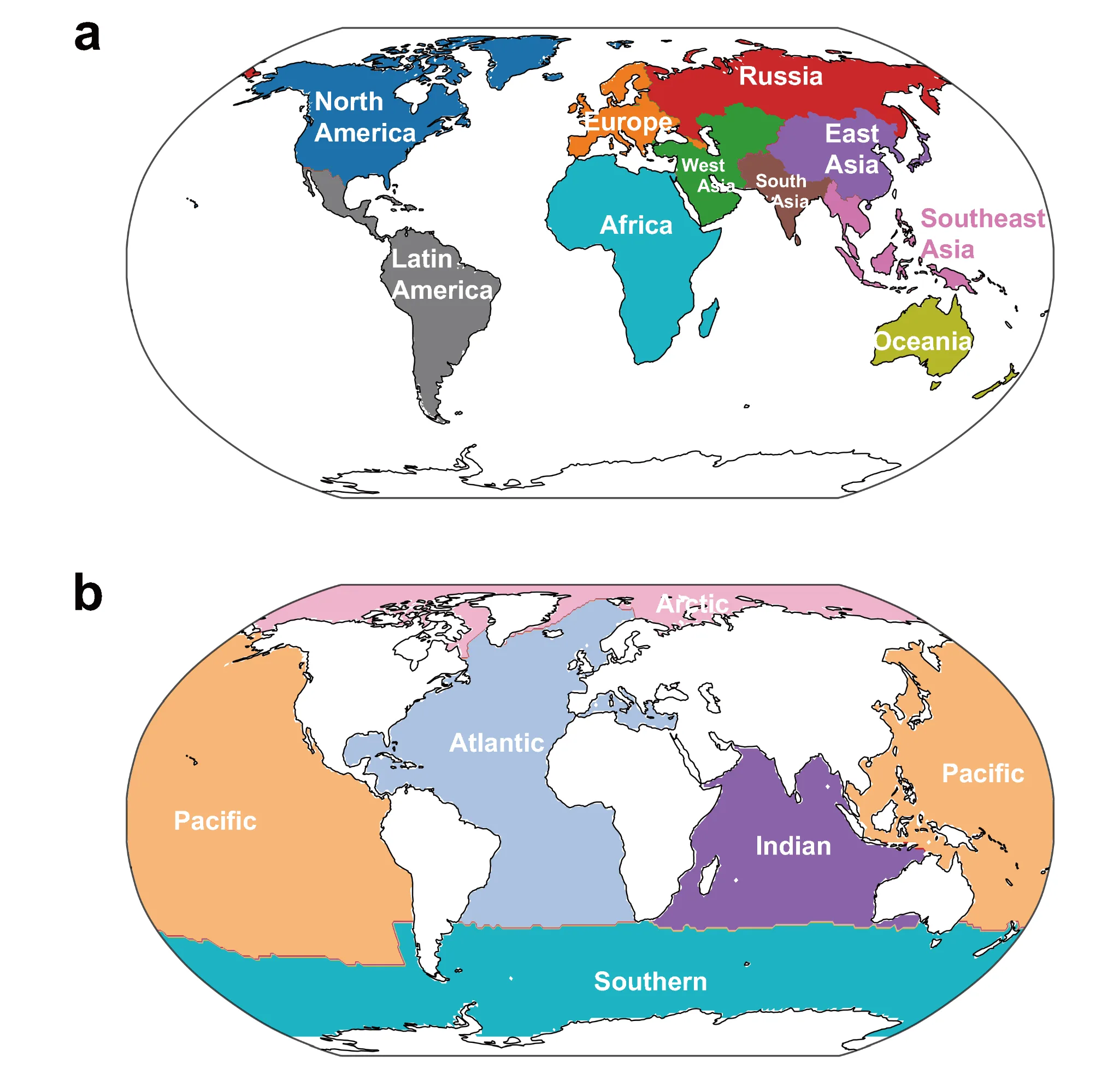
The average atmospheric CO₂ growth rate from June-July 2023 to June-July 2024 was 3.66 ± 0.09 ppm per year, a record since 1979. The growth rate anomaly after removing the long-term trend was 1.1 ppm per year, slightly smaller than during the major El Niño events of 1997/98 and 2015/16. The main contribution to the anomaly came from a reduction in the land carbon sink of 2.24 GtC per year, including 0.3 GtC per year from fires, partially offset by an increase in the ocean sink of 0.38 GtC per year relative to the 2015-2022 average. The tropics accounted for 97.5% of the land flux anomaly: the Amazon 50.6%, central Africa 34%, and Southeast Asia 8.2%. Vegetation models show stronger carbon losses in the tropics in 2023/24 than in 1997/98 and 2015/16, while inversions show losses comparable to 2015/16.
Implications
This work demonstrates that the record atmospheric CO₂ growth in 2023/24 is explained primarily by a weakening of the land carbon sink, not by an increase in anthropogenic emissions. This highlights the vulnerability of tropical ecosystems to El Niño-related droughts and their importance in climate projections. Unlike neighboring studies that focus on individual aspects of the carbon cycle or paleoclimate, this work for the first time combines low-latency estimates of all major budget components over a full El Niño year, allowing a quantitative separation of land, ocean, and emission contributions.
Future development
The development of low-latency carbon cycle monitoring methods will continue through improved model emulators and fuller use of satellite data, including new burned-area products that account for small fires. Emulators of 19 vegetation models are expected to become a standard tool in future releases of the operational budget. Particular attention will be paid to analyzing the second extreme drought in the Amazon in the second half of 2024 and the ongoing drought in central Africa.
Impact
The results are important for climatology, carbon biogeochemistry, and Earth remote sensing, as they provide an operational quantitative assessment of the global carbon cycle's response to a climate anomaly.
Next steps
Immediate next steps include validating vegetation model emulators against independent full-year data, analyzing the effects of lagged tree mortality and decomposition of large woody debris, and incorporating new burned-area products to refine fire emissions.
Key open problems
This work is directly related to the unresolved problem of quantifying the sensitivity of the land carbon sink to drought and extreme heat. The contribution of lagged tree mortality and the dead wood pool to the interannual variability of the carbon balance of tropical forests remains an open question. Furthermore, the discrepancy between vegetation models and atmospheric inversions in estimating flux anomalies indicates the need to improve the parameterization of photosynthesis and respiration responses to water stress.
The knowledge machine's view
This section is addressed to the author of the paper and their colleagues. Neighbouring works were found by meaning-based search across our archive, not by word overlap. We do not review: we show the field around the work.
What the work does
This paper presents a near-real-time assessment of the global CO₂ budget from July 2023 to July 2024, covering the 2023/24 El Niño. Using three dynamic global vegetation models, ocean model emulators, and three atmospheric inversions based on OCO-2, the authors show that the record increase in atmospheric CO₂ (3.66 ± 0.09 ppm/yr) was driven by a reduction in the land sink of 2.24 GtC/yr, with the tropics contributing 97.5% of the anomaly and the Amazon accounting for half of the losses.
Where its strength is
The strength of this work lies in combining low-latency estimates of all major carbon budget components over a full El Niño year, enabling rapid diagnosis of ecosystem responses to an extreme event.
Where it could go next
- It might be interesting to compare the land sink anomalies you derived with long-term vegetation productivity dynamics under climate change, as explored in a related paper on plant lifespan.based on: Plant Life Could Last Over a Billion Years arXiv:2512.24538
- Another related work addresses 'reflation', the recovery of the carbon cycle after disturbances. Your near-real-time budget approach could help track the recovery phase following the current El Niño and compare it with past events.based on: Reflation: When a Planet Inhales After Exhaling arXiv:2607.13793
Worth trying
- You could test using your emulators to forecast the land sink several months ahead after the El Niño ends, to gauge the speed of recovery.
- It would be interesting to see how the anomaly estimates change when using alternative climate forcings, for instance, higher-resolution reanalysis.
- Applying the same approach to other extreme events, such as droughts or fires not linked to El Niño, might be worthwhile.
Why this may matter
Near-real-time carbon budget assessment during extreme climate events is crucial for understanding climate system feedbacks and could aid in developing early warning systems for the state of the carbon cycle.
Nearby works in our archive
- Plant Life Could Last Over a Billion Yearssimilarity 0.48
- Reflation: When a Planet Inhales After Exhalingsimilarity 0.47
- Atmosphere found on a small icy body beyond Neptunesimilarity 0.45
The archive is sparse around this work: the closest review is only 0.48, against a usual 0.64. It looks like few have drilled nearby.
The 2023 Amazon drought was so severe that river levels fell to historic lows, and in some areas navigation completely ceased. The area affected by water deficit reached 68.2% of the region, more than in any previous El Niño since 1997.
A scenario in which tropical forests turn from a carbon sink into a source is explored in Kim Stanley Robinson's novel 'The Ministry for the Future', where a heat wave in India triggers a cascade of climate disasters. This work shows that such a transition is already occurring in reality during strong El Niño events.
Key numbers
- CO₂ growth rate: 3.66 ± 0.09 ppm per year
- land sink reduction: 2.24 GtC per year
- tropical share of anomaly: 97.5%
- Amazon contribution: 50.6%
- maximum drought area in the Amazon: 68.2%