Seven Embryos in One Disk: The Birth of an Extreme Stellar Family ✛
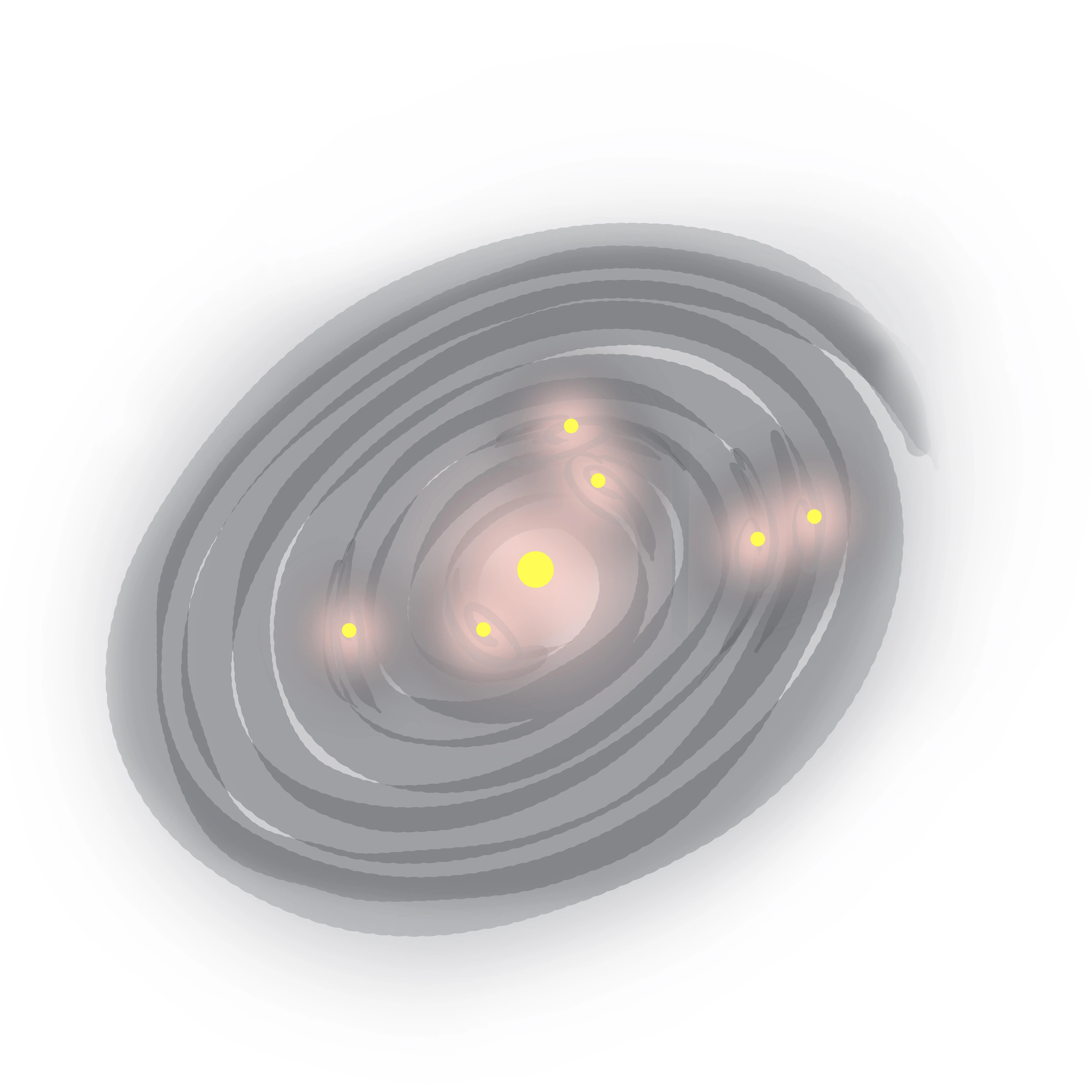
In the dark cloud NGC 6334I-North, 5500 light-years from Earth, the ALMA radio interferometer spotted something unexpected: around a young massive star, a disk of gas and dust is swirling, and inside it are seven dense clumps. Each one could become a star. This is what the birth of a stellar family looks like, and an unusually large one at that.
Usually, multiple stars come in pairs or triples. Here, we see a tight dance of seven protostars locked in a common gas disk. The disk rotates according to Kepler's laws, like planets around the Sun, but its mass is so great that it begins to break apart on its own. The Toomre parameter Q, a measure of a disk's stability against fragmentation, drops to values of 1–2 near the clumps: this is the threshold beyond which gravity overcomes rotation and heat. The disk becomes unstable, like an overloaded carousel, and shatters into separate eddies, the seeds of future stars.
Theory had predicted this possibility, but observations had only found binary and triple systems. Now, for the first time, a sevenfold system has been seen in the act of being born. The separations between the clumps, on average 298 astronomical units, are too small for fragmentation of the parent cloud; in that case, they would be scattered over thousands of AU. Simulations of the collapse of a gas cloud with a mass of 200 solar masses reproduced a similar picture, with fragments of masses 0.03–0.23 M☉, tightly packed together. So it is disk fragmentation, not core fragmentation, that gave rise to this family.
This discovery fills a gap between theory and observations. Massive stars often form in clusters, where dynamical interactions quickly erase the initial conditions. Here, we see the system in its pristine state, before gravitational encounters reshuffle it. Further observations at higher resolution will allow us to search for secondary disks around individual clumps and trace their orbital evolution. Perhaps, in a few million years, this dance will grow into a dispersed cluster, but for now, seven embryos are circling in a shared waltz.
The seven clumps fit within a region about 1500 AU across, which is smaller than the distance from the Sun to the Oort cloud.
In Liu Cixin's novel "The Three-Body Problem," the chaotic dynamics of a triple system make the planet uninhabitable; here, seven protostars in a tight disk offer a natural laboratory for studying such dynamics.