Seven in a Disk: How an Extreme Stellar System Is Born ✛
Context
The question of how multiple star systems form remains open: competing scenarios include core, filament, and disk fragmentation. For massive stars, direct observations of initial configurations are rare due to large distances and dense environments. This work sits alongside studies of protoplanetary disks, organic molecules, and star formation in molecular clouds, but has almost no close neighbors: the nearest topically related archival analysis is at a distance of 0.58. Previous observations have revealed only binary and triple systems in disks, while theoretical models predicted the possibility of higher multiplicity. This work is the first to show a sevenfold system in a disk, filling the gap between theory and observations.
Methods
Observations were carried out with ALMA at 1.3 mm in two configurations: the short baseline gave a resolution of 0.30″×0.27″, and the long baseline gave 0.076″×0.058″ (about 78 au at a distance of 1.3 kpc). Clumps were identified on the continuum map using the imfit procedure. Disk kinematics were derived from the CH3CN 12₄–11₄ line using the 3D Barolo code, which fits a tilted-ring model. Gas temperatures were determined from the ladder of transitions of the isotopologue ¹³CH3CN in the XCLASS package. To test the scenario, hydrodynamic simulations of the collapse of a 200 M☉ cloud were performed with resolution down to 0.75 au at the inner disk edge, followed by synthetic observations in RADMC-3D.
Results
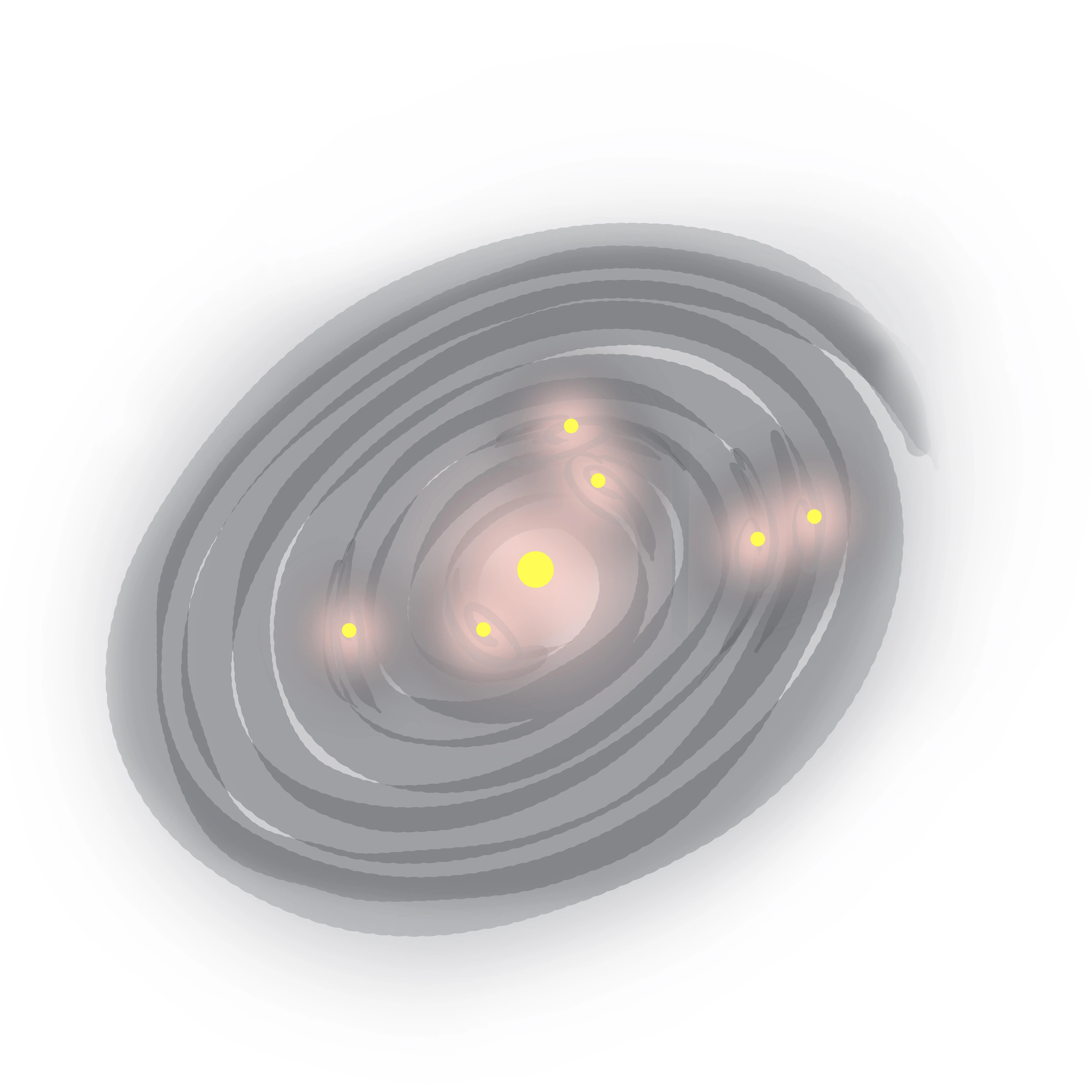
Seven clumps (C1–C7) were detected in the continuum, with radii of 89–189 au and gas masses of 0.04–0.25 M☉. Their projected separations between nearest neighbors range from 181 to 461 au, with a mean of 298 au. After deconvolving the disk inclination (i=26.3°), the mean separation increases to 332 au, notably smaller than the typical 1000 au for core fragmentation and 3.5 times smaller than the thermal Jeans length of 1168 au. The disk, with a mass of 1.87 M☉, rotates following Keplerian law (V∝r^(−0.53±0.09)) around a central protostar of about 4.9 M☉. The disk-to-star mass ratio of 0.2–0.6 exceeds the threshold of 0.1 for gravitational instability. The Toomre parameter Q in the vicinity of most clumps drops to 1–2, indicating marginal instability. Virial analysis shows that all clumps are gravitationally bound to the system ($E_i$/|$W_i$| < 1). The simulations reproduce a similar picture: fragments with masses of 0.03–0.23 M☉ form in the disk, and their kinematics resemble the observations.
Implications
This work is the first to show that disk fragmentation can produce not only binary and triple systems but also sevenfold systems on a scale of 1500 au. This distinguishes it from archival neighbors that either consider lower multiplicity, wider separations, or are limited to chemistry and dust without direct connection to the fragmentation mechanism. Confirmation of the disk scenario for extreme multiplicity provides observational support for theories of massive cluster formation, where dynamical interactions quickly erase initial conditions.
Future development
Further observations with higher angular resolution and sensitivity will allow the search for secondary disks around individual clumps and the tracking of their orbital evolution. Comparison with broader surveys of massive protostars will show how common such sevenfold systems are and how they change over time.
Impact
The results will affect models of star formation in clusters and the interpretation of the statistics of multiple systems in the Galaxy.
Next steps
Conduct monitoring of the proper motions of the clumps and search for accretion disks around each component.
Key open problems
For the astrophysics of star formation, the initial mass function of multiple systems and how dynamical evolution transforms primordial multiplicity into that observed in main-sequence stars remain unresolved questions.
The knowledge machine's view
This section is addressed to the author of the paper and their colleagues. Neighbouring works were found by meaning-based search across our archive, not by word overlap. We do not review: we show the field around the work.
What the work does
Using ALMA, a system of seven protostellar condensations embedded in a Keplerian disk has been detected in the region NGC 6334I-North. The condensations are identified in the continuum, their masses and separations are determined, the disk kinematics is reconstructed from the CH3CN line, and temperatures are derived from the isotopologue ¹³CH3CN. Hydrodynamic simulations of cloud collapse reproduce a similar configuration, indicating disk fragmentation.
Where its strength is
This work provides the first observational evidence that disk fragmentation can produce a system with such a high multiplicity as seven components on a scale of ~1500 au. It fills the gap between theoretical predictions and previous observations of only binary and triple systems.
Where it could go next
- It might be interesting to compare the obtained picture with the chemical composition of the disk: there is an analysis in the archive about how carbon and oxygen change the appearance of disks, which could help understand how fragmentation affects chemistry and vice versa.based on: Cosmic Kitchen: How Carbon and Oxygen Shape the Look of Disks arXiv:2602.16030
- There is a related work on protoplanetary disk dynamics and accretion; perhaps it is worth considering how accretion onto the fragments and the central star might evolve in such a close system.based on: How Dust Disks Dance Around Newborn Stars arXiv:2608.02204v1
- Since the disk is gravitationally unstable, it would be interesting to compare with observations of dust rings in other systems to understand how instability manifests in the dust distribution.based on: Dust Rings at the Edge of a Distant System arXiv:2605.11486
Worth trying
- Conduct simulations of the evolution of the seven condensations over longer timescales to trace their orbital dynamics and possible mergers.
- Search for signs of accretion streams or spiral arms in the ALMA data that could further confirm gravitational instability.
- Compare the chemical composition of the condensations with models of shock chemistry during fragmentation.
Why this may matter
Such systems are the missing link between the formation of single stars and star clusters; understanding their birth is important for multiplicity statistics and the initial mass function.
Nearby works in our archive
- Dust Rings at the Edge of a Distant Systemsimilarity 0.59
- A Cradle Carved by Lightsimilarity 0.57
- Cosmic Kneading: Turbulent Amplification of Magnetic Fields in Newborn Neutron Starssimilarity 0.56
- A Ring of Warmth in a Star's Cradlesimilarity 0.56
- How Dust Disks Dance Around Newborn Starssimilarity 0.56
- The Stellar Forge: A First Glimpse at the Birth of Cosmic Crystalssimilarity 0.56
- Cosmic Kitchen: How Carbon and Oxygen Shape the Look of Diskssimilarity 0.55
The archive is sparse around this work: the closest review is only 0.59, against a usual 0.64. It looks like few have drilled nearby.
Seven clumps fit within a region about 1500 au across, which is smaller than the distance from the Sun to the Oort cloud.
In Liu Cixin's novel "The Three-Body Problem," the chaotic dynamics of a triple system makes the planet uninhabitable; here, seven protostars in a tight disk serve as a natural laboratory for studying such dynamics.
Key numbers
- number of protostars: 7
- mean separation between components: 298 au (projected)
- disk mass: 1.87 M☉
- disk-to-star mass ratio: 0.2–0.6
- Toomre parameter Q near clumps: 1–2