Are you one of the authors of this paper? Email us from your institutional or work email address mentioning this article's arXiv ID and we'll verify you and give you edit access to this page.
Are you an author who sees something we missed or got wrong? Write to us — the subject line already carries the paper id. We read every note and correct the write-up.
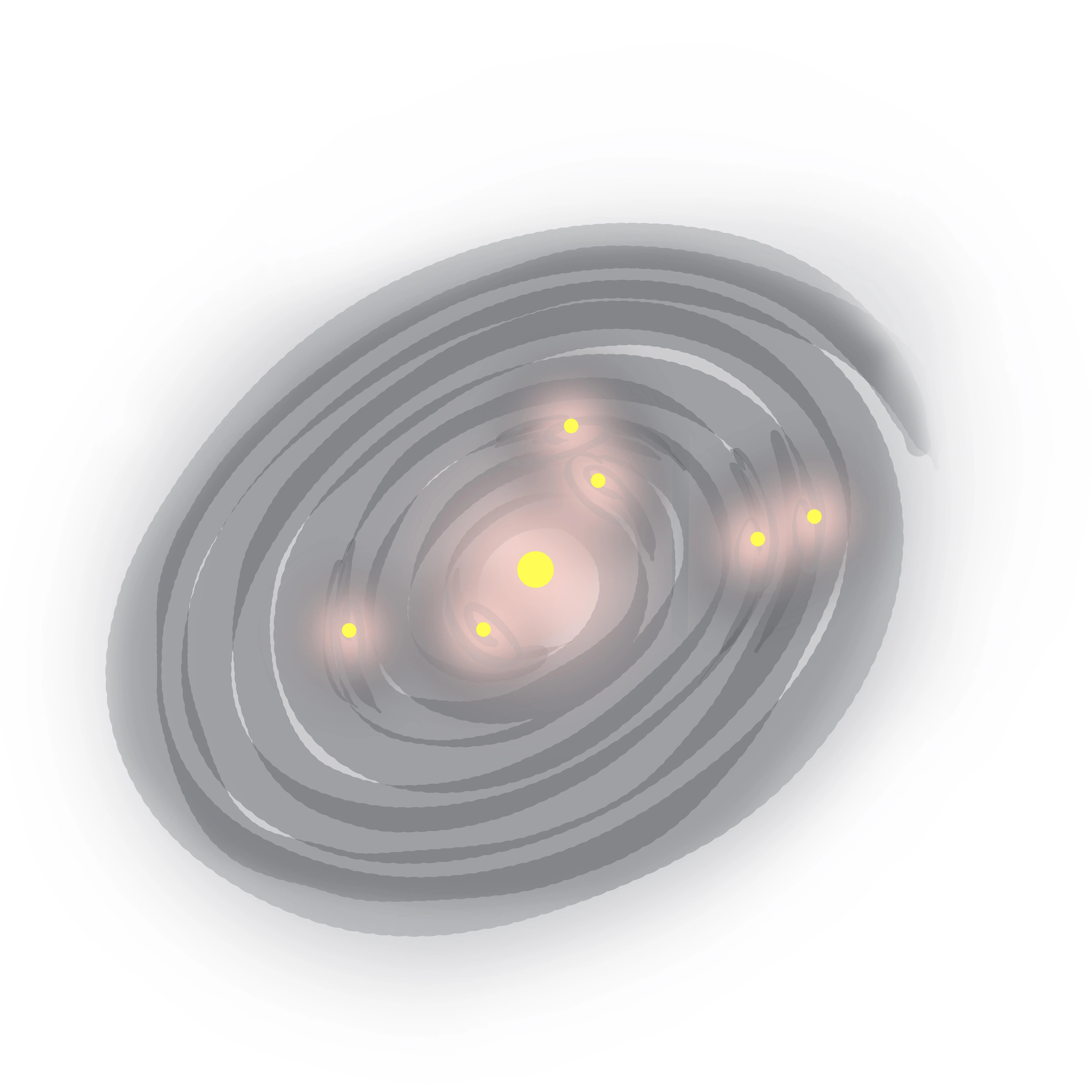
Astronomers have for the first time seen seven baby stars born from a single disk, just like from a batch of dough.
In the nebula NGC 6334I, astronomers spotted seven stellar embryos in a single rotating gas and dust disk at distances of 181–461 Earth-Sun distances. This is a record: previously, such disks were known to host no more than two or three.
The disk turned out to be too massive and fast, so it tore apart like thin pizza dough. Each piece condensed into a separate star.
Such a mechanism was considered common for binary systems, but not for seven. Now it’s clear that nature can "bake" a whole family of stars at once.
These tight-knit groups are true factories of cosmic cataclysms. Over time, the stars may collide, explode as supernovae, turn into neutron stars, and merge, emitting gravitational waves. Such mergers forge the heaviest elements, like gold, which we find on Earth.
Most stars live not alone, but in pairs or trios. But finding seven in one disk is like baking seven buns from one piece of dough. Astronomers saw such a tight neighborhood for the first time.
Science fiction loves worlds with multiple suns, like Tatooine or Pandora. The discovery shows that nature can light up seven suns at once in one system, bringing the boldest fantasies to life.
Q = \frac{c_s \kappa}{\pi G \Sigma}
Toomre parameter: the ratio of stabilizing factors (sound speed c_s and epicyclic frequency κ) to destabilizing gravity (gravitational constant G and disk surface density Σ). If Q < 1, the disk is gravitationally unstable and fragments.
V \propto r^{-0.53 \pm 0.09}
Keplerian rotation law: gas velocity falls with distance from the central star roughly as the inverse square root of the radius, indicating that the central mass dominates.