The Invisible Janitor at the Heart of the Milky Way ✛
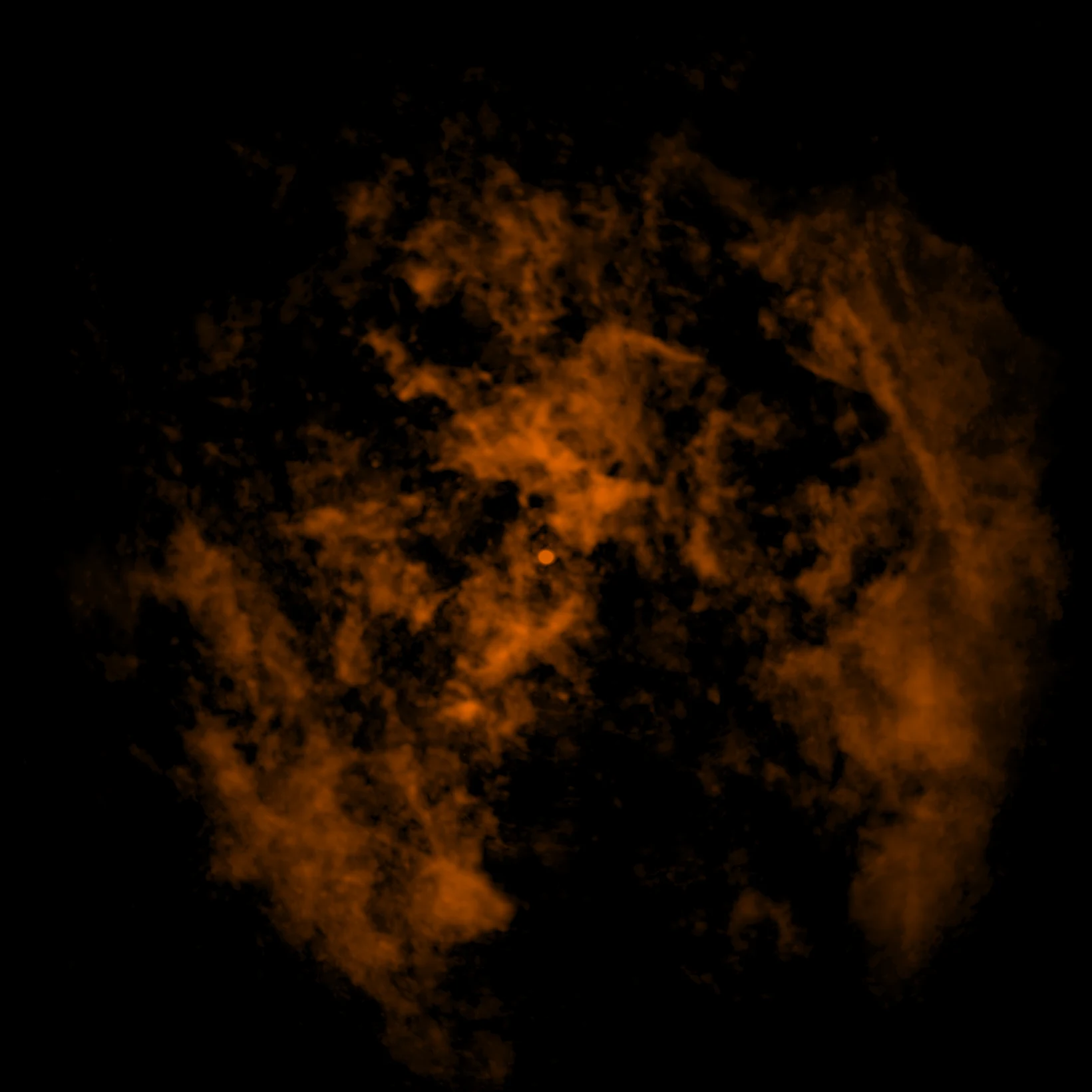
At the center of the Milky Way, 27,000 light-years from Earth, lives the supermassive black hole Sagittarius A*. It weighs in at four million Suns. It does not flare brightly like quasars; instead, it smolders almost imperceptibly. For a long time, astronomers debated whether it blows a wind. Now we have the answer: it does. An invisible janitor is clearing the snow around a streetlamp.
New maps from the ALMA radio telescope array in Chile's Atacama Desert reveal a conical cavity free of cold molecular gas. It extends from the black hole toward the south-southwest for at least one parsec (about 3.26 light-years) and has an opening angle of about 45 degrees. The edges of the cavity coincide with regions of low infrared absorption and with the start of the Western Arc of the mini-spiral, which is ionized gas at the inner edge of the molecular ring. This is the first direct evidence that the wind from the black hole mechanically affects cold gas at the center of the galaxy.
Earlier data were contradictory. Some observations pointed to a wind; others to its absence. Now, an ultra-deep map of carbon monoxide (CO) emission, with a sensitivity of 80 microjanskys per channel, has revealed an emptiness exactly where cold gas should have been. The void matches hot gas seen in X-rays. It is as if the snow around the streetlamp had been cleared, leaving warm steam in its place.
The discovery matters not only for our galaxy. Most supermassive black holes in the universe are in a quiescent state, and their weak winds may influence star formation in the central regions of galaxies. Now astronomers have a benchmark for studying such 'quiet' influence. In the future, deeper observations with ALMA and new instruments such as ngVLA will allow us to trace the cavity beyond one parsec and estimate the total energy of the wind. Numerical simulations will help us understand how often the wind changes direction and how that regulates the inflow of gas to the black hole.
The wind from Sagittarius A* is so weak that it could not be found for over 50 years, even though the black hole itself was discovered in 1974. For comparison, a wind power of $10^{38}$ erg/s is equivalent to the total radiation of a hundred billion Suns, but at the distance of the Galactic center, it only slightly 'blows through' the cold gas.
In Stanislaw Lem's novel 'Fiasco', the protagonists encounter the consequences of an alien civilization's activity, which tries to control the radiation of its star. The wind from the black hole at the Galactic center is a natural analog of such 'control', only on scales that humanity is just beginning to observe.