Wind from the Heart of the Milky Way ✛
Context
The center of the Milky Way is a laboratory where a supermassive black hole can be examined in detail that is inaccessible for distant galaxies. Neighboring works in our archive explore the black hole's shadow, its X-ray flares, polarized light, and the wind from the accretion disk; all of them concern the activity of Sagittarius A*. However, direct evidence of a large-scale wind blowing from the black hole itself has been lacking: on scales of a few parsecs, the data contradicted each other. This work fills the gap by showing how the wind interacts with the cold gas of the central molecular ring.
Methods
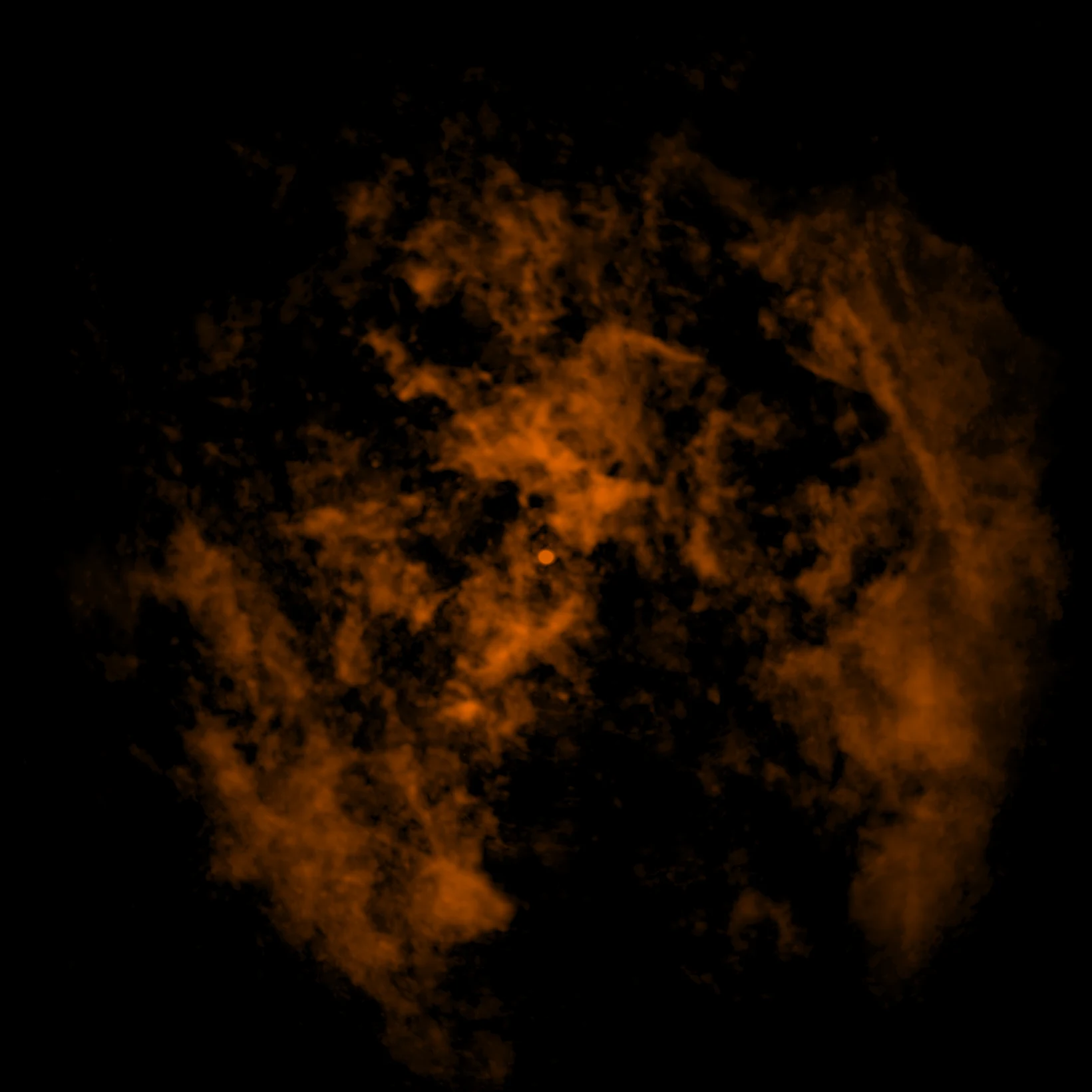
The authors combined data from three ALMA projects (Band 6, around 230 GHz) from 2017–2021 to obtain a map of CO molecule emission in the J=2−1 line with an angular resolution of about 0.25 arcseconds and a sensitivity of 80 microjansky per channel. This is a hundred times deeper and eighty times sharper than previous maps. To remove the bright emission from the black hole itself, its variability was modeled every 15–30 seconds using the UVMultiFit program and subtracted from the data. The resulting image revealed the distribution of cold gas with a temperature of about 100 kelvins within a parsec of the center.
Results
The map shows a conical cavity free of cold molecular gas. It extends from Sagittarius A* to the south-southwest for at least 1 parsec and has an opening angle of about 45 degrees. The edges of the cavity coincide with regions of low infrared absorption and with the beginning of the Western Arc of the mini-spiral, which is ionized gas at the inner edge of the molecular ring. The wind power required to maintain the cavity is estimated at $10^{37}$–$10^{38}$ erg/s, which is about a hundred times the bolometric luminosity of the black hole. The same ratio is observed for the black hole M87*, confirming a unified mechanism for launching winds.
Implications
Unlike neighboring works that studied either the emission from the black hole itself or its immediate surroundings, this work directly captures, for the first time, the wind's effect on the cold gas of the central parsec. This is the first test of predictions that even a quiescent black hole should clear a path for itself. The discovery shows that weak and direction-changing winds may be typical for most quiescent galaxies in the Universe.
Future development
Deeper observations with ALMA and future instruments such as ngVLA will allow tracing the cavity beyond one parsec and estimating the total wind energy. Numerical simulations of the wind's interaction with the inhomogeneous ring gas will help understand how often the wind changes direction and how this affects gas accretion onto the black hole.
Impact
The results are important for understanding galaxy evolution: weak winds from quiescent black holes may regulate star formation in central regions. They also provide a benchmark for interpreting observations of distant active galactic nuclei.
Next steps
Conduct deep radio observations to search for faint emission from the cavity edges. Build detailed hydrodynamic simulations to link the observed cavity shape to the wind parameters.
Key open problems
This work directly addresses the unresolved problem of feedback from supermassive black holes in the quiescent phase: how exactly a weak wind transfers energy to the surrounding gas and why its traces are so difficult to detect. It also refines the mass and energy balance in the Galactic center, where estimates of the accretion rate and gas loss have not been consistent.
The knowledge machine's view
This section is addressed to the author of the paper and their colleagues. Neighbouring works were found by meaning-based search across our archive, not by word overlap. We do not review: we show the field around the work.
What the work does
The authors combined data from three ALMA projects (Band 6, CO J=2−1) taken between 2017 and 2021 to produce a map of cold molecular gas around Sagittarius A* with a resolution of 0.25 arcseconds and a sensitivity of 80 microjanskys per channel. After subtracting the variable emission from the black hole, they discovered a conical cavity at least a parsec long, devoid of cold gas, and estimated the wind power at 10^37–10^38 erg/s.
Where its strength is
This is the first direct demonstration that a wind from a supermassive black hole affects the cold gas in the central parsec, providing a benchmark for studying the weak influence of black holes on galaxies.
Where it could go next
- It might be interesting to compare the discovered cavity with maps of dust and magnetic fields in the central parsec to trace how the wind interacts with different phases of the interstellar medium.based on: Dust Beaten by Invisible Waves arXiv:2601.02865
- There is related work on winds from the black hole's accretion disk; comparing with it could clarify how much of the wind's energy comes from the disk versus the black hole itself.based on: Wind from a Black Hole arXiv:2603.17609
- The archive contains studies of black hole winds in other galaxies; comparing with them would help understand how typical such a cavity is for quiescent nuclei.based on: Winds from Black Holes arXiv:2604.22922
Worth trying
- Search for similar cavities in archival ALMA data using other lines (e.g., HCN or HCO+) to test how the wind affects denser gas.
- Compare the cavity's position with high-energy neutrino distributions from the Galactic center, should such data become available.
- Check whether the wind's interaction with clouds explains the observed asymmetry of the Western Arc of the mini-spiral.
Why this may matter
The discovery shows that even a quiescent supermassive black hole can influence its host galaxy by clearing out gas and regulating star formation at the center. This is important for understanding galaxy evolution.
Nearby works in our archive
- How the Milky Way's Wind Tears Apart Cloudssimilarity 0.58
- The Heart of the Galaxy in Detailsimilarity 0.56
- A Black Hole in a Fur Hatsimilarity 0.55
- Wind from a Black Holesimilarity 0.55
- The Milky Way Speaks the Language of Neutrinossimilarity 0.55
- Winds from Black Holessimilarity 0.54
- Dust Beaten by Invisible Wavessimilarity 0.54
The archive is sparse around this work: the closest review is only 0.58, against a usual 0.64. It looks like few have drilled nearby.
The wind from Sagittarius A* is so weak that it could not be found for over 50 years, even though the black hole itself was discovered in 1974. For comparison, a wind power of $10^{38}$ erg/s is equivalent to the total radiation of a hundred billion Suns, but at the distance of the Galactic center, it only slightly 'blows through' the cold gas.
In Stanislaw Lem's novel 'Fiasco', the protagonists encounter the consequences of an alien civilization's activity, which tries to control the radiation of its star. The wind from the black hole at the Galactic center is a natural analog of such 'control', only on scales that humanity is just beginning to observe.
Key numbers
- cavity length: at least 1 parsec
- opening angle: about 45 degrees
- wind power: 1037–1038 erg/s
- map sensitivity: 80 microjansky per channel
- cold gas mass within 0.5 pc: about 300 solar masses