Are you one of the authors of this paper? Email us from your institutional or work email address mentioning this article's arXiv ID and we'll verify you and give you edit access to this page.
Are you an author who sees something we missed or got wrong? Write to us — the subject line already carries the paper id. We read every note and correct the write-up.
XRISM's X-ray spectrometer has revealed a dense but surprisingly slow wind around the neutron star GX 13+1, hiding the source's true brightness.
About 25,000 light-years from Earth, in the constellation Sagittarius, a dense veil wraps around the neutron star GX 13+1. It scatters X-ray photons the way fog scatters streetlight, and for a long time it hid the source's true power from astronomers. The Resolve spectrometer aboard Japan's XRISM mission, launched in 2023, managed to examine this veil in exquisite detail. It turns out to be moving surprisingly slowly, at just 330 km/s, even though the star's luminosity reaches the Eddington limit, where radiation pressure can tear matter away from the inner regions of the accretion disk.
The wind is so dense that it scatters about half of the X-ray photons, making the source appear dimmer, even though it actually shines at the Eddington limit.
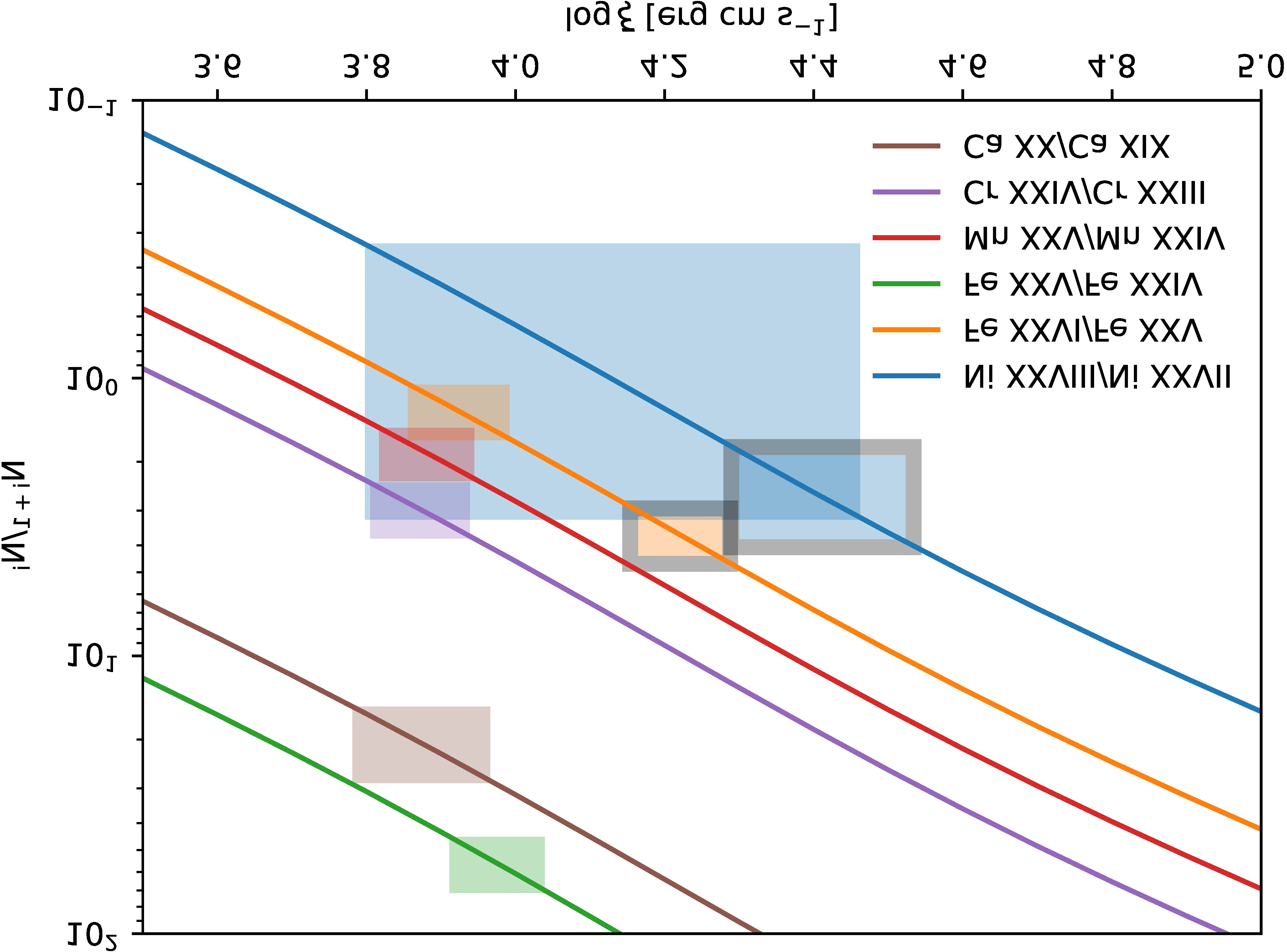
This veil is an accretion wind: a stream of gas that carries material off the surface of the disk swirling around the neutron star. The spectrum of GX 13+1 shows dozens of absorption lines from ions of silicon, sulfur, argon, calcium, iron, and nickel. Their analysis reveals that the wind's column density reaches 1.3–1.4×$10^{24}$ atoms per square centimeter. That means every X-ray photon encounters roughly one electron capable of scattering it. Such an optical depth for Thomson scattering is comparable to unity, and the wind acts like a semitransparent mirror, dimming and redistributing the radiation.
Previously, it was thought that at luminosities near the Eddington limit, a fast wind from the inner disk regions, accelerated by radiation pressure to thousands of kilometers per second, should arise. But that did not happen for GX 13+1. Instead, we see a slow, thermally driven radiative outflow launched from the outer, cooler parts of the disk. Modeling that accounts for photon scattering within the wind itself has allowed astronomers to recover the true luminosity of the source: about 1.8×$10^{38}$ erg/s, which matches the Eddington limit for a neutron star with a mass of about 1.4 solar masses. The mass-loss rate via the wind is estimated at 1.2–39×$10^{18}$ g/s, comparable to or even exceeding the accretion rate onto the star.
The Thomson optical depth of the wind, $τ_{es}$ ≈ 1, means that each photon, on average, undergoes one scattering before leaving the system. It is like light passing through a layer of fog where visibility is limited to a few meters.
These results change our picture of how stars "feed" their winds. If the Eddington mechanism was once the leading candidate for the engine, it is now clear that in some systems, thermally driven radiative launching from the outer disk edges dominates. This matters not only for understanding individual binary systems, but also for the broader picture: similar processes may occur around supermassive black holes, where winds regulate galaxy growth. In the future, observations of GX 13+1 in high-density states and searches for weak metastable lines, such as Fe XXIII near 6.6 keV, will help refine the geometry and physics of this dense veil.
The wind is so dense that it scatters about half of the X-ray photons, making the source appear dimmer, even though it actually shines at the Eddington limit.
The optical depth for electron scattering is proportional to the hydrogen column density and the Thomson cross section; the factor 1.21 accounts for the number of electrons per hydrogen atom in a fully ionized plasma of solar composition.