A Slow Wind from a Super-Eddington X-ray Binary ✛
Context
Accretion disks in strong gravity ubiquitously produce winds, seen as blueshifted absorption lines in X-rays. The most powerful of these, the so-called Eddington winds, are expected in systems where radiation pressure can lift matter off the inner disk at luminosities close to the Eddington limit. Such winds should be extremely fast and carry large kinetic power, making them prime candidates for the feedback mechanism linking supermassive black hole growth to their host galaxies. This work joins recent studies of winds from black holes and neutron stars, but stands out because it is the first time that a slow, rather than fast, wind has been measured in detail for a bright, high-luminosity source.
Methods
The spectrum of GX 13+1 was obtained on February 25, 2024, with the Resolve microcalorimeter aboard XRISM, offering an energy resolution of 4.5 eV at 6 keV, four times better than previous grating spectrometers. Simultaneous NuSTAR data were also used for the broadband continuum. Absorption lines were modeled ion by ion with the local model Ionabs, then with the full photoionization code pion in the SPEX package. Two wind components were considered: a slow one responsible for the main narrow lines, and a fast one creating the blue wing of the most ionized lines. The model also included radiation scattered and re-emitted by the wind, which explained the residual flux at the centers of saturated lines.
Results
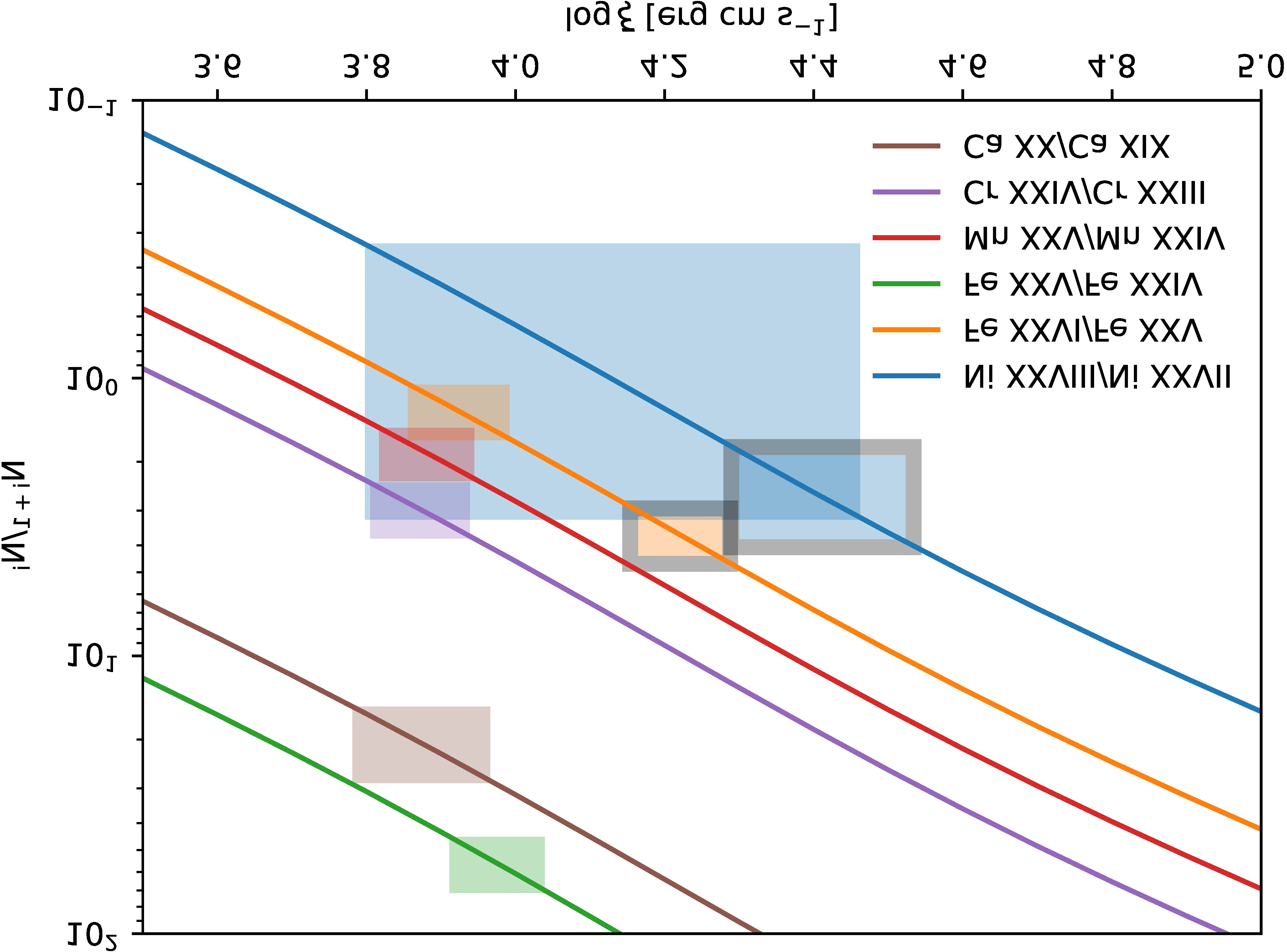
The Resolve spectrum showed dozens of strong, slightly blueshifted (about 330 km/s) and narrow (turbulent velocity about 150 km/s) absorption lines from hydrogen- and helium-like ions of silicon, sulfur, argon, calcium, titanium, chromium, manganese, iron, cobalt, and nickel. For the first time, numerous high-order transitions up to Kθ (n=1–9) in Fe XXV and Kη (n=1–8) in Fe XXVI were detected, requiring an extremely high column density for the wind. Modeling gives an equivalent hydrogen column of NH ≈ 1.3–1.4×$10^{24}$ cm^-2, corresponding to a Thomson optical depth of τes ≈ 1. After correcting for scattering, the bolometric luminosity of the source reaches 1.8×$10^{38}$ erg/s, roughly the Eddington limit. The wind turned out to be stratified: a fast component at about 640 km/s with higher ionization (log ξ ≈ 4.7) complements the slow one, though its column density is less secure. The mass loss rate in the wind is estimated at 1.2–39×$10^{18}$ g/s, comparable to or exceeding the accretion rate onto the neutron star.
Implications
This work shows that at Eddington luminosity in a binary system, a fast Eddington wind may not form; instead, a slow, thermally driven radiative outflow from the outer disk regions can dominate. This distinguishes GX 13+1 from recent observations of the supermassive black hole PDS 456, where XRISM saw a quasi-spherical wind at about 0.3c. The obtained constraints imply that any fast winds from the inner disk in this system must be strongly collimated toward the poles, otherwise they would destroy the slow outer wind. Thus, the work refines the physics of wind launching in bright accretion flows and highlights the difference in mechanisms depending on the mass of the compact object.
Future development
Further observations of GX 13+1 in states with high column density will help test the repeatability of the discovered regime. A more precise measurement of the wind density is possible via weak metastable lines, such as Fe XXIII near 6.6 keV, which will require improved models. Comparison with other X-ray binaries and active galactic nuclei at super-Eddington luminosities will allow a unified picture of wind launching in strong gravity.
Impact
The results will affect models of accretion disks and winds in X-ray binaries, as well as the understanding of feedback from active galactic nuclei.
Next steps
Detailed modeling including scattered radiation is planned to refine the wind geometry, and archival data of other sources will be searched for similar states.
Key open problems
For X-ray binaries, the mechanism of wind launching remains an open question: magnetic fields, radiation pressure, or Compton heating. This work shows that in the super-Eddington regime, the thermally driven radiative mechanism dominates, but it cannot completely rule out a magnetic contribution due to uncertainties in the column density of the fast component.
The knowledge machine's view
This section is addressed to the author of the paper and their colleagues. Neighbouring works were found by meaning-based search across our archive, not by word overlap. We do not review: we show the field around the work.
What the work does
The study analyzes observations of the X-ray binary GX 13+1 taken with XRISM and NuSTAR. A high-resolution spectrum reveals a slow wind with a column density of ~10^24 cm^-2 and a velocity of ~330 km/s. Modeling indicates a thermally driven radiative mechanism originating from the outer parts of the disk, rather than an Eddington wind from the inner regions.
Where its strength is
Detailed measurements of the slow wind at Eddington luminosity, including the detection of high-order transitions and the inclusion of scattering, provide unique constraints on the physics of accretion disk winds.
Where it could go next
- It might be interesting to compare the properties of the slow wind with winds from black holes, where optically thick outflows are also observed, for example, in the study on the black hole wind.based on: Wind from a Black Hole arXiv:2603.17609
- Closely related is the study of the SS 433 jet, where matter acceleration is modeled; perhaps a similar approach can be applied to investigate the wind launching and its connection to the jet in GX 13+1.based on: Hidden Accelerator in the SS 433 Jet arXiv:2608.02314v1
- Polarization analysis methods applied to the Venus atmosphere could be adapted to study the scattering geometry in the wind of GX 13+1, refining its structure.based on: How Polarizing Sunglasses Unveiled the Invisible Waves of Venus arXiv:2607.16557v1
Worth trying
- Investigate how the line profiles change when accounting for density inhomogeneities in the wind, using approaches from the study on turbulence in neutron stars.
- Compare the measured wind parameters with predictions from models developed for little red dots, where radiation pressure also plays a key role.
- Apply generative AI methods to reconstruct the density and velocity distribution of the wind from observed lines, similar to the reconstruction of neutron star matter.
Why this may matter
Understanding the launching mechanisms of slow winds at Eddington luminosity is crucial for assessing feedback in accreting systems, from X-ray binaries to active galactic nuclei.
Nearby works in our archive
- Wind from a Black Holesimilarity 0.56
- Hidden Accelerator in the SS 433 Jetsimilarity 0.53
- How Radio Signals Reveal Secrets of the Solar Windsimilarity 0.53
- How Polarizing Sunglasses Unveiled the Invisible Waves of Venussimilarity 0.53
- Echoes from a Black Hole's Dinnersimilarity 0.53
- Cosmic Pressure Cooker: Unraveling the Mystery of Little Red Dotssimilarity 0.52
The archive is sparse around this work: the closest review is only 0.56, against a usual 0.64. It looks like few have drilled nearby.
The wind is so dense that it scatters about half of the X-ray photons, making the source appear dimmer, even though it actually shines at the Eddington limit.
Key numbers
- slow wind speed: 330 km/s
- column density: 1.3–1.4×1024 cm^-2
- Thomson optical depth: ≈1
- source luminosity: ≈1.8×1038 erg/s (about the Eddington limit)
- mass loss rate: 1.2–39×1018 g/s