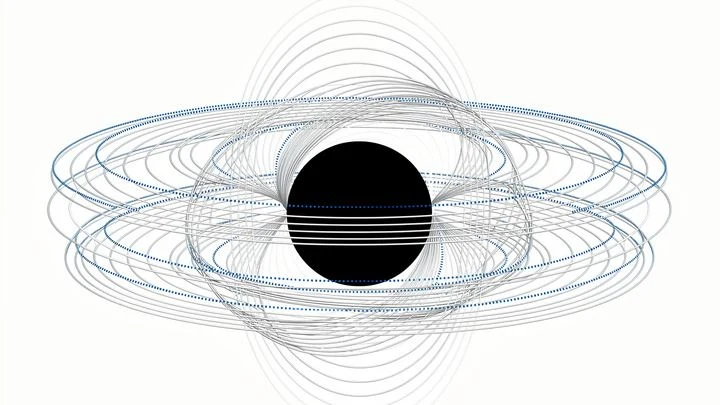
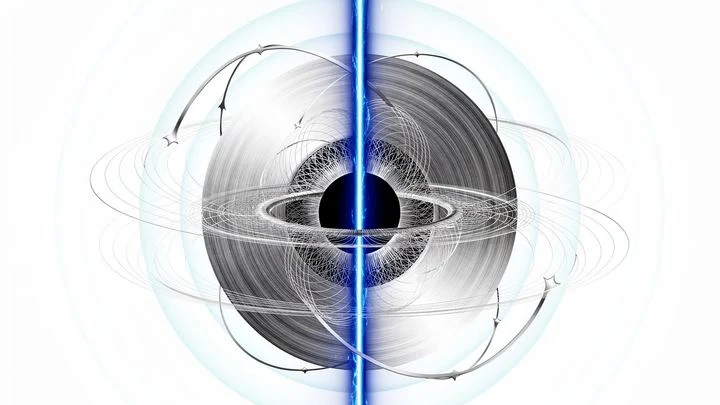
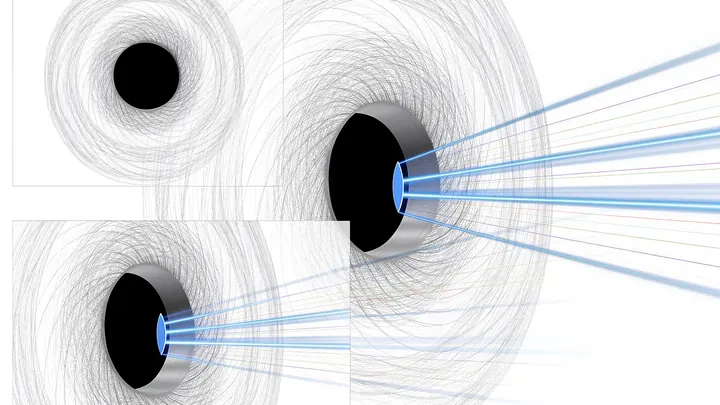
The iron line is a prominentspectral feature produced by iron atoms in the hot, ionized gas swirling around a black hole. When this gas is illuminated by X-rays from the inner accretion disk, iron atoms fluoresce, emitting X-rays at a characteristic energy. Near a black hole, the extreme gravitational field and the high orbital velocities of the gas distort this emission: the line becomes broadened and skewed, with a long tail extending to lower energies. This relativistic broadening is a direct signature of the black hole's presence and its influence on surrounding matter.
History
The relativistic iron line was first predicted in the late 1980s by Fabian and collaborators, and the first clear observational evidence came from ASCA observations of the Seyfert galaxy MCG-6-30-15 in 1995.
How it works
The iron line originates from fluorescence: X-rays from the hot inner disk strike cooler iron atoms in the outer disk or corona, causing them to re-emit at specific energies. As this emitted light climbs out of the black hole's gravitational well, it loses energy (gravitational redshift), shifting the line to lower energies. Simultaneously, the Doppler effect from the fast-moving gas broadens the line, with the approaching side shifted to higher energies and the receding side to lower ones. The resulting profile—broad, skewed, with a distinctive red tail—encodes the black hole's spin and the geometry of the innermost stable orbit.
In practice
Astronomers use iron line profiles to measure black hole spins and test general relativity in strong gravitational fields, informing models of galaxy evolution and accretion physics.
Fun fact
The iron line's red tail can extend so far that it appears to 'leak' below the energy where any iron emission should physically stop, a feature that has sparked debates about exotic physics near black holes.
Galaxy Mrk 590 behaves like a radio receiver that sometimes picks up a signal and sometimes fades into static. Its supermassive black hole has been brightening and dimming for decades, and astronomers caught every such 'switch-on.' In 2017, the receiver came alive again, but the VLA radio telescope heard not the signal they expected.
A black hole paired with a star works like a pump: it pulls gas from its companion, swirls it into a glowing disk, and occasionally ejects some of that matter in two narrow jets. In 2021, the system 4U 1543-475 put on such a show.
A black hole's shadow isn't just a black circle. Usually, we see a dark void surrounded by a glowing ring of hot gas. But if a black hole wasn't born from a dying star but has existed forever, its shadow might hide a surprise.
An eternal black hole is a solution to Einstein's equations with no past and no collapse.
The cosmic detective story began with a quiet flash in the optical band. AT2019wzc slowly brightened and faded like a smoldering ember. But hidden inside was something more energetic — repeating soft X-ray bursts that astronomers call quasi-periodic eruptions.
These eruptions last minutes to hours and repeat every few hours or days.
A black hole is not just an abyss. It is a seething cauldron whose temperature rises as it evaporates. The authors of the study found that when the heat reaches a critical threshold, the hole seems to boil. It emits superheavy particles — the very ones that exist on a scale where any theory of gravity collapses.
A bright lantern in thick fog seems dim, while a weak flame in clear air can be seen a kilometer away. A similar oddity baffled astrophysicists almost half a century ago.
A black hole is a place from which nothing can escape. But some theories allow that deep inside, at the quantum level, it might bounce and turn into its opposite — a white hole, which only spews out matter and light.
A group of physicists built a computer model of such a transformation.
At the hearts of many galaxies, cosmic tops of incredible power spin — supermassive black holes. Their nature was first described by Schwarzschild right after Einstein gifted the world with general relativity.
The cosmos is full of screams we can't hear. Every time a black hole tears a star apart, a blinding flash is born, and often — a narrow relativistic jet, shooting out thousands of light-years. But if that searchlight is aimed away from Earth, we see only a faint afterglow — a radio echo arriving with a delay.
For years, silence reigned in the heart of galaxy 1ES 1927+654: the accreting gas merely whispered in X-rays, leaking slow winds. But in 2022–2025, the picture changed dramatically. Spectra taken by XMM-Newton and Swift lit up with emission lines — a narrow peak at 0.56 keV, likely from OVII oxygen, a broader feature near 1 keV, and a powerful iron band in the 6–7 keV region.
In the center of almost every large galaxy lurks a supermassive black hole, whose gravitational abyss was first mathematically described by Karl Schwarzschild. When it swallows gas, a dazzling active nucleus is born — a quasar.
In the early Universe, tiny black holes could have been born — mountain-mass but atomic-nucleus-sized. Today they could serve as factories for dark matter. There are two mechanisms: the familiar evaporation (Hawking radiation) and the lesser-known superradiance.
A black hole is a place where gravity is so strong that even light cannot escape. But around it there is a glowing ring of gas, and in the center a dark void known as the shadow. The size of this shadow depends on how spacetime is curved.
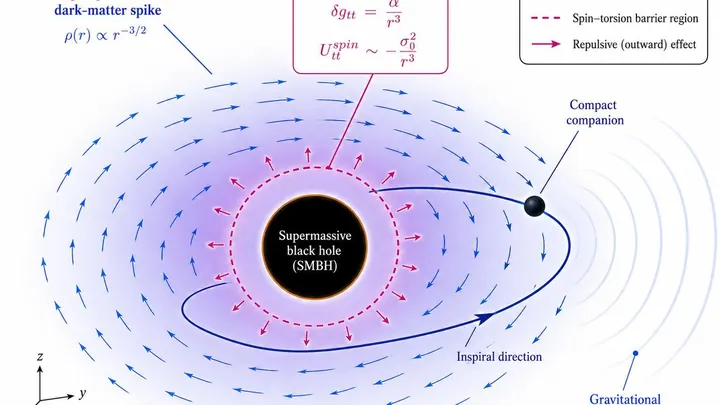
A supermassive black hole drifts through a cloud of dark matter. In the usual picture, this invisible substance just adds mass and barely interacts with ordinary matter. But dark matter particles could have intrinsic rotation — spin.
Gravitational waves from a tiny body falling into a black hole work like an X-ray image. Only instead of a bone, they illuminate the curved spacetime itself.
A spinning top whirling so fast that it forces light around it into spirals: that's a fitting image for what happens near a black hole's horizon. Hot plasma falls in and emits radio waves. Their polarization (the plane in which the wave oscillates) becomes an arrow pointing in the direction of energy flow.
The Sun is a boiling cauldron of hydrogen and helium, where scorching gas is caught in magnetic snares. When invisible ropes reconnect, energy comparable to billions of thermonuclear explosions is released. Where does it go?
A black hole is like a whirlpool in the ocean: anything that falls in disappears forever. But if the whirlpool spins and carries a slight electric charge, and invisible axion particles (dark matter candidates) are buzzing around it, its surface stops being smooth.
The city has long been asleep: not a single lit window, not a single new house. Only in the very center, in one lone building, someone forgot to turn off a spotlight. That's what a galaxy looks like when stars are no longer born, yet its central black hole still shines.
A black hole isn’t a perfectly smooth ball. Einstein’s theory allows invisible 'hair' — clumps of scalar field — to swarm around it, warping spacetime. The shadow — the dark region from which light can’t escape — was predicted by Penrose in the 1960s.
A giant black hole tore apart a star, leaving behind a lopsided disk of scorching gas — like a vinyl record warped by the heat. Now a tiny black hole (or a star) zips around and repeatedly pierces that disk. Each puncture is a bright X-ray flare.
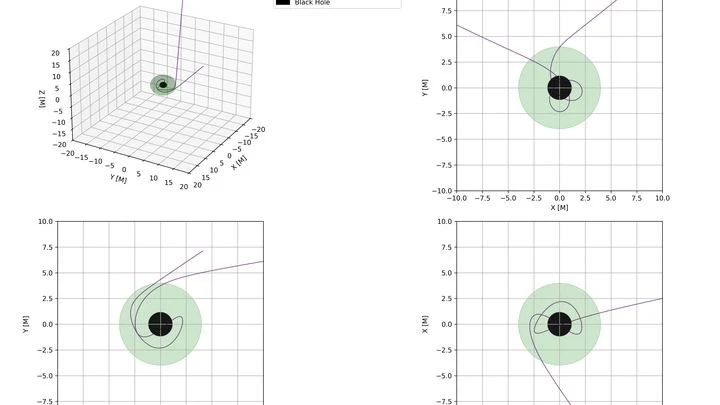
Light passing by a black hole falls into a gravitational trap: its trajectory curves and the particle bounces along a nearly closed orbit, like a pinball.
A powerful vacuum cleaner sucks in not only dust but also its own collection bag. That's roughly how a black hole behaves at the center of a 'red dot'—a distant galaxy where the glow comes not from the hole itself but from its dense gas shroud. This shroud is so thick it resembles a puffed-up cool star. And, like many stars, it has a magnetic field.
A swing swings higher and higher if you push it in rhythm. A similar mechanism kicks in when a dead star orbits a massive black hole shrouded in a cloud of ultralight particles. These particles are candidates for dark matter — the invisible substance that keeps galaxies from flying apart.
A pair of figure skaters spins while holding hands. If their path is a perfect circle, each push from a partner is predictable. But stretch that path into an oval, and the effort becomes uneven: a jerk as they come together, a lull as they pull apart. Something similar happens with two black holes in the final minutes before they merge.
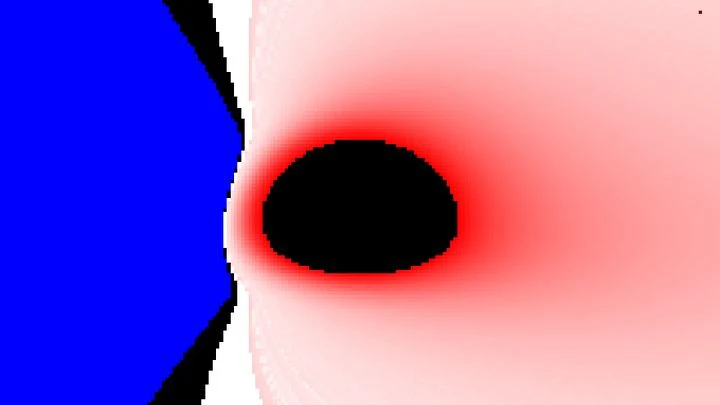
A black hole is not just a dark sphere in space. If there is gas and dust nearby, they swirl into a flat, glowing disk that gradually falls inward. This disk acts like a lamp, illuminating the hole itself, and against the bright background you can see its shadow — a dark silhouette with sharp edges.
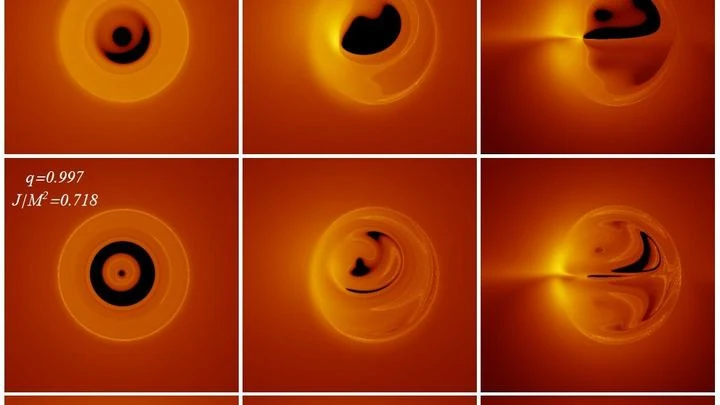
But what if the disk is not flat but torn into pieces?
Light passing by a massive body bends around it, like a stream of cars swerving around a deep pothole in the road. The steeper the pothole's slopes, the more the trajectories curve, and the fewer straight paths remain to the observer. That's how a black hole's shadow is born: a region from which light can no longer escape.
The black hole GRS 1915+105 usually hides behind a dense gas curtain: its X-ray emission is heavily absorbed on its way to us. But in April 2023, it suddenly flared: the X-ray flux jumped nearly tenfold.
At the center of the Milky Way lies the supermassive black hole Sagittarius A*. It is four million times more massive than the Sun, but by cosmic standards it behaves quietly: it only occasionally flares up when it swallows a clump of gas.
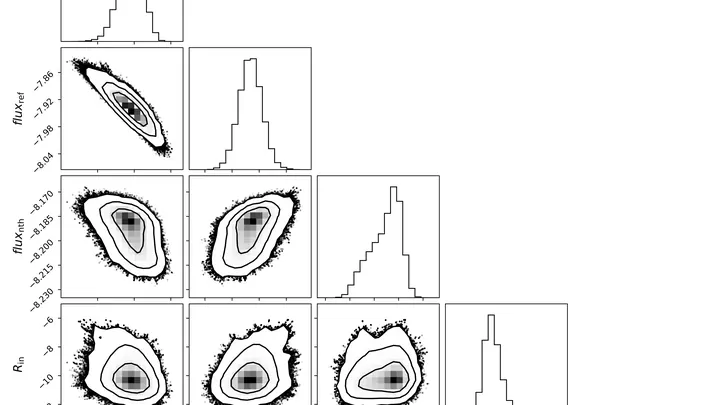
At the center of the distant galaxy MCG-6-30-15 lies a supermassive black hole. Around it swirls a disk of incandescent gas, and above the disk hangs a cloud of even hotter particles — the corona. In February 2024, three X-ray telescopes (XRISM, NuSTAR, and XMM-Newton) observed this system simultaneously.
At the center of a black hole lies a singularity — a point where spacetime is crushed infinitely. Black holes can change state, much like water freezing or boiling. Usually, these transitions are noticed by observing the hole's surroundings.
In the galaxy NGC 1566, located in the constellation Dorado, there is an active nucleus — a supermassive black hole surrounded by a cloud of fast-moving gas. As the gas falls toward the hole, it heats up and emits bright spectral lines. Sometimes these lines become very broad — a sign of the gas's rapid rotation.
The night sky looks still, but sometimes one of the stars suddenly begins to brighten. That's what happened with the system AT 2019wey: it was spotted by the TESS telescope, which usually hunts for planets around other stars, but happened to be imaging that patch of sky every half hour.
For half a century, astronomers puzzled over the nature of the powerful X-ray emission from Gamma Cassiopeiae — a bright beacon in its constellation whose X-ray glow didn't fit models of single stars. An invisible companion was suspected, but direct evidence was lacking.
When two black holes collide, they send out gravitational waves and ring like a massive bell. The fading sound, or ringdown, carries the imprint of the final black hole. But if dark energy, the force accelerating the universe, changes over time, it can cling to the black hole like a thin paint layer.
The black hole in V4641 Sagittarii behaves like a vacuum cleaner running at full power, but neighbors only see a faint indicator light. The LHAASO and HAWC telescopes caught gamma rays from it with energies up to 0.8 PeV — millions of times more energetic than hospital X-rays.
A giant cosmic funnel sucks in gas from its surroundings. But not all of that gas falls in — some is spat back out, like splashes from boiling water. That's exactly what the ultraluminous X-ray source NGC 5204 X-1 does: a compact object (likely a black hole) feeds so voraciously that the excess escapes in powerful jets.
In 2026, a black hole in the binary system GS 1354-64 woke up: it began pulling matter from its companion star, and a scorching disk swirled around it.
The gas in a galaxy glows like a neon sign, and by the color of that glow, astronomers can tell how hot it is. The logic is simple: the more heavy elements (which astronomers call metals) in the gas, the better it cools. So galaxies rich in metals should have cooler gas. But new observations show the opposite.