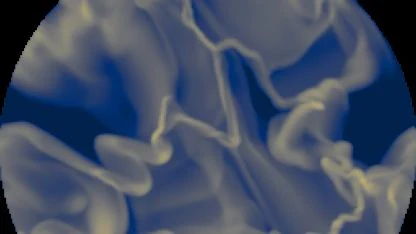
Column density is a measure of how many particles are present in a column of unit cross-sectional area along a given line of sight. It is typically expressed in units of particles per square centimeter (cm⁻²) and is a fundamental quantity in astrophysics, where it quantifies the amount of gas or dust between an observer and a distant source. For example, the column density of hydrogen in the interstellar medium tells astronomers how much material lies along the path to a star, affecting the star's observed brightness and spectrum. Column density is distinct from volume density (particles per cubic centimeter) because it integrates along the line of sight, making it directly relevant to observations of absorption and emission.
History
The concept of column density has been used in astronomy since the early 20th century, particularly in studies of stellar atmospheres and interstellar absorption lines. It became a standard tool with the development of radio astronomy and ultraviolet spectroscopy in the mid-1900s.
How it works
To obtain column density, one integrates the volume density n(r) along the line of sight from the observer to the source: N = ∫ n(r) dr. In practice, astronomers infer column density from spectral line measurements—the strength of absorption or emission lines depends on the number of absorbing or emitting particles along the path. For instance, the hydrogen column density is often derived from the Lyman-alpha absorption line, and dust column density from infrared extinction maps.
In practice
Column density is used to map the distribution of gas in galaxies, to correct for extinction in astronomical observations, and to assess the shielding of molecular clouds from ultraviolet radiation, which affects star formation.
Fun fact
The column density of the Earth's atmosphere at sea level is about 10²⁵ molecules per square centimeter, which is why the sky is blue—Rayleigh scattering is efficient because the column is so thick.
Units by system: SI: m2 · CGS: cm2 · Planck: l p2 · natural: gev2
The cosmological constant is causing the universe to expand at an accelerating rate. In the far future, when all matter has dispersed, only empty de Sitter space will remain — an ideal cosmic backdrop.
Every molecule is like a set of building blocks: the same pieces can be assembled in different ways. Two assemblies with the same atoms but different geometry are called isomers. If one can be turned into the other by a simple rotation around a bond, they are conformers, like a bent arm versus a straight one.
Long before a star ignites in a gas cloud, chemical life is already bustling. In cold, dense clumps of gas, called starless cores, atoms stick together to form molecules, both simple and complex. To peer into this invisible kitchen, astronomers aimed a 40-meter radio telescope in Yebes at 23 such clouds in the Orion Nebula.
In turbulent air, droplets don't fly in straight lines: they get tossed around like dust motes in a beam of light. Physicists have built a setup that tracks each droplet, which is about a tenth of the thickness of a human hair. A camera captures their motion, and a computer reconstructs their trajectories.
A boiling cauldron: steam rises, water churns, and the temperature varies from point to point. So it is in space: the gas clouds around young stars are not smooth spheres but a seething mixture with vortices and density fluctuations. Astronomers long treated such clouds as homogeneous, but this simplification can skew conclusions.
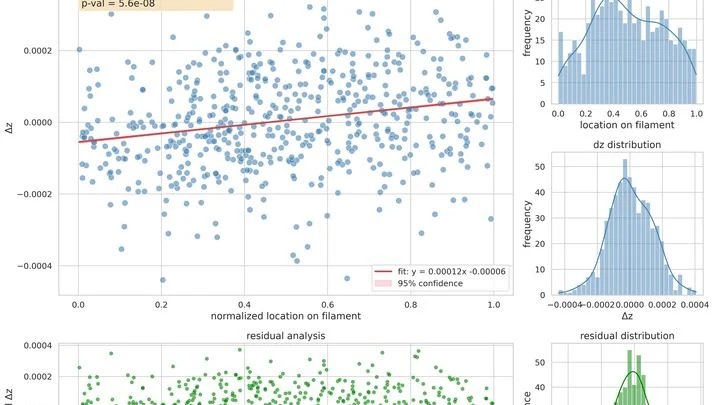
On large scales, the universe resembles a giant spiderweb: bright galaxy clusters are connected by long filaments of galaxies, gas, and dark matter. Previously, it was thought that matter flows along these filaments like water through pipes, heading toward the clusters.