Plasma density is the number of free charged particles—ions and electrons—per unit volume in a plasma. It is one of the most fundamental parameters in plasma physics, determining how the plasma conducts electricity, how it interacts with electromagnetic waves, and how it responds to magnetic fields. In fusion research, achieving the right density is a delicate balancing act: too low, and the fusion reactions fizzle; too high, and the plasma becomes unstable and cools down.
History
The concept of plasma density emerged in the early 20th century with the work of Irving Langmuir, who coined the term 'plasma' in 1928 and studied its collective oscillations.
How it works
Plasma density is typically measured in particles per cubic centimeter, ranging from about 10^6 in interstellar space to 10^14 in a fusion tokamak and up to 10^20 in laser-produced plasmas. The density directly affects the plasma frequency—the natural oscillation rate of electrons—which in turn determines how radio waves and light propagate through the plasma. In a plasma channel, for instance, the density profile acts like a lens, guiding laser beams along a narrow path.
In practice
Plasma density is a critical control parameter in fusion reactors like ITER, where it must be tuned to sustain the burning plasma, and in plasma-based particle accelerators, where density gradients accelerate electrons to high energies over short distances.
Fun fact
In a tokamak, the plasma density is so low that the gas inside is a better vacuum than the space around the International Space Station.
Units by system: SI: m3 · CGS: cm3 · Planck: l p3 · natural: ev3
A vacuum cleaner sucks in dust even if there is more of it near the nozzle. The same happens in a tokamak: plasma particles are drawn toward the center, even though their density is higher at the edge. This phenomenon is called particle pinch, and it contradicts the usual rule that everything tends to move from dense regions to sparse ones.
Two caravans travel toward each other along a narrow road. One is wide and slow, carrying a load of density. The other, a string of light carts carrying current, slips between the first. Thus, in a magnetron discharge, two structures rotating in opposite directions coexist: the density spoke and the current filaments.
A laser beam strikes a thin target hidden inside layers of another material. Within billionths of a second, the material is compressed to a density of 25 grams per cubic centimeter, as if a piece of lead became more than twice as heavy without moving an inch.
Microwave plasma in a vortex is like a kitchen mixer that simultaneously heats and stirs the gas. In the reactor, the gas is swirled, and microwaves heat it to thousands of degrees, tearing carbon dioxide molecules apart. Scientists created a computer model of such a reactor to understand how pressure affects the process.
Plasma is not just hot gas; it's an entire orchestra of charged particles, each group playing its own part. Heavy ions (atoms that have lost electrons) set the slow rhythm, while light electrons dart around ten thousand times faster.
The Orion Nebula is a showcase of astrophysics, a laboratory for studying star formation right in our backyard. For over a century, its light has been split into spectra, and each forbidden line whispers its own version of how many electrons per cubic centimeter.
If you stick two identical thermometers into a pot of hot water, they'll both read the same, and we relax, thinking the temperature is measured correctly. But in a rarefied gas heated to millions of degrees, this trick stops working.
Plutonium is a metal with attitude. One form shrinks when cooled, another swells. But at room temperature, the alloy behaves strangely: the ruler says one thing, X-rays say another. The ruler shows the sample barely grows, while X-rays see atoms in the crystal lattice moving further apart.
A stream of electrons enters plasma like a jet of water hitting a calm pond. The jet disturbs the surface, giving rise to waves that grow quickly and mix the water. In plasma, this process is called the Buneman instability: the electron beam excites oscillations that then scatter its energy.
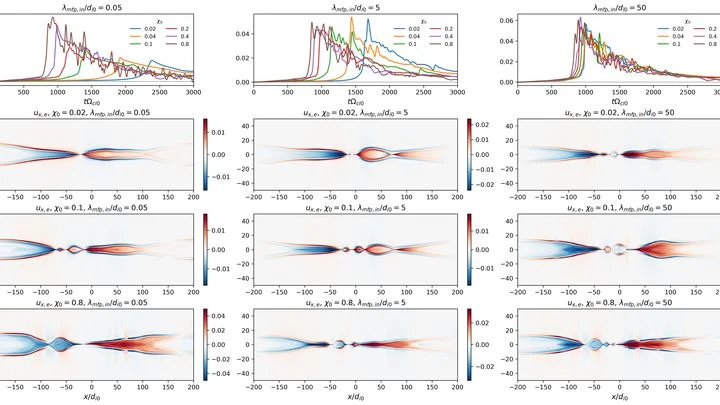
Near black holes and neutron stars, plasma churns like water in a boiling kettle. But this 'kettle' has no walls — only magnetic fields that twist and tear. At the tears, thin sheets form where magnetic field lines reconnect, giving particles a kick like a surfer catching a wave.
In plasma where some atoms remain neutral, magnetic field lines can rearrange at different speeds. This is like two rubber bands that are initially stuck together, then suddenly snap apart and contract, releasing energy.
A laser pulse racing through plasma is like a runner carving a path through a crowd. It shoves electrons aside, leaving behind a rarefied channel, just as the crowd parts for a sprinter. In this channel, the crest of the light wave moves slightly faster than light in a vacuum, and it is this speed that determines how efficiently the pulse transfers energy to particles.
A short laser pulse strikes the air, and a tiny lightning bolt flashes at the point of impact. It lives longer than you'd think: the bright glow is visible for half a millisecond, and a faint one for nearly twenty milliseconds.
A fusion reactor is an attempt to hold a miniature sun in a magnetic cage. To get more energy out of it, you need to squeeze the plasma denser. But tokamaks have an invisible fence: once the density crosses a certain line, the plasma shudders and falls apart. This disruption is one of the main mysteries on the road to clean energy.