Record Gamma-Ray Burst: When a Black Hole Falls into a Star ✛
Context
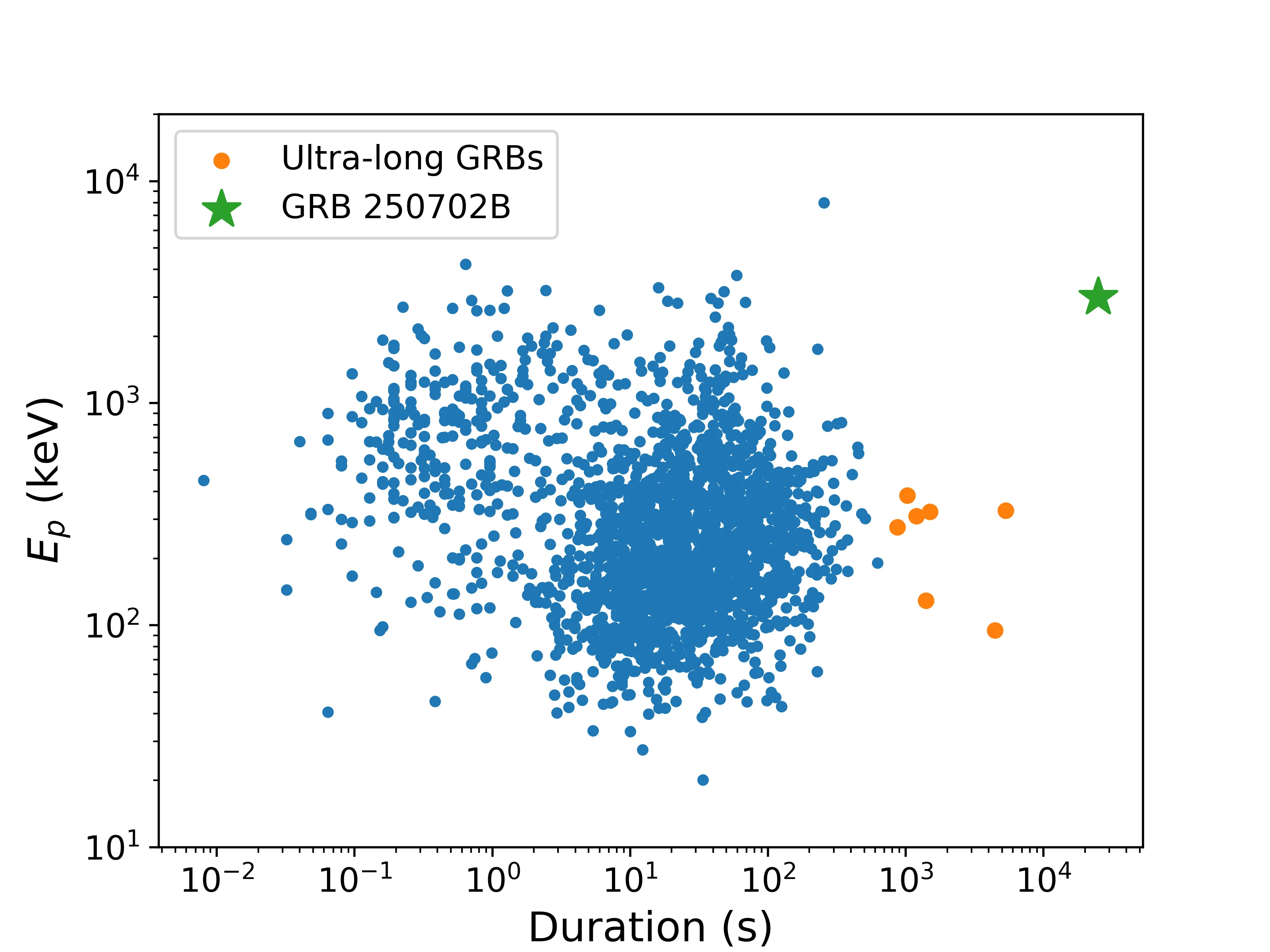
Gamma-ray bursts come in two flavors: short ones from neutron star mergers, and long ones from collapsars, the collapsing cores of massive stars. Ultra-long bursts lasting more than 1,000 seconds remain puzzling: a collapsar cannot sustain a jet for more than a few thousand seconds because a single star has limited angular momentum. GRB 250702B, with its record duration of about 25,000 seconds, became an extreme test for all models. The work joins the ranks of ultra-long burst studies such as GRB 111209A and GRB 101225A, but surpasses them in duration and demands a new explanation.
Methods
The observations were carried out with five instruments: Fermi-GBM, Konus-Wind, Swift-BAT, Psyche-GRNS, and MAXI. Each instrument contributed in its own way: GBM provided high time resolution, Konus-Wind and Psyche-GRNS provided continuous coverage, BAT provided localization, and MAXI provided X-ray context. The duration was determined from the combined light curve: from the first significant signal in Konus-Wind to the last flare in Swift-BAT. The minimum variability was computed using wavelet analysis following the method of Golkou and Butler. Spectra were constructed from GBM and Konus-Wind data, and the maximum photon energy was searched for in the channels of Psyche-GRNS and the BGO detectors of GBM.
Results
The observed gamma-ray duration was at least 25,000 seconds (about 12,500 seconds in the rest frame), which is twice as long as the previous record, GRB 111209A. The minimum variability is about 1 second in the observer's frame and 0.5 seconds in the rest frame, typical for jets from stellar-mass black holes. The spectral lag is consistent with zero, as in short bursts. The peak energy of the spectrum turned out to be unusually high: 3–4 MeV according to GBM, while Konus-Wind gave about 0.8 MeV. The maximum detected photon energy is at least 5 MeV in the observer's frame (10 MeV in the rest frame). The isotropic energy was about 1.4×$10^{54}$ erg, and the collimated energy about 5.8×$10^{49}$ erg, which falls within typical values for long bursts. At the same time, the ratio of energy to peak luminosity turned out to be extreme: the burst was very long but not very bright.
Implications
The work rules out all known progenitors: collapsars do not provide the required duration, tidal disruption events do not provide the required variability, and white dwarf mergers do not provide the required energy. The only model that naturally explains all the properties is the merger of a stellar-mass black hole with a helium star. Unlike neighboring works that described individual bursts or statistics, here a specific mechanism is proposed for the first time, linking the super-long duration to the orbital angular momentum of the infalling black hole. This makes the helium merger a new class of gamma-ray burst progenitors.
Future development
The helium merger model predicts that super-long bursts should be accompanied by weak supernovae with low nickel-56 yields, and their population should follow star formation, including regions with high metallicity. Future observations, especially with LSST surveys and new gamma-ray monitors, will allow these predictions to be tested. Detailed hydrodynamic simulations of the merger process will also be needed to refine the jet and supernova parameters.
Impact
The findings will affect gamma-ray burst astrophysics, the theory of binary star evolution, and our understanding of supernovae with narrow emission lines.
Next steps
We need to search for similar events in archival data and set up systematic monitoring of ultra-long bursts. It is also important to perform detailed modeling of helium mergers to predict observational signatures.
Key open problems
This work is directly linked to the unresolved problem of the progenitors of ultra-long gamma-ray bursts. It also touches on how helium stars expand in binary systems and the connection between gamma-ray bursts and rare types of supernovae.
The knowledge machine's view
This section is addressed to the author of the paper and their colleagues. Neighbouring works were found by meaning-based search across our archive, not by word overlap. We do not review: we show the field around the work.
What the work does
The paper describes GRB 250702B, a record-breaking gamma-ray burst with gamma-ray emission lasting at least 25,000 seconds and sub-second variability. The authors analyze data from five instruments, determine the duration, variability, spectra, and energy, rule out known progenitors, and propose a model involving the merger of a black hole with a helium star.
Where its strength is
For the first time, a specific mechanism is proposed that links the super-long duration to the orbital angular momentum of the infalling black hole, opening up a new class of gamma-ray burst progenitors.
Where it could go next
- It might be interesting to compare the proposed model with observations of pulsations in gamma-ray bursts to see whether quasi-periodic oscillations could arise in a jet from a helium merger.based on: Rhythms of Black Holes: 34 Pulsations in Gamma-Ray Bursts arXiv:2510.11136
- Related work exists on the delay between gravitational-wave and gamma-ray signals; perhaps for a helium merger one could estimate the expected delay and use it as an additional test of the model.based on: Light and Gravity Lag: The Key to Jet Birth arXiv:2606.29515
- To test the helium merger model, one could consider what the afterglow of such an event would look like: there is an analysis dedicated to the X-ray afterglow of gamma-ray bursts that could provide guidelines.based on: X-ray Thunder After Gamma-ray Lightning arXiv:2601.14137
Worth trying
- Test whether the helium merger model predicts quasi-periodic oscillations similar to those found in other bursts.
- Estimate the expected delay between a possible gravitational-wave signal and the gamma-ray burst for a helium merger.
- Compare the observed afterglow of GRB 250702B with predictions for the new progenitor, using X-ray observation data.
Why this may matter
The proposed mechanism could fill the gap between collapsars and tidal disruption events, explaining super-long bursts and paving the way for searching for gravitational-wave counterparts from black hole–helium star mergers.
Nearby works in our archive
- A 160-Millisecond Beacon: The Birth of a Magnetar in a Gamma-Ray Burstsimilarity 0.57
- X-ray Thunder After Gamma-ray Lightningsimilarity 0.57
- Record-Bright Flare from a Gamma-Ray Burstsimilarity 0.56
- Echo of a Gamma-Ray Burst: Neutrons Chase the Lightsimilarity 0.55
- Rhythms of Black Holes: 34 Pulsations in Gamma-Ray Burstssimilarity 0.54
- The Cosmic Potter: How Rotation and Magnetic Fields Shape a Black Holesimilarity 0.53
- Light and Gravity Lag: The Key to Jet Birthsimilarity 0.52
The archive is sparse around this work: the closest review is only 0.57, against a usual 0.64. It looks like few have drilled nearby.
GRB 250702B lasted about 7 hours, longer than a flight from Moscow to New York. Yet individual flares within it varied on sub-second timescales, as if a fast engine were running inside a slow process.
The merger of a black hole with a star echoes the plot of "Interstellar," where the black hole Gargantua interacts with surrounding matter, but here the scale is stellar, not supermassive.
Key numbers
- длительность гамма-излучения: не менее 25 000 секунд (около 7 часов)
- минимальная переменность: около 1 секунды (0,5 с в системе покоя)
- максимальная энергия фотона: не менее 5 МэВ (10 МэВ в системе покоя)
- изотропная энергия: 1,4×1054 эрг
- коллимированная энергия джета: 4,1×1050 эрг