Black Hole Tugboat: Birth of a Stellar Core ✛
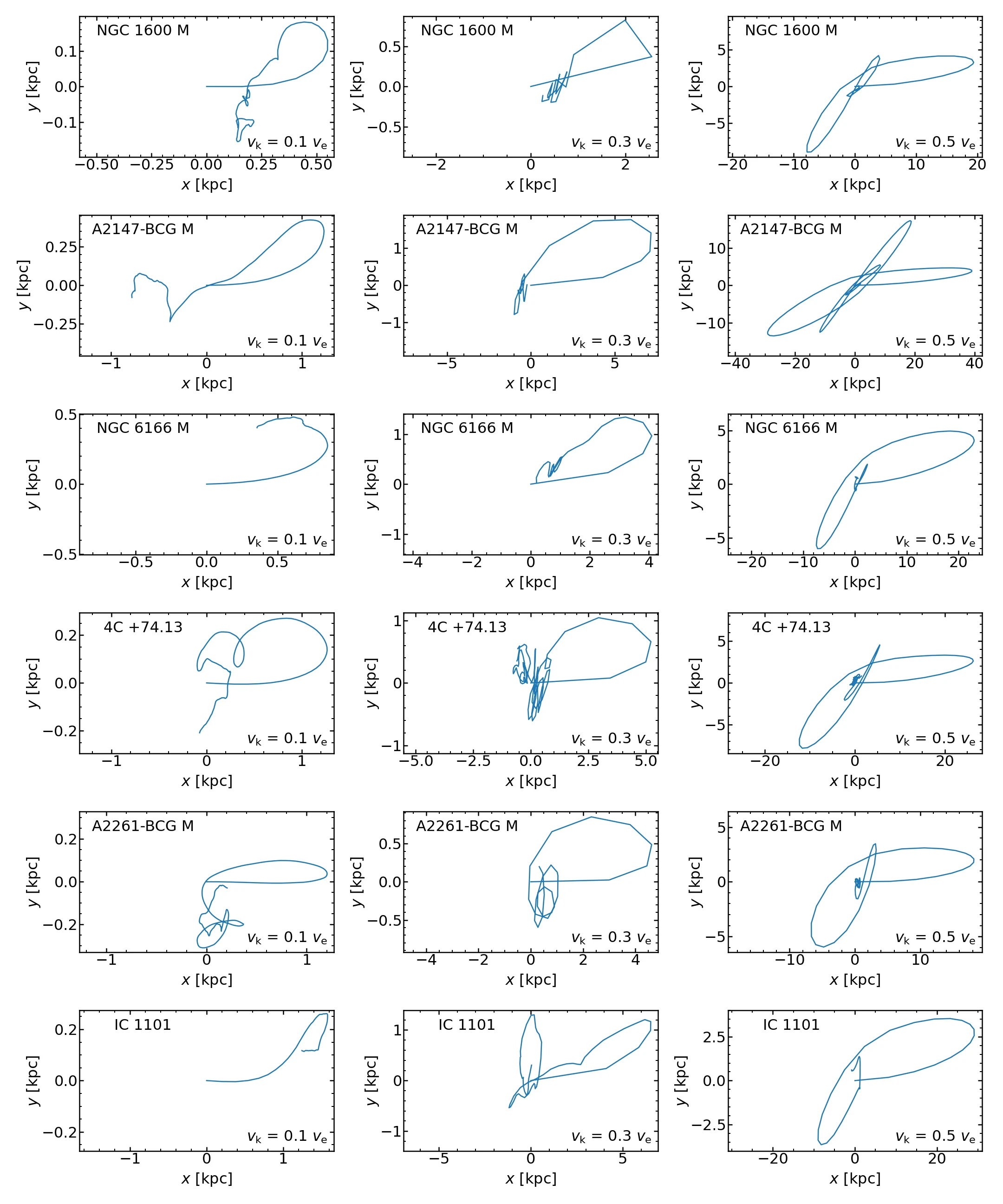
When galaxies collide, their supermassive black holes merge and get a sharp kick from gravitational waves (predicted by Einstein, detected by instruments built by Weiss and Thorne). It used to be thought that the recoil accelerates the black hole to thousands of km/s and scatters all stars from the center — nuclear star clusters are doomed. But observations say otherwise: a third of giant galaxies still have them.
The answer lies in 'towing.' Like a ship in a harbor, a black hole behaves differently depending on its speed. A slow motion barely disturbs the boats around it. Too fast, and it scatters them. But in the range of 500–1000 km/s, it acts like a tugboat, pulling a compact swarm along. Stars bunch up into a ball less than ten light-years across — millions of suns packed into a tiny plot.
Remarkably, you can't tell this cluster apart from its neighbors by color or age. The only giveaway is a flawless sphere, as if carved by spacetime curvature itself. So towing explains how black holes and star cores coexist at the centers of galaxies.
These clusters can pack millions of stars into a space less than ten light-years across — imagine cramming all the stars in the Sun's neighborhood into a single city block.