Tugboat Black Hole: How Supermassive Objects Drag Star Clusters Along ✛
Context
Nuclear star clusters, dense and bright concentrations at galaxy centers, were considered incompatible with the most massive supermassive black holes. The logic is simple: when galaxies merge, their black holes form a tight pair that, interacting with stars, ejects them from the center (the 'core scouring' effect). However, recent observations, including data from the Hubble Space Telescope, show that about a third of massive elliptical galaxies do have central light excesses resembling NSCs, but with unusually large sizes and velocity dispersions. This work fits into a series of studies where black hole mergers and gravitational-wave kicks have already been used to explain the formation of giant cores and flat brightness profiles. Here, for the first time, it is shown that the same process at lower kick speeds can create, rather than destroy, a central stellar concentration.
Methods
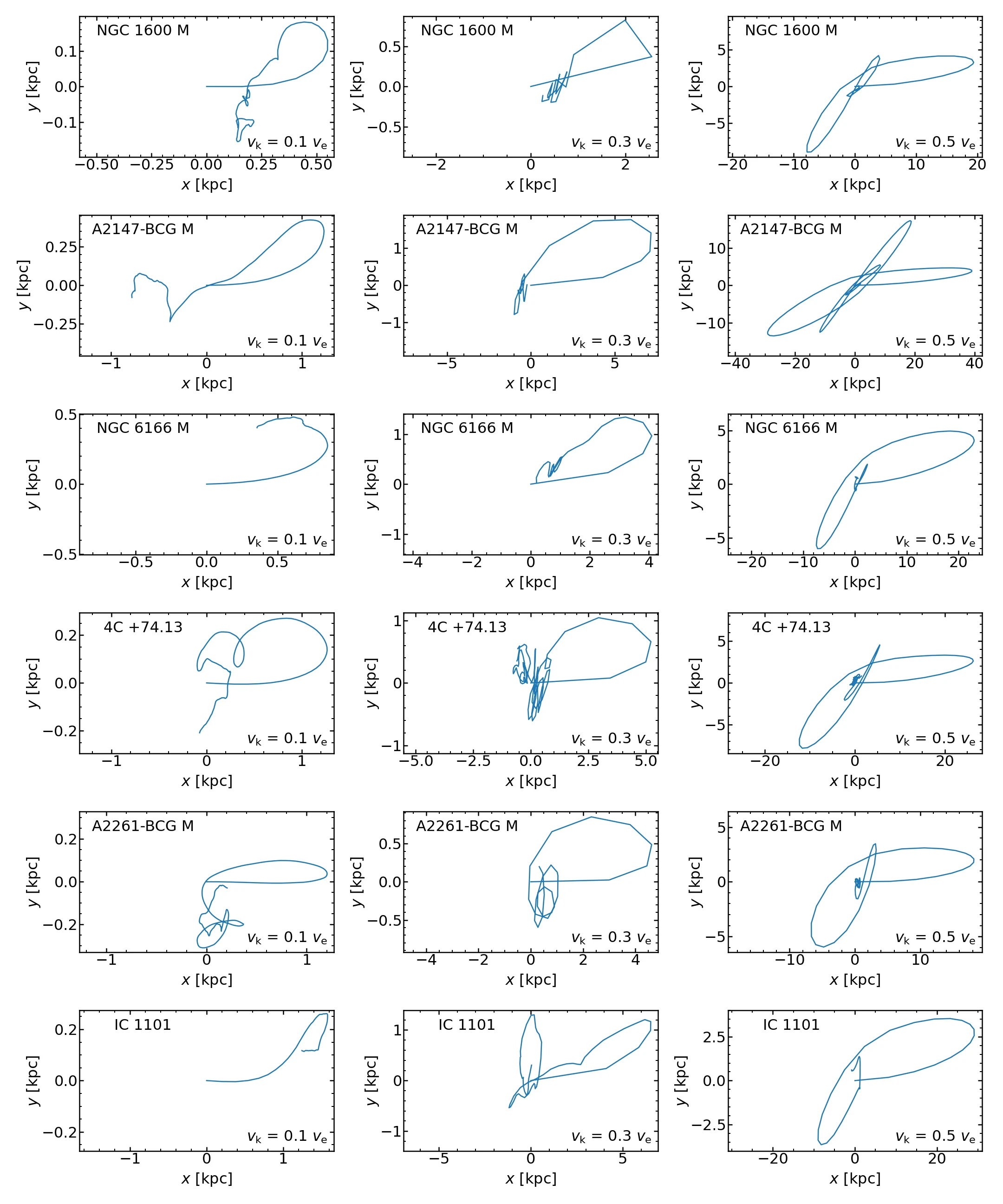
The authors ran a series of N-body simulations of equal-mass galaxy mergers, modeling six real giant elliptical galaxies with known core sizes (NGC 1600, A2147-BCG, NGC 6166, 4C+74.13, A2261-BCG, IC 1101). Each galaxy is represented as the product of a merger of two identical progenitors, each containing a stellar bulge, a dark halo, and a supermassive black hole. After the binary black hole forms and hardens, it is replaced by a single black hole with the combined mass, and it is given a gravitational-wave recoil kick with a speed of 0.1, 0.3, or 0.5 times the galaxy's escape velocity. The black hole's motion is then simulated until it transitions to Brownian motion. The analysis uses the griffin code with an adaptive fast multipole method and Plummer softening, along with the AGAMA library for building equilibrium models. Central resolution is enhanced using a particle mass refinement scheme.
Results
At low kick speeds (0.1 times the escape velocity), the black hole does not travel far and quickly decelerates, so the density profile barely changes. At high speeds (0.5 and above), the black hole ejects many stars and forms a flat core. But at intermediate speeds (0.3–0.5), two effects compete: some stars become bound to the black hole and travel with it, while others are ejected as it returns. As a result, a dense concentration remains at the center, surrounded by a flattened core. For five models (NGC 1600 at 0.3 and 0.5, A2147-BCG at 0.3, NGC 6166 and IC 1101 at 0.5), such concentrations are clearly visible in the density profiles. The masses of bound stars range from 0.5 to 38.4 × $10^8$ solar masses, radii from 30 to 470 parsecs, and velocity dispersions from 405 to 637 km/s. These values fall within the observed range for NSCs, albeit at the upper end. The concentrations are nearly spherical (ellipticity 0.06–0.24). Their relaxation times exceed 10 billion years, meaning the structures are stable.
Implications
This work shows that forming nuclear star clusters in giant elliptical galaxies requires neither infalling globular clusters nor star formation from gas; the merger process of black holes alone suffices. This resolves the contradiction between predictions of NSC destruction and their observed presence in massive systems. Unlike neighboring studies, where gravitational-wave kicks only explained core expansion and profile flattening, here the same mechanism at moderate speeds creates a central concentration. Thus, the same process can lead to opposite observational manifestations depending on kick speed. This broadens our understanding of the role of supermassive black hole mergers in galaxy evolution.
Future development
The black hole dragging mechanism can be tested on a larger sample of galaxies with high spatial resolution, for example, with future observations on 30-meter-class telescopes or the James Webb Space Telescope. If such clusters are found in galaxies with known merger signatures, it would directly confirm the model. Additionally, one can investigate how the process depends on black hole mass, the mass ratio of merging galaxies, and the presence of gas. In the future, this mechanism could be incorporated into semi-analytic models of galaxy formation to better predict the occurrence rate of NSCs.
Impact
The results will affect the interpretation of observations of central regions of massive galaxies and models of coevolution of supermassive black holes and their hosts. They also provide an observational test for estimating the frequency and magnitude of gravitational-wave kicks.
Next steps
Plans include higher-resolution simulations to confirm the process and study its details, as well as adding a small amount of gas to test hydrodynamic effects. Additionally, the authors are preparing a detailed comparison with reprocessed observational data for NGC 6166 and NGC 4486.
Key open problems
This work directly addresses the unresolved question of the origin of nuclear star clusters in massive elliptical galaxies, where classical mechanisms (infall of globular clusters and star formation from gas) face difficulties. It also touches on the coevolution of supermassive black holes and their host galaxies, specifically how black hole mergers shape observed nuclear structures.
The knowledge machine's view
This section is addressed to the author of the paper and their colleagues. Neighbouring works were found by meaning-based search across our archive, not by word overlap. We do not review: we show the field around the work.
What the work does
The authors model mergers of equal-mass galaxies using N-body simulations and show that at moderate gravitational-wave recoil velocities of the supermassive black hole (0.3–0.5 of the escape velocity), some stars remain bound to it and, upon its return, form a central concentration resembling a nuclear star cluster. The models reproduce the observed sizes, masses, and velocity dispersions for six real elliptical galaxies.
Where its strength is
The work proposes a concrete mechanism for the formation of nuclear star clusters in massive elliptical galaxies, which naturally explains their sphericity and chemical homogeneity, and supports it quantitatively with simulations.
Where it could go next
- It might be interesting to compare this mechanism with the formation of quasi-stars: in both cases, a supermassive black hole interacts with the surrounding stellar population, and comparing the dynamics could clarify which conditions favor the binding of stars.based on: Quasi-Stars: Black Holes Inside Giant Stars arXiv:2604.22924
- Related work on the role of bars in bringing supermassive black holes together suggests that accounting for the non-sphericity of the galactic potential after a merger could change the efficiency of dragging and the final shape of the nuclear cluster.based on: How Galactic Bars Change the Dance of Black Holes arXiv:2607.26125v1
- The idea of invisible conductors of galactic disks implies that black holes can influence stellar kinematics; here one can check whether the dragging process leaves observable traces in the velocity dispersion or anisotropy at the center.based on: Invisible Conductors of Galactic Disks arXiv:2606.22559
Worth trying
- Test how well the predicted sphericity of nuclear clusters holds when the rotation of the merging galaxies is taken into account.
- Compare the chemical composition of stars in model clusters with observed data for NGC 1600 and other objects.
- Assess how the frequency of nuclear clusters depends on the distribution of black hole recoil velocities.
Nearby works in our archive
- Quasi-Stars: Black Holes Inside Giant Starssimilarity 0.59
- The Acceleration of Invisible Pairs: What the Dance of Black Holes Revealssimilarity 0.58
- Invisible Conductors of Galactic Diskssimilarity 0.57
- Gas Jumps Over the Ringsimilarity 0.57
- Dark Stars: Hypothetical Cradles of Supermassive Black Holessimilarity 0.56
- Gas Clouds Dance Around the Galactic Centersimilarity 0.56
- How Galactic Bars Change the Dance of Black Holessimilarity 0.56
The archive is sparse around this work: the closest review is only 0.59, against a usual 0.64. It looks like few have drilled nearby.
The recoil speed of a black hole can reach 4000 km/s, enough to escape the galaxy permanently. But in most cases, the kick is much weaker, and the black hole, like a pendulum, passes through the center several times before settling down.
In Greg Egan's novel 'The Clockwork Rocket,' civilizations use black holes as engines to move star systems. The black hole dragging mechanism, albeit on a much smaller scale, resembles this idea: a black hole indeed drags stars along with it.
Key numbers
- kick speed: 500–1000 km/s
- NSC mass: 0.5–38.4 × 10⁸ M⊙
- NSC radius: 30–470 pc
- velocity dispersion: 405–637 km/s
- relaxation time: >10 billion years