Tugboat Black Hole: How Supermassive Objects Drag Star Clusters Along ✛
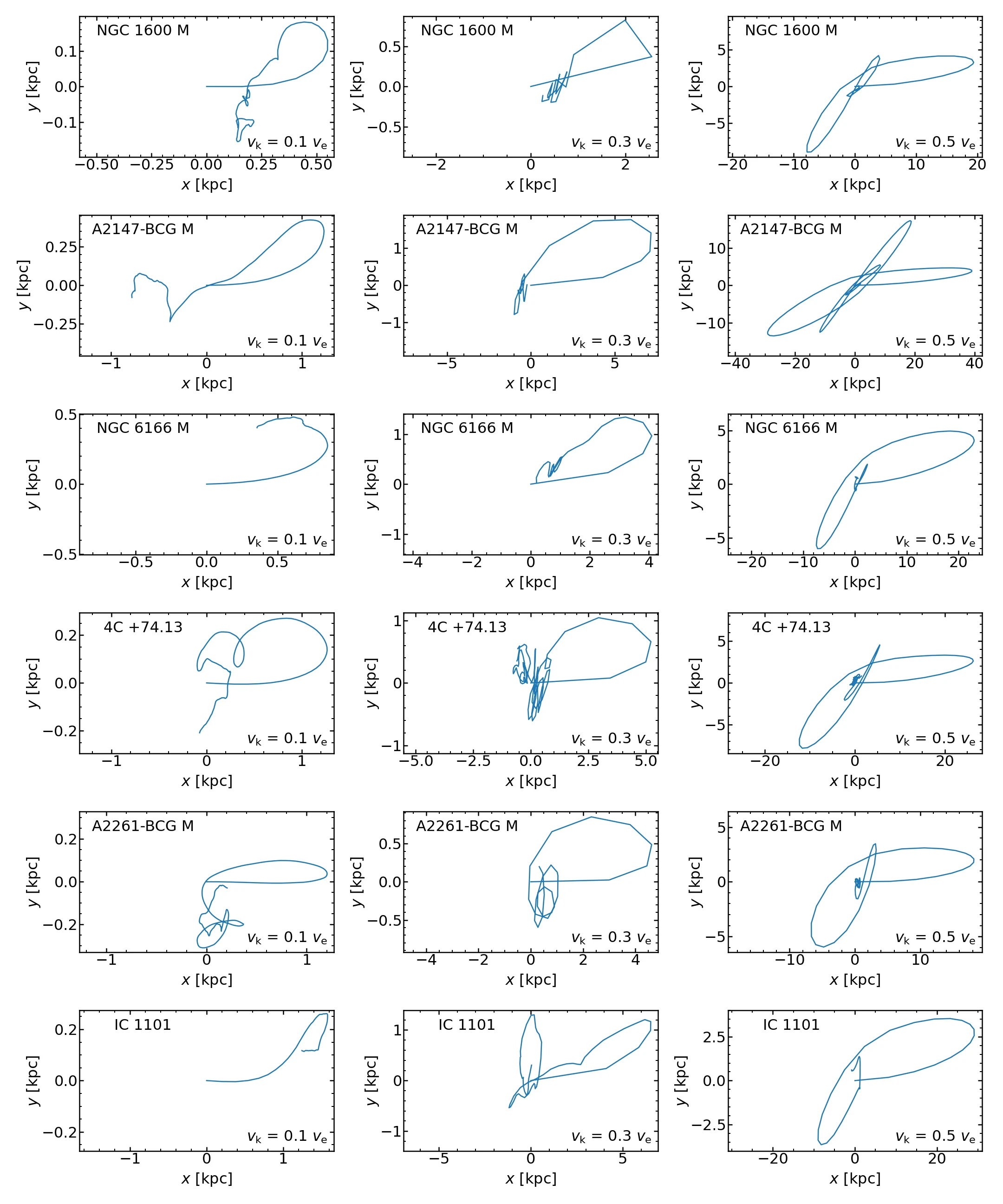
At the center of galaxy NGC 1600, 200 million light-years away, astronomers spotted a dense cluster of stars. It looked like a bright knot against the diffuse glow, and that was unexpected. It was thought that in such giant elliptical galaxies, nuclear star clusters do not survive: mergers of supermassive black holes should have ejected stars from the center, leaving only a void. But Hubble Space Telescope observations show that up to a third of massive elliptical galaxies do hide a dense stellar concentration in their cores. How did it get there?
The answer lies in the moment when two galaxies merge and their black holes, spiraling around each other, emit gravitational waves. These waves carry away energy and momentum, and the combined black hole gets a kick, like a cannon after firing. If the kick is moderate, the black hole does not leave the galaxy but starts to oscillate around the center, like a pendulum. And here comes the effect the authors call 'black hole dragging': the black hole, moving through the stellar sea, pulls some stars along, like a tugboat towing barges. Stars that become gravitationally bound to the black hole follow it on its travels. When the black hole returns to the center, these stars stay there, forming a dense core, the very nuclear star cluster.
To test the idea, the scientists ran a series of computer simulations reproducing galaxy mergers. They took six real giant elliptical galaxies: NGC 1600, A2147-BCG, NGC 6166, 4C+74.13, A2261-BCG, and IC 1101, and modeled them as the product of a collision of two identical progenitors. Each simulation tracked the fates of millions of stars and dark matter, as well as the black hole, which after the merger was given a recoil speed of 0.1, 0.3, or 0.5 times the galaxy's escape velocity. The results showed that at low recoil speeds, the black hole barely moves and the stellar density profile remains unchanged. At high speeds, it ejects stars from the center, creating a flat core. But at intermediate speeds, precisely 500–1000 km/s, there is a competition between two effects: some stars become bound to the black hole and move with it, while others are ejected when it returns. What remains at the center is a dense concentration surrounded by a flattened core.
The masses of such concentrations in the simulations ranged from 0.5 to 38.4 × $10^8$ solar masses, radii from 30 to 470 parsecs, and the velocity dispersions of stars inside from 405 to 637 km/s. These values fall within the range of observed nuclear star clusters, though at the upper end. The concentrations are nearly spherical: their ellipticity is only 0.06–0.24. And they are stable: their relaxation time exceeds 10 billion years, so they will outlive many generations of stars. This resolves a long-standing contradiction between theory, which predicted the destruction of NSCs in giant galaxies, and observations, which found them. It turns out that the same process, gravitational-wave recoil, can either destroy or create a central stellar concentration, depending on the speed.
The future of this mechanism lies with new telescopes. Thirty-meter-class instruments and the James Webb Space Telescope will be able to distinguish such clusters in distant galaxies and test whether they really are born this way. If spherical, chemically homogeneous stellar concentrations are found in galaxies with signs of past mergers, that will be direct confirmation of the model. For now, the tugboat black hole remains an elegant explanation of how the darkest objects in the universe can gather stellar caravans around themselves.
The recoil speed of a black hole can reach 4000 km/s, enough to escape the galaxy permanently. But in most cases, the kick is much weaker, and the black hole, like a pendulum, passes through the center several times before settling down.
In Greg Egan's novel 'The Clockwork Rocket,' civilizations use black holes as engines to move star systems. The black hole dragging mechanism, albeit on a much smaller scale, resembles this idea: a black hole indeed drags stars along with it.