The Milky Way's Dark Halo is Flattened and Twisted express
The Milky Way's stellar disk is like a glowing pinwheel, and dark matter is an invisible cloud around it. For the first time, its shape has been precisely measured. Astronomers tracked the motions of millions of stars and built a 3D map of the тёмное гало out to 160,000 light-years. Back in the day, Fritz Zwicky and Vera Rubin proved the existence of hidden mass, but its distribution remained a mystery.
The picture was stunning. The гало is not spherical, but elongated and flattened, like a deflated rugby ball. And its long axis sticks out almost perpendicular to the stellar disk — as if an invisible frame had been tilted by 90 degrees. This orientation matches the plane in which the dwarf satellite galaxies orbit.
Such a tilt is simply explained: billions of years ago, the Milky Way's disk flipped under the gravitational pressure of small galaxies. Computer simulations confirm this. The discovery ties the Standard Model to the actual behavior of galaxies and finally explains the enigmatic plane of satellites.
Original abstract
as written by the authors arXiv:2510.08684
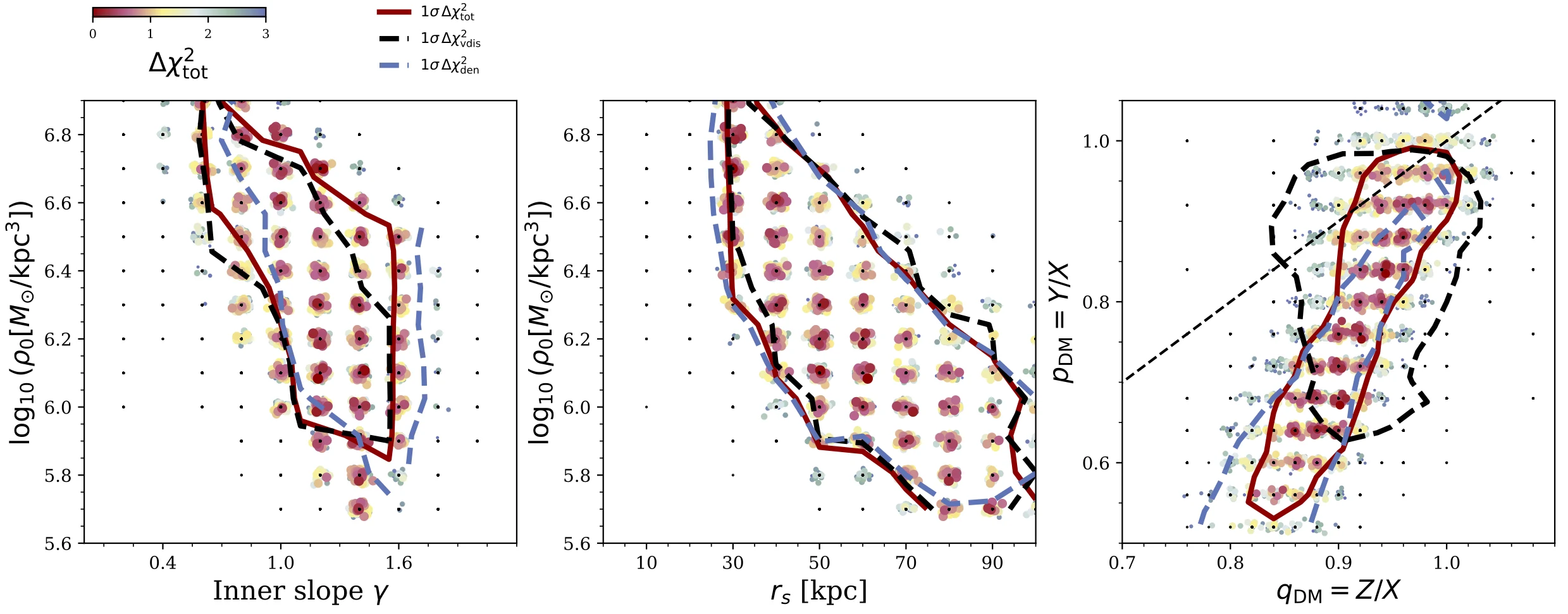
Unveiling the 3D shape of the Milky Way's dark-matter halo is critical to understanding its formation history. We created an innovative dynamical model with minimal assumptions on the internal dynamical structures and accommodates a highly flexible triaxial DM halo. By applying the method to 6D phase-space data of K-giant stars from LAMOST + Gaia, we robustly determine the 3D dark-matter distribution of the Milky Way out to approximately $$50$$ kpc. We discover a triaxial, nearly oblate dark-matter halo with $$q_{\rm DM} = Z/X= 0.92\pm0.08$$, $$p_{\rm DM} = Y/X= 0.8\pm0.2$$ averagely within 50 kpc, where $$Z$$ axis is defined perpendicular to the stellar disk. The axes ratio $$q_{\rm DM} > p_{\rm DM}$$ is strongly preferred; the long-intermediate axis plane of the dark-matter halo is unexpectedly vertical to the Galactic disk, yet aligned with the `plane of satellites'. This striking configuration suggests that the Galactic disk (and the inner halo) has flipped, likely torqued by minor mergers, from an original alignment with the outer dark-matter halo and satellite plane, as supported by Milky Way analogues from Auriga and TNG50. By allowing $$q_{\rm DM}(r)$$ and $$p_{\rm DM}(r)$$ vary with radii, we find tentative evidence that the dark-matter halo is twisted, that it agrees alignment with the disk in the inner regions and transitions to a vertical orientation at $$r\gtrsim 20$$ kpc, supporting the disk flip scenario prediction. Such disk reorientation is non-trivial yet its physical mechanism is straightforward to comprehend and naturally originates a vertical satellite plane. Our findings offer a unified framework that links dark-matter halo orientation, satellite alignment, and disk evolution, reinforcing the internal consistency of the Milky Way in $$\Lambda$$CDM model.
There is five times more dark matter than ordinary matter. Without its invisible gravity, galaxies would fly apart from centrifugal force.