Quantum Communication Speeds Up Nearly Five Times express
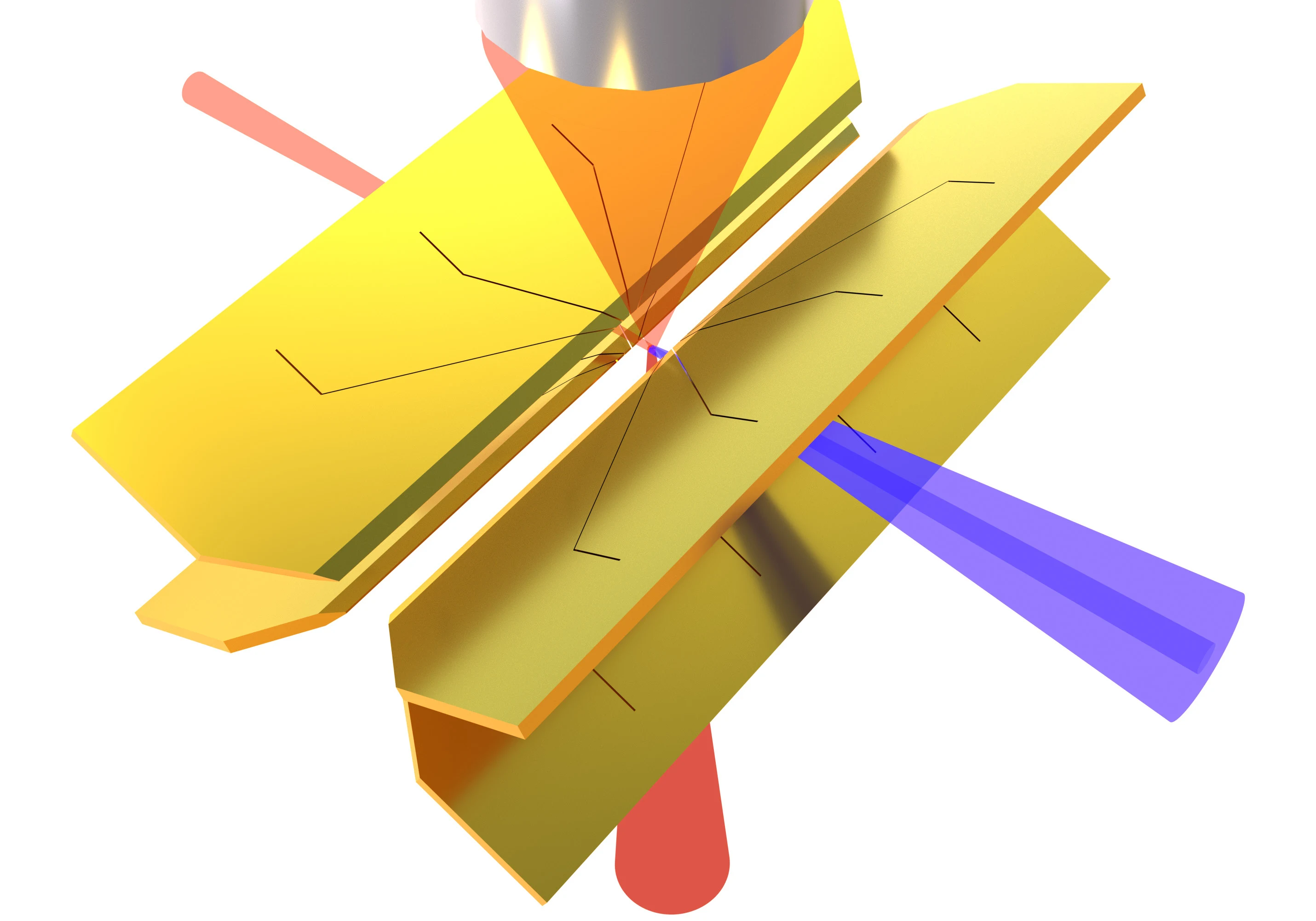
Regular quantum communication is like a postal service that sends letters strictly one at a time. If the route is long, you have to wait an indecently long time for a reply. Physicists sped up the process by dispatching ten 'postal trucks' — light pulses — into a single optical fiber, but in different time windows. In the experiment, two ions (charged atoms) in traps connected by a 1.2 km cable each received ten photons per cycle. This allowed them to create entanglement 4.59 times faster, with 95.9% accuracy.
This approach is like a construction set: you can add new ion nodes, and the network will speed up, bringing us closer to secure communication and distributed computing.
Original abstract
as written by the authors arXiv:2510.20392
Quantum networks and quantum repeaters represent the promising avenues for building large-scale quantum information systems, serving as foundational infrastructure for distributed quantum computing, long-distance quantum communication, and networked quantum sensing. A critical step in realizing a functional quantum network is the efficient and high-fidelity establishment of heralded entanglement between remote quantum nodes. Multiplexing offers a powerful strategy to accelerate remote entanglement distribution, particularly over long optical fibers. Here, we demonstrate the first multiplexing-enhanced heralded entanglement between two trapped-ion quantum network nodes. By multiplexing $$10$$ temporal photonic modes, we achieve a 4.59-fold speedup in ion-ion entanglement generation and attain an entanglement fidelity of $$95.9\pm1.5\%$$ over $$1.2$$ km of fiber. Employing a dual-type architecture, our system is readily scalable to multiple nodes, thereby establishing a key building block for future large-scale quantum networks.
Without the ten-channel trick, entangling two charged atoms over a kilometer-long fiber would take minutes — about as long as it takes to brew a cup of coffee. Now it all happens in the time it takes you to blink.
The idea of instantaneous communication via entanglement underpins the plot of Liu Cixin's novel 'Through the Stars', where the heroes attempt to communicate with deep space without delay.