Popular

Quantum Communication Speeds Up Nearly Five Times ⚡ экспресс

Original: "Multiplexed ion-ion entanglement over $$1.2$$ kilometer fibers"
arXiv:2510.20392 · 2025-10-23 · CC BY 4.0 · ⏱ 1 min · Quantum Physics
Scientists have for the first time used a ten-light-channel trick to speed up entanglement between charged atoms.
Abstract

For the first time, scientists have turbocharged the creation of quantum entanglement between two trapped-ion nodes by sending light signals in parallel batches—like throwing multiple lottery tickets into the draw at once. This made the connection 4.59 times faster, with 95.9% fidelity, over a distance of 1.2 km. Think of it as playing the lottery: the more tickets you enter, the quicker you hit the jackpot. The technique scales up easily, paving the way for distributed quantum computing.

Links in the knowledge graph 1

📄 Showing the "Simple" version — "Popular" is not ready yet. Add it to favorites to help prioritize it.

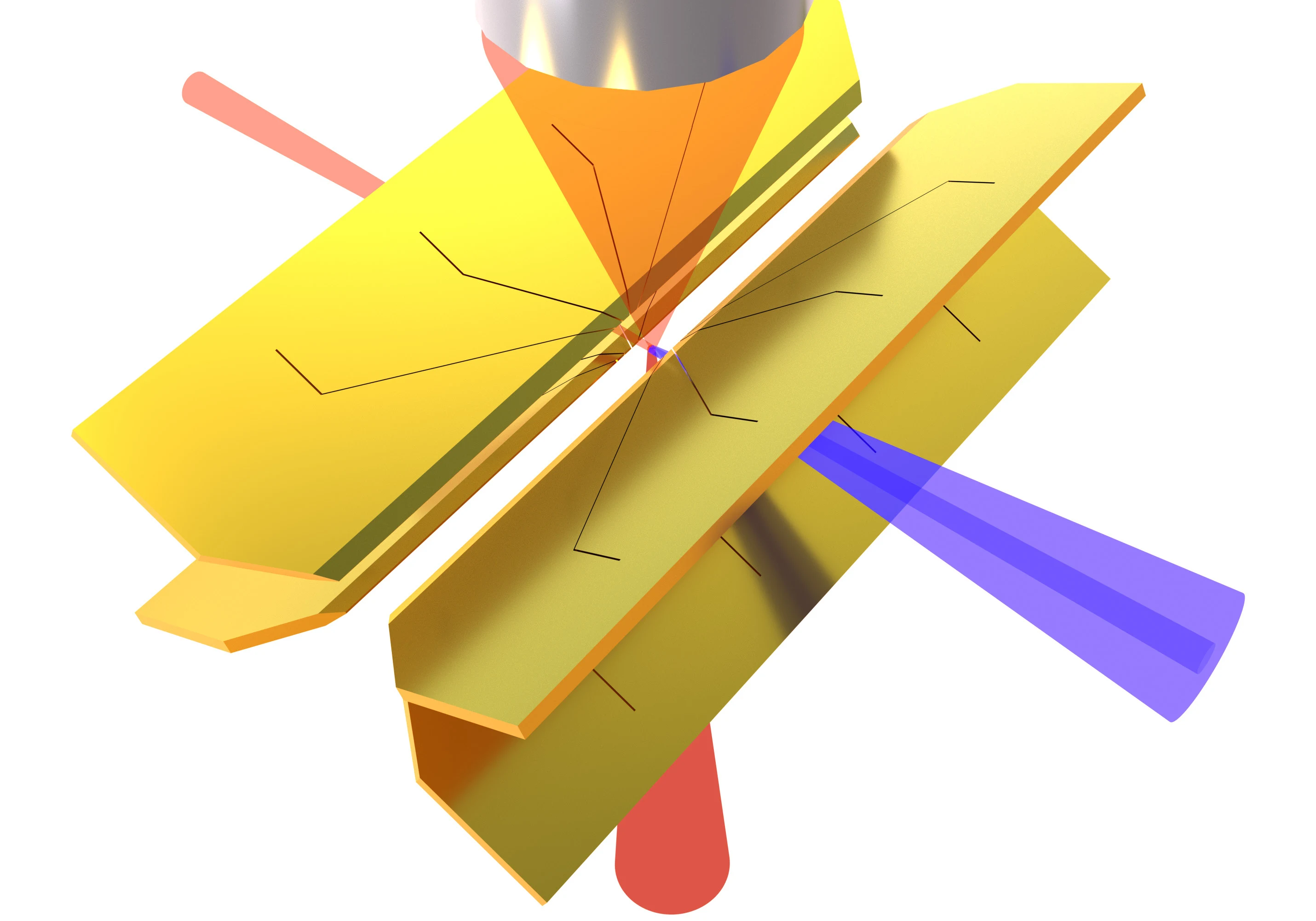
Regular quantum communication is like a postal service that sends letters strictly one at a time. If the route is long, you have to wait an indecently long time for a reply. Physicists sped up the process by dispatching ten 'postal trucks' — light pulses — into a single optical fiber, but in different time windows. In the experiment, two ions (charged atoms) in traps connected by a 1.2 km cable each received ten photons per cycle. This allowed them to create entanglement 4.59 times faster, with 95.9% accuracy.

Entanglement is quantum 'mail' without a courier: it instantly delivers information about a particle's state over any distance. Without it, a quantum internet cannot be built.

This approach is like a construction set: you can add new ion nodes, and the network will speed up, bringing us closer to secure communication and distributed computing.

🎯 Without the ten-channel trick, entangling two charged atoms over a kilometer-long fiber would take minutes — about as long as it takes to brew a cup of coffee. Now it all happens in the time it takes you to blink.

🎬 The idea of instantaneous communication via entanglement underpins the plot of Liu Cixin's novel 'Through the Stars', where the heroes attempt to communicate with deep space without delay.

Scientists
Christian DopplerD. B. McLaughlinDidier QuelozMichel MayorR. A. RossiterAlbert Einstein
Tags
speed of light photometry entropy
Laws
second law of thermodynamicsDoppler effectprinciple of constancy of the speed of lightBekenstein-Hawking entropymass–energy equivalenceMaxwell's equations
Original: arXiv:2510.20392 · CC BY 4.0 · bridge42worlds