Popular

The Moon — a Giant Gravitational Bell ⚡ экспресс

Original: "Super amplification of lunar response to gravitational waves driven by thick crust"
· Lei Zhang, Jinhai Zhang, Han Yan, Xian Chen
arXiv:2511.04067 · 2025-11-06 · CC BY · ⏱ 1 min · Exoplanets Computational Physics Geophysics
Like a bell, the Moon rings from gravitational waves, and scientists have found the spot where this ringing is heard best.
Abstract

The Moon, like a giant tuning fork, resonates with gravitational waves—ripples in spacetime. New simulations that account for topography and internal structure show that most of the surface amplifies these waves more than twofold, far exceeding previous estimates. Around the South Pole–Aitken basin, where the lunar crust is thickest, amplification can reach tens of times at a frequency of about 0.015 Hz. It's as if a faint whisper suddenly turned into a clear voice at certain spots on the Moon.

Links in the knowledge graph 1

📄 Showing the "Simple" version — "Popular" is not ready yet. Add it to favorites to help prioritize it.

The Moon is not just a rocky sphere, but a giant bell. Passing through it, gravitational waves cause it to vibrate almost imperceptibly. This tremor was predicted by Einstein, and Weber was the first to try to hear it with Earth-based detectors.

Recent modeling has revealed the secret: the varying thickness of the crust acts like an acoustic lens. In the South Pole–Aitken crater, where the crust thickens to 80 km, the signal becomes dozens of times louder — at a frequency of one oscillation per minute. It is this spacetime ripple that betrays the mergers of black holes.

Now scientists have a precise map of the Moon's most 'hearing' spots. By placing instruments there, we will be able to discern cosmic events on the other side of the Universe. And here's something astonishing: this amplifier-crater is so vast that its diameter is three times the distance from London to Moscow.

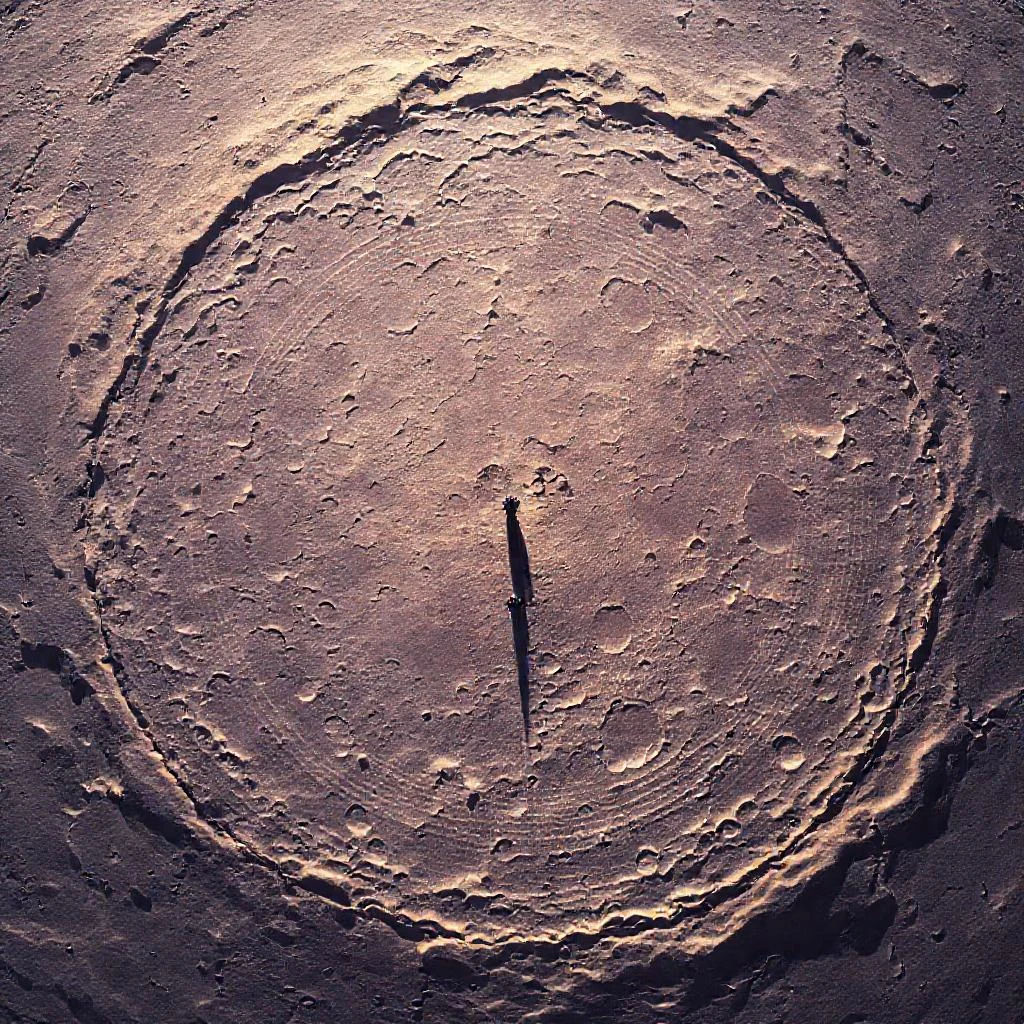
🎯 The South Pole–Aitken crater is the largest impact basin in the Solar System with a diameter of 2500 km. Its rims are higher than the Himalayas, and the crust here is thicker than anywhere else on the Moon.

Scientists
Stephen HawkingJacob BekensteinAlbert EinsteinFritz ZwickyVera RubinBernhard Riemann
Tags
gravitational waves spacetime curvature black hole
Laws
Hawking radiationgravitational lensingBekenstein-Hawking entropyEinstein field equationsequivalence principleno-hair theorem
Original: arXiv:2511.04067 · CC BY · bridge42worlds