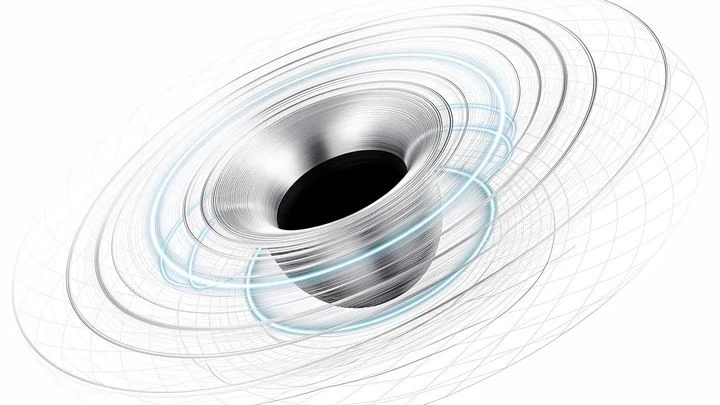
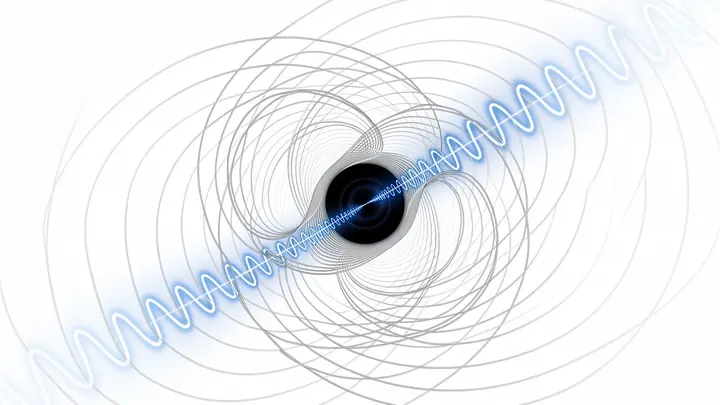
Black hole resonance refers to the phenomenon where a rotating black hole interacts with surrounding matter or fields, amplifying certain waves or creating stable 'clouds' of particles. The most famous example is superradiance: when waves of the correct frequency hit a rotating black hole, they can extract rotational energy, growing in amplitude. If the waves are massive (like a scalar field), they can become trapped in the black hole's vicinity, forming a gravitational atom-like cloud that grows over time. This resonance is a key mechanism for probing black hole properties and for explaining certain astrophysical signals.
History
The concept of superradiance was predicted by Roger Penrose in 1969 and generalized to waves by Yakov Zel'dovich in 1971. The idea of scalar clouds around black holes was developed in the 1970s and revived in the 2010s as a potential dark matter probe.
How it works
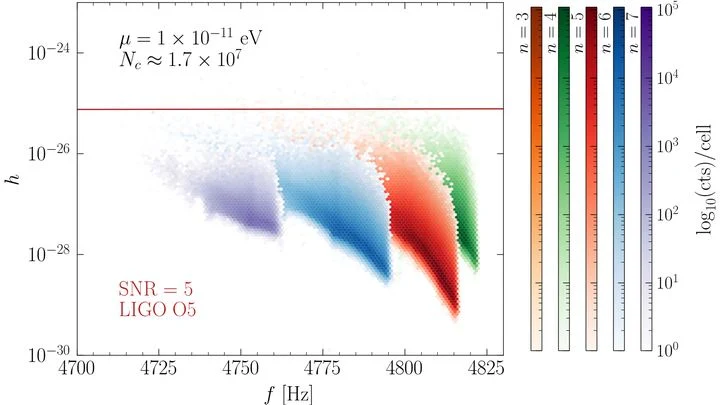
The mechanism relies on the ergosphere of a rotating black hole, where spacetime itself is dragged along the rotation. A wave entering this region can be scattered with increased energy if its frequency is lower than the black hole's angular velocity. For massive fields, the wave can be bound in a potential well created by the black hole's gravity and the field's mass, leading to repeated amplification — a 'black hole bomb' if unchecked. The growth rate depends on the field mass and the black hole's spin, and the resulting cloud emits gravitational waves, which could be detected by observatories like LIGO.
In practice
Black hole resonance is used to test the no-hair theorem, to constrain the mass of ultralight bosons (dark matter candidates), and to explain gaps in the observed mass spectrum of black holes. It also provides a mechanism for generating gravitational wave signals from otherwise quiet black holes.
Fun fact
The 'black hole bomb' — where a mirror around the black hole causes superradiant waves to grow exponentially — was proposed in 1972 and later shown to be a natural consequence of massive fields, potentially limiting the spin of astrophysical black holes.
A black hole isn't just a cosmic vacuum cleaner. If it rotates, it can amplify waves around it, much like a mountain echo repeats sound. For ultralight dark matter (particles billions of times lighter than an electron), this effect, called superradiance, can create a huge cloud.
You could send a short radio pulse toward a black hole and wait for the reflected echo. Intuitively, the shorter the signal, the better it would probe the finest details of spacetime right at the horizon: that region from which even light cannot return.
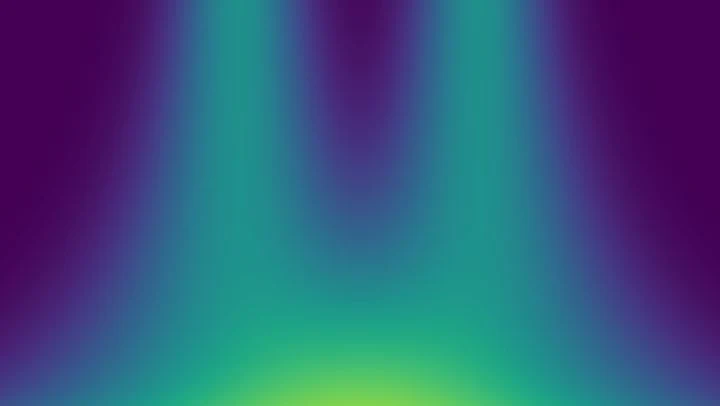
At the center of many galaxies lurks an invisible cloud — a halo of dark matter. If this matter is cold and light enough, it behaves like a superfluid: it flows without friction, and any rotation in it twists into tiny quantum vortices — threads the size of an atomic nucleus.
Imagine a river at a rapid: the current accelerates until no wave can go against the flow. So it is with gas near a black hole: reaching the speed of sound, it locks itself in — an acoustic black hole is born, a twin of the gravitational abyss. Here the event horizon is woven from a flow faster than its own sound.
If a black hole spins quickly, it can hold a cloud of ultralight particles around it, so light that their mass almost vanishes. They arrange themselves in layers, like electrons in an atom, only here gravity does the job instead of electric forces. This structure stores energy, like a coiled spring.
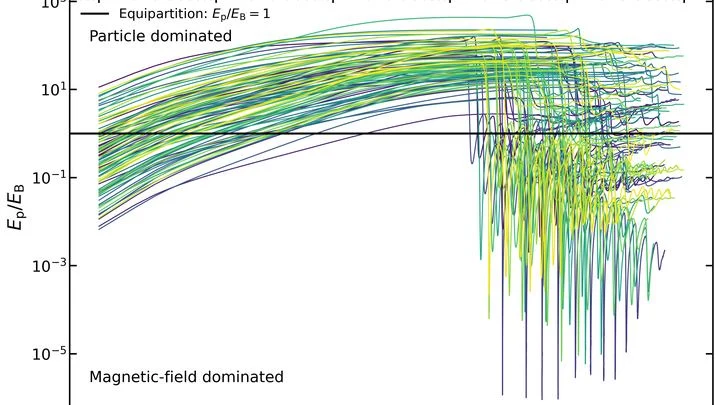
Blacksmith's bellows fan the fire by forcefully pushing out air. In space, the shock wave from a supernova, a concept introduced by Fritz Zwicky, acts like such bellows: it catches up with a giant bubble of charged particles and magnetic fields formed around a spinning neutron star…
Strike a bell, and it rings. But the sound isn't arbitrary: the bell itself picks out the notes to which its metal is tuned. It turns out a black hole behaves the same way. When something falls into it, or its spacetime gets warped, it starts to oscillate.
Einstein and Rosen imagined a bridge connecting two sheets of reality. Wheeler gave it a name — wormhole, and Thorne with Morris proved: the tunnel is traversable if you fill it with exotic matter.
A swing swings higher and higher if you push it in rhythm. A similar mechanism kicks in when a dead star orbits a massive black hole shrouded in a cloud of ultralight particles. These particles are candidates for dark matter — the invisible substance that keeps galaxies from flying apart.
The term 'wormhole'—coined for physics by John Archibald Wheeler in 1957—still teases the imagination. It's a hypothetical tunnel through curved spacetime, connecting distant regions of the Universe or even different universes.
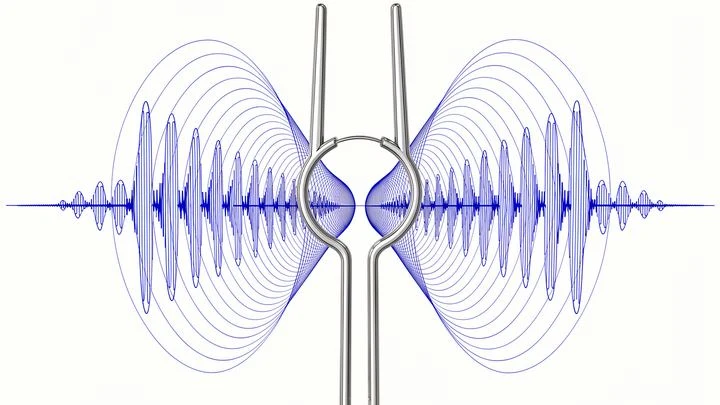
A tuning fork, once struck, makes neighboring strings vibrate. Much the same happens with a cloud of ultralight particles (also called axions) around a rapidly spinning black hole. The hole, like a motor, spins up the particles, and they begin to emit gravitational waves — a trembling of space itself.
Black holes aren't silent abysses, but nature's tuning forks. Their rapid spin, predicted by Roger Penrose, makes spacetime itself sing, producing a stream of the lightest particles — axions. These accumulate around the hole, like sound in a concert hall, and begin to oscillate in unison.
At the heart of the Milky Way spins a stellar bar — an elongated cluster, like a rotating paddle. Its gravity creates a rhythmic field around it, like waves from a speedboat.
A wormhole is a tunnel that pierces through curved space and connects distant regions of the Universe. Recently, Juan Maldacena and his colleagues proposed a working model of such a hole based on a special combination of spatial curvature and quantum particles.
The Moon is not just a rocky sphere, but a giant bell. Passing through it, gravitational waves cause it to vibrate almost imperceptibly. This tremor was predicted by Einstein, and Weber was the first to try to hear it with Earth-based detectors.