Black hole superradiance is a process by which waves—such as electromagnetic or gravitational waves—are amplified as they scatter off a rotating black hole, extracting energy from the black hole's rotation. This effect occurs in the ergosphere, a region outside the event horizon where spacetime is dragged along by the black hole's rotation. Superradiance can lead to the growth of fields around the black hole, potentially creating 'black hole bombs' if the amplified waves are trapped by a mirror-like mechanism.
History
The effect was first predicted by Roger Penrose in 1969 as a mechanism to extract energy from a rotating black hole, and later extended to wave amplification by Yakov Zel'dovich and others in the 1970s.
How it works
When a wave enters the ergosphere, it can be scattered with increased amplitude if its frequency is lower than a threshold set by the black hole's rotation rate. The wave gains energy at the expense of the black hole's rotational energy, which slows down the black hole. If the wave is confined, it can repeatedly amplify, leading to exponential growth and the formation of a 'bomb' that eventually releases energy in a burst.
In practice
Superradiance is studied as a potential source of gravitational waves and as a mechanism to probe the existence of ultralight particles, which could form clouds around black holes and produce detectable signals.
Fun fact
Superradiance is analogous to the 'rotational superradiance' in quantum mechanics, where a rotating cylinder can amplify sound waves, a phenomenon demonstrated in laboratory experiments with water waves.
The mirror races along at nearly forty thousand kilometers per second. Light that strikes it bounces back, but changed, like a ball volleyed by a racket in mid-swing. That's exactly the kind of mirror scientists have built inside an ultra-thin glass thread filled with hydrogen.
First, a powerful laser pulse is sent down the fiber.
A spinning top whirls so fast that the air around it starts to rotate in unison. A black hole behaves in much the same way: if it spins, it can transfer its energy to particles that happen to be nearby. This process is called superradiance: it's like an echo in the mountains, but instead of sound, new particles are born.
A black hole isn't just a cosmic vacuum cleaner. If it rotates, it can amplify waves around it, much like a mountain echo repeats sound. For ultralight dark matter (particles billions of times lighter than an electron), this effect, called superradiance, can create a huge cloud.
A black hole is not an absolutely black bag. In 1974, Stephen Hawking showed that it glows — faintly, but continuously. This radiation is born not inside, but outside, right at the boundary from which even light cannot escape.
A new study sharpens the picture.
A stone falls into still water — ripples spread across the surface. A black hole behaves similarly when something falls into it or when it merges with another black hole. The hole begins to oscillate, and these oscillations propagate through space as gravitational waves.
When two black holes merge far away, we receive a tremor of space — gravitational waves. Usually, they are described by Einstein's equations, but what if gravity works differently at the tiniest distances? The authors took one such hypothesis — Hořava–Lifshitz gravity.
The agony of a solitary black hole lasts forever. But in its final moments, as its mass evaporates according to the law discovered by Hawking, it manages to send a radio farewell signal. Not a quantum whisper, but a classical hum — if only there's a magnetic field nearby.
In the centers of distant galaxies, X-ray 'beacons' sometimes light up. They don't flash randomly but on a strict schedule: every few hours or days. These bursts are called quasi-periodic eruptions (repeating at nearly regular intervals).
In the first moments after the Big Bang, matter and antimatter were almost perfectly balanced. But something tipped the scales — otherwise everything would have annihilated into radiation, leaving the universe empty. One candidate for the role of "tipper" is the ultraheavy right-handed neutrino.
In the early Universe, tiny black holes could have been born — mountain-mass but atomic-nucleus-sized. Today they could serve as factories for dark matter. There are two mechanisms: the familiar evaporation (Hawking radiation) and the lesser-known superradiance.
At the center of attention is a black hole with two points of no return: the outer and inner horizons. Beyond the outer horizon, space and time swap roles, but the journey is not over. Further in, at the inner horizon, gravity has another surprise in store.
Light passes through a crumpled film — and comes out slightly altered. In much the same way, gravitational waves born in the early universe feel the lumpy distribution of galaxies and dark matter.
When a piano falls into an abyss, we think about the abyss. We don't think about the piano's cover. In much the same way, astrophysicists have for decades studied extreme close encounters between small bodies and massive black holes. They focused on the black hole itself and what orbits it. But what the 'bullet'—the small object heading toward doom — is wearing, almost no one asked.
At the heart of nearly every large galaxy lives a supermassive black hole — a silent giant around which stars, gas, and other, smaller black holes orbit. From time to time, one of these objects breaks free from its orbit and begins to fall toward the central monster in a tightening spiral.
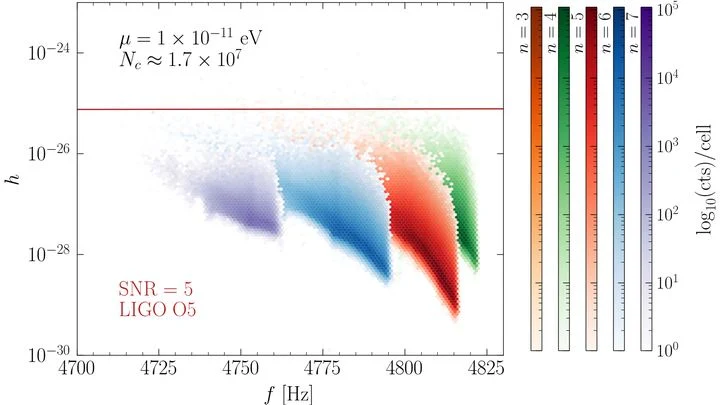
If a black hole spins quickly, it can hold a cloud of ultralight particles around it, so light that their mass almost vanishes. They arrange themselves in layers, like electrons in an atom, only here gravity does the job instead of electric forces. This structure stores energy, like a coiled spring.
Gravitational waves are ripples in the very fabric of spacetime, akin to vibrations of a giant cosmic string. Conventional detectors like LIGO and Virgo pick up low-frequency "notes"—disturbances from mergers of massive black holes of stellar masses.
Blacksmith's bellows fan the fire by forcefully pushing out air. In space, the shock wave from a supernova, a concept introduced by Fritz Zwicky, acts like such bellows: it catches up with a giant bubble of charged particles and magnetic fields formed around a spinning neutron star…
Gravitational waves — the cosmic tremors from distant cataclysms — are so faint that detecting them is like trying to hear a whisper in a hurricane. But a black hole can amplify that whisper many times over.
In the usual picture, a black hole is a featureless pit in spacetime. But if a shell of matter vibrates around it, the gap between the edge of the abyss and this shell becomes a resonant cavity.
A massive top spins so fast that space itself twists into a spiral around it. This is a black hole — only instead of wood and metal, it's made of pure gravity. Add an unusual electromagnetic field that slightly changes the rules of the game, and you get a 'deformed' black hole: its shape and behavior differ a bit from the familiar ones described half a century ago.
A swing swings higher and higher if you push it in rhythm. A similar mechanism kicks in when a dead star orbits a massive black hole shrouded in a cloud of ultralight particles. These particles are candidates for dark matter — the invisible substance that keeps galaxies from flying apart.
A pair of figure skaters spins while holding hands. If their path is a perfect circle, each push from a partner is predictable. But stretch that path into an oval, and the effort becomes uneven: a jerk as they come together, a lull as they pull apart. Something similar happens with two black holes in the final minutes before they merge.
Water flowing through a pipe can become a trap for sound. If the flow speed exceeds the speed of sound in water, then sound waves trying to go against the current can no longer escape: they are swept away, like light beyond a black hole's horizon.
A tuning fork, once struck, makes neighboring strings vibrate. Much the same happens with a cloud of ultralight particles (also called axions) around a rapidly spinning black hole. The hole, like a motor, spins up the particles, and they begin to emit gravitational waves — a trembling of space itself.
A gamma-ray burst is a brief but extremely powerful flash of light, born from the merger of neutron stars or the collapse of a massive star. Inside such a flash, plasma flows race at enormous speeds and collide with each other.
Tiny black holes, born right after the birth of the universe, are supposed to evaporate — shedding mass as invisible particles. This was predicted by Stephen Hawking, and this 'Hawking evaporation' contributed to the expansion of the young cosmos.
Black holes aren't silent abysses, but nature's tuning forks. Their rapid spin, predicted by Roger Penrose, makes spacetime itself sing, producing a stream of the lightest particles — axions. These accumulate around the hole, like sound in a concert hall, and begin to oscillate in unison.
The Big Bang was like a cosmic thunderclap that set the fabric of space vibrating. These vibrations — gravitational waves — still echo through the Universe like a fading rumble from that ancient event. The louder the initial 'bang,' the more primordial black holes should have formed.
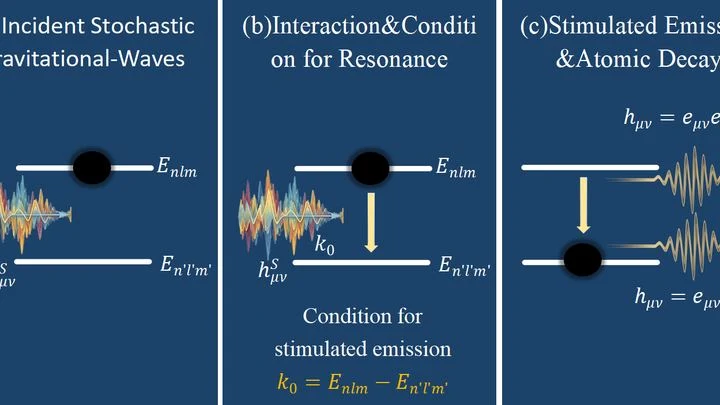
A multitude of atoms can act like a synchronized orchestra: if each emits light in unison with the rest, the flash becomes many times brighter. This is superradiance — a phenomenon well studied in the lab, but almost never sought in space. Now astrophysicists suspect that such collective 'notes' also play out in interstellar space.
Light from an ordinary lamp is chaos: photons scatter in all directions with no order. But if you make many atoms emit light simultaneously and in sync, you get a short, powerful flash, like applause that turns individual claps into a single burst. Such coordinated emission is called superradiance.
The black hole in the binary system V4641 Sagittarii behaves like a giant blender. It sucks in matter from its companion star and flings it back into space in two narrow jets. These jets slam into the surrounding gas like a water jet hitting sand, gradually carving out a huge cavity around the hole.
The Moon is not just a rocky sphere, but a giant bell. Passing through it, gravitational waves cause it to vibrate almost imperceptibly. This tremor was predicted by Einstein, and Weber was the first to try to hear it with Earth-based detectors.