Are you one of the authors of this paper? Email us from your institutional or work email address mentioning this article's arXiv ID and we'll verify you and give you edit access to this page.
Are you an author who sees something we missed or got wrong? Write to us — the subject line already carries the paper id. We read every note and correct the write-up.
Engineers built a quantum processor from 98 barium ions that makes very few errors.
📄 Showing the "Simple" version — "Advanced" is not ready yet. Add it to favorites to help prioritize it.
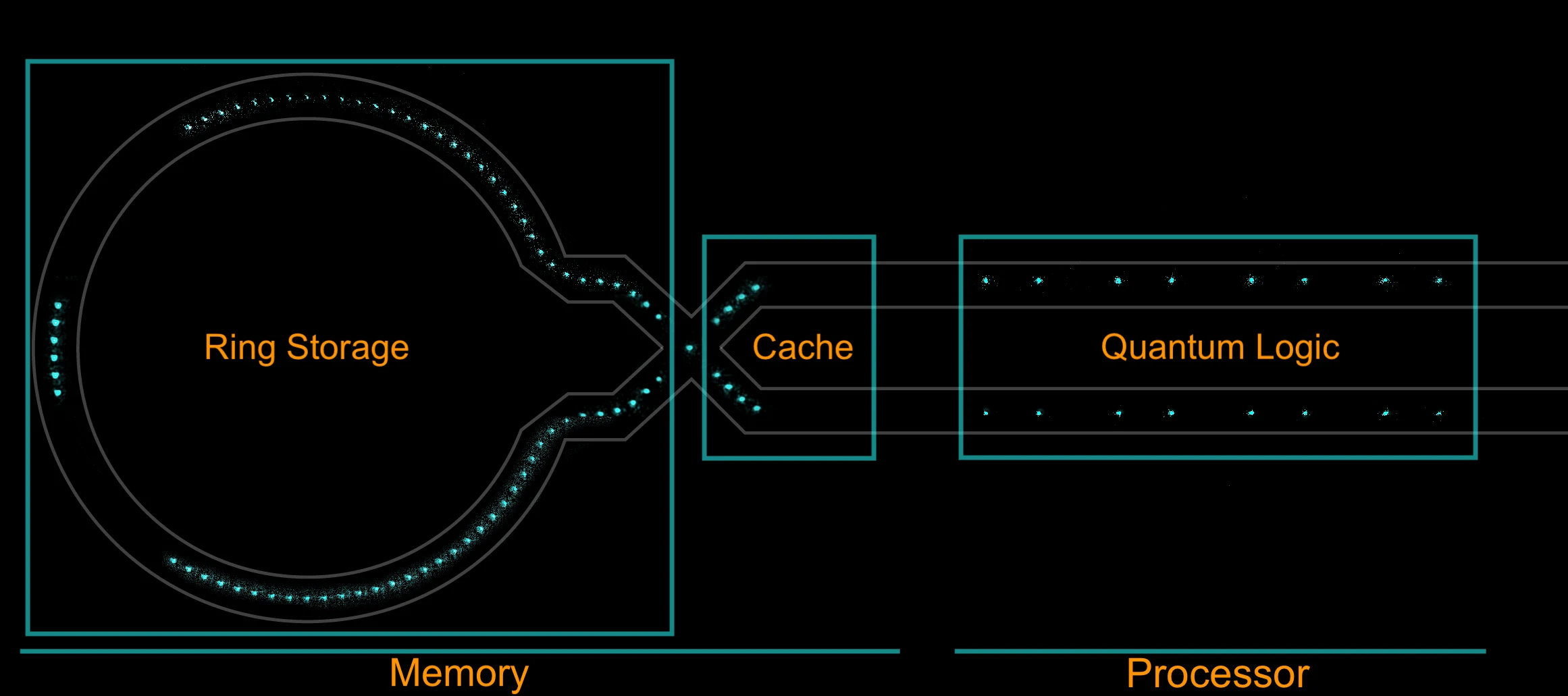
In the new Helios processor, 98 barium ions circle along a closed loop, like horses on a carousel. This architecture allows any ion to exchange data with any other, making the system flexible and powerful. Laser pulses, like a conductor's baton, issue commands at the speed of light.
The main problem of quantum computing is errors. The more complex the task, the higher the chance of failure. Helios breaks this pattern: its operations are 99.992% accurate — roughly one error per 12,500 steps. This is a record for systems of this size.
We report on Quantinuum Helios, a 98-qubit trapped-ion quantum processor based on the quantum charge-coupled device (QCCD) architecture. Helios features $$^{137}$$Ba$$^{+}$$ hyperfine qubits, all-to-all connectivity enabled by a rotatable ion storage ring connecting two quantum operation regions by a junction, speed improvements from parallelized operations, and a new software stack with real-time compilation of dynamic programs. Averaged over all operational zones in the system, we achieve average infidelities of $$2.5(1)\times10^{-5}$$ for single-qubit gates, $$7.9(2)\times10^{-4}$$ for two-qubit gates, and $$4.8(6)\times10^{-4}$$ for state preparation and measurement, none of which are fundamentally limited and likely able to be improved. These component infidelities are predictive of system-level performance in both random Clifford circuits and random circuit sampling, the latter demonstrating that Helios operates well beyond the reach of classical simulation and establishes a new frontier of fidelity and complexity for quantum computers.