New Quantum Computer Fires Up 98 Ions express
Original: "Helios: A 98-qubit trapped-ion quantum computer"
I am the author ·
Anthony Ransford ,
M. S. Allman ,
Jake Arkinstall ,
J. P. Campora III ,
Samuel F. Cooper ,
Robert D. Delaney ,
Joan M. Dreiling ,
Brian Estey ,
Caroline Figgatt ,
Alex Hall ,
Ali A. Husain ,
Akhil Isanaka ,
Colin J. Kennedy ,
Nikhil Kotibhaskar ,
Ivaylo S. Madjarov ,
Karl Mayer ,
Alistair R. Milne ,
Annie J. Park ,
Adam P. Reed ,
Riley Ancona ,
Molly P. Andersen ,
Pablo Andres-Martinez ,
Will Angenent ,
Liz Argueta ,
Benjamin Arkin ,
Leonardo Ascarrunz ,
William Baker ,
Corey Barnes ,
John Bartolotta ,
Jordan Berg ,
Ryan Besand ,
Bryce Bjork ,
Matt Blain ,
Paul Blanchard ,
Robin Blume-Kohout ,
Matt Bohn ,
Agustin Borgna ,
Daniel Y. Botamanenko ,
Robert Boutelle ,
Natalie Brown ,
Grant T. Buckingham ,
Nathaniel Q. Burdick ,
William Cody Burton ,
Varis Carey ,
Christopher J. Carron ,
Joe Chambers ,
John Children ,
Victor E. Colussi ,
Steven Crepinsek ,
Andrew Cureton ,
Joe Davies ,
Daniel Davis ,
Matthew DeCross ,
David Deen ,
Conor Delaney ,
Davide DelVento ,
B. J. DeSalvo ,
Jason Dominy ,
Ross Duncan ,
Vanya Eccles ,
Alec Edgington ,
Neal Erickson ,
Stephen Erickson ,
Christopher T. Ertsgaard ,
Bruce Evans ,
Tyler Evans ,
Maya I. Fabrikant ,
Andrew Fischer ,
Cameron Foltz ,
Michael Foss-Feig ,
David Francois ,
Brad Freyberg ,
Charles Gao ,
Robert Garay ,
Jane Garvin ,
David M. Gaudiosi ,
Christopher N. Gilbreth ,
Josh Giles ,
Erin Glynn ,
Jeff Graves ,
Azure Hansen ,
David Hayes ,
Lukas Heidemann ,
Bob Higashi ,
Tyler Hilbun ,
Jordan Hines ,
Ariana Hlavaty ,
Kyle Hoffman ,
Ian M. Hoffman ,
Craig Holliman ,
Isobel Hooper ,
Bob Horning ,
James Hostetter ,
Daniel Hothem ,
Jack Houlton ,
Jared Hout ,
Ross Hutson ,
Ryan T. Jacobs ,
Trent Jacobs ,
Melf Johannsen ,
Jacob Johansen ,
Loren Jones ,
Sydney Julian ,
Ryan Jung ,
Aidan Keay ,
Todd Klein ,
Mark Koch ,
Ryo Kondo ,
Chang Kong ,
Asa Kosto ,
Alan Lawrence ,
David Liefer ,
Michelle Lollie ,
Dominic Lucchetti ,
Nathan K. Lysne ,
Christian Lytle ,
Callum MacPherson ,
Andrew Malm ,
Spencer Mather ,
Brian Mathewson ,
Daniel Maxwell ,
Lauren McCaffrey ,
Hannah McDougall ,
Robin Mendoza ,
Michael Mills ,
Richard Morrison ,
Louis Narmour ,
Nhung Nguyen ,
Lora Nugent ,
Scott Olson ,
Daniel Ouellette ,
Jeremy Parks ,
Zach Peters ,
Jessie Petricka ,
Juan M. Pino ,
Frank Polito ,
Matthias Preidl ,
Gabriel Price ,
Timothy Proctor ,
McKinley Pugh ,
Noah Ratcliff ,
Daisy Raymondson ,
Peter Rhodes ,
Conrad Roman ,
Craig Roy ,
Ciaran Ryan-Anderson ,
Fernando Betanzo Sanchez ,
George Sangiolo ,
Tatiana Sawadski ,
Andrew Schaffer ,
Peter Schow ,
Jon Sedlacek ,
Henry Semenenko ,
Peter Shevchuk ,
Susan Shore ,
Peter Siegfried ,
Kartik Singhal ,
Seyon Sivarajah ,
Thomas Skripka ,
Lucas Sletten ,
Ben Spaun ,
R. Tucker Sprenkle ,
Paul Stoufer ,
Mariel Tader ,
Stephen F. Taylor ,
Travis H. Thompson ,
Raanan Tobey ,
Anh Tran ,
Tam Tran ,
Grahame Vittorini ,
Curtis Volin ,
Jim Walker ,
Sam White ,
Douglas Wilson ,
Quinn Wolf ,
Chester Wringe ,
Kevin Young ,
Jian Zheng ,
Kristen Zuraski ,
Charles H. Baldwin ,
Alex Chernoguzov ,
John P. Gaebler ,
Steven J. Sanders ,
Brian Neyenhuis ,
Russell Stutz ,
Justin G. Bohnet Engineers built a quantum processor from 98 barium ions that makes very few errors.
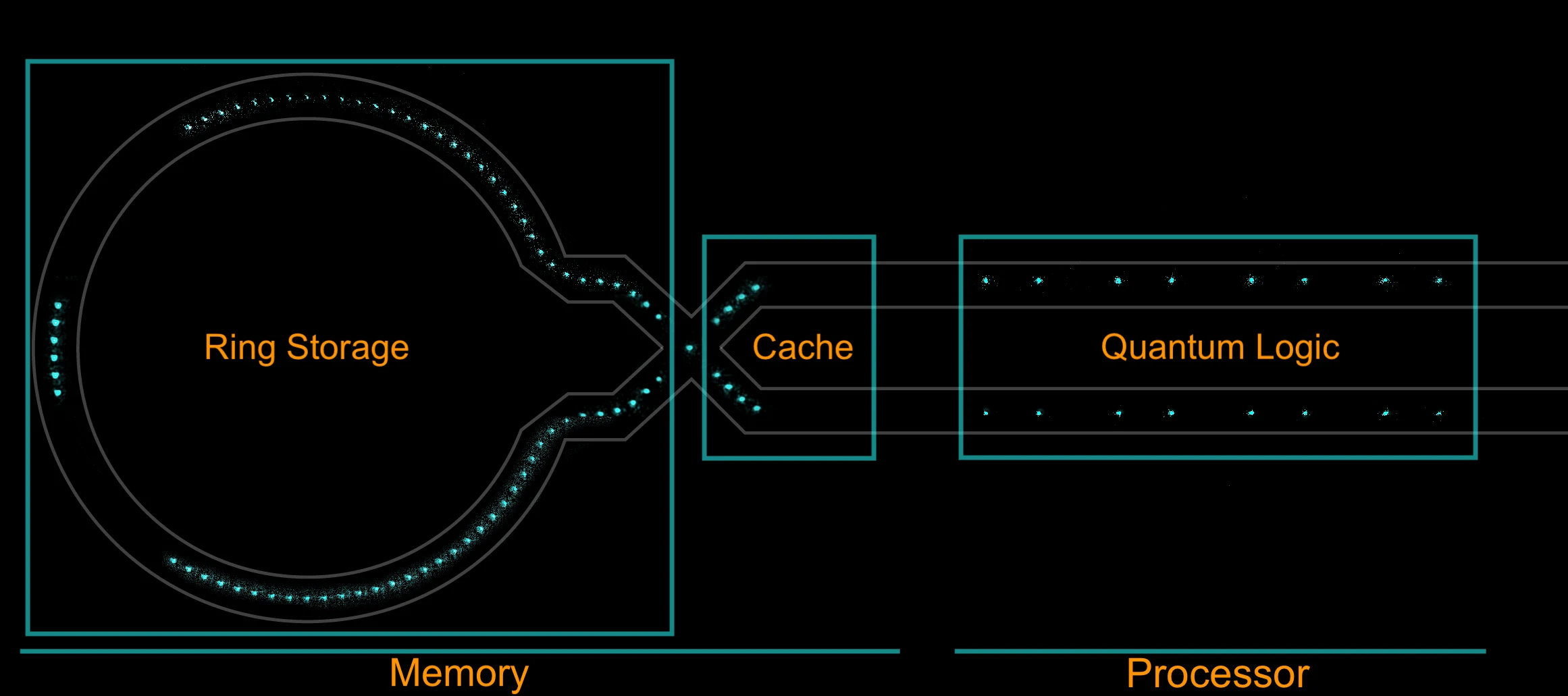
‹ › In the new Helios processor, 98 barium ions circle along a closed loop, like horses on a carousel. This architecture allows any ion to exchange data with any other, making the system flexible and powerful. Laser pulses, like a conductor 's baton, issue commands at the speed of light .
The main problem of quantum computing is
errors . The more complex the task, the higher the chance of failure.
Helios breaks this pattern: its operations are 99.992% accurate — roughly
one error per 12,500 steps . This is a record for systems of this size.
Meanwhile, the temperature in the trap is close to absolute zero — colder than interstellar space . Laser measurements check the state of each ion. Such reliability paves the way for computations unimaginable for classical supercomputers . The idea of a quantum computer was proposed by Richard Feynman , and the ion trap technology was developed by David Wineland .
Barium-137 was not chosen by chance: its energy levels are so convenient that a laser tunes them like a remote flips through TV channels.
Such a machine resembles the quantum computer from Arthur C. Clarke's novel, capable of modeling consciousness.
Reads well Too long Unclear Great A bit dry
send