Disorder as an Ally: Quantum Memory express
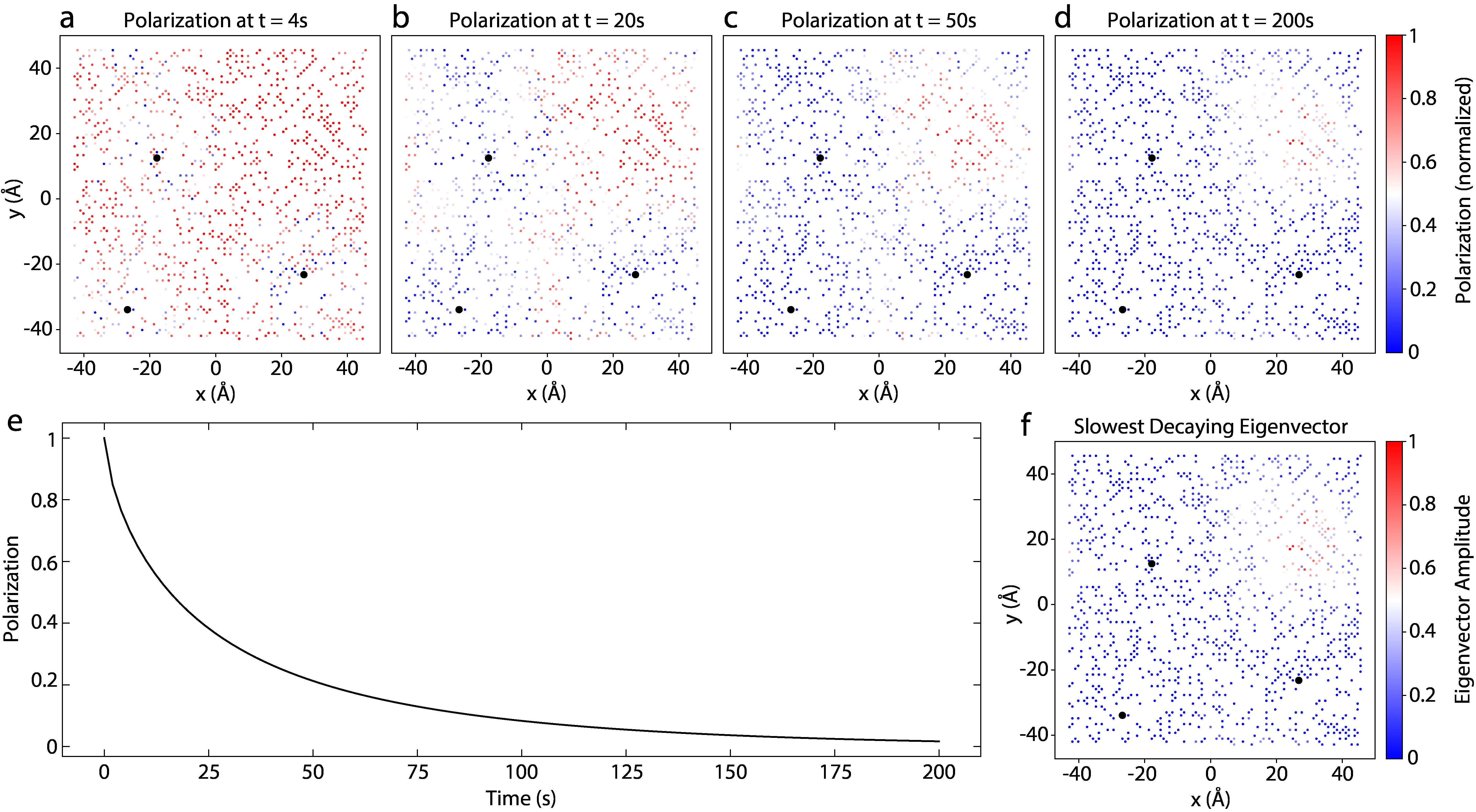
In everyday life, order saves, disorder destroys. With quantum information, it's the opposite. In diamond, electrons and carbon nuclei act like tiny magnets storing a whisper. Gossipy electrons spread it instantly; nuclei pass it along the chain slowly. But crystal imperfections create quiet dead ends where leakage can't enter: there the whisper lives hundreds of times longer.
With light pulses (optical spectroscopy), we can hush the gossip or slow the chain. The growth of entropy, the measure of chaos, usually destroys order. Yet local disorder blocks global decay. This was already pondered by Schrödinger and von Neumann. Conclusion: long-lived quantum memory requires not sterile purity but a dose of chaos.
Original abstract
as written by the authors arXiv:2511.07785
Elucidating the emergence of irreversible macroscopic laws from reversible quantum many-body dynamics is a question of broad importance across all quantum science. Many-body decoherence plays a key role in this transition, yet connecting microscopic dynamics to emergent macroscopic behavior remains challenging. Here, in a doubly disordered electron-nuclear spin network, we uncover an emergent decoherence law for nuclear polarization, $$e^{-\sqrt{R_{p}t}}e^{-R_{d}t}$$, that is robust across broad parameter regimes. We trace its microscopic origins to two interdependent decoherence channels: long-range interactions mediated by the electron network and spin transport within the nuclear network exhibiting anomalous, sub-diffusive dynamics. We demonstrate the capacity to control--and even eliminate--either channel individually through a combination of Floquet engineering and (optical) environment modulation. We find that disorder, typically viewed as detrimental, here proves protective, generating isolated electron-free clusters that localize polarization and prolong coherence lifetimes. These findings establish a microscopic framework for manipulating decoherence pathways and suggests engineered disorder as a new design principle for realizing long-lived quantum memories and sensors.
At room temperature, such quantum states decay in milliseconds, but in the described experiment, the lifetime grew hundreds of times longer thanks to isolated 'pockets' in the crystal.