Webb Spots Chemical Weather on Brown Dwarfs express
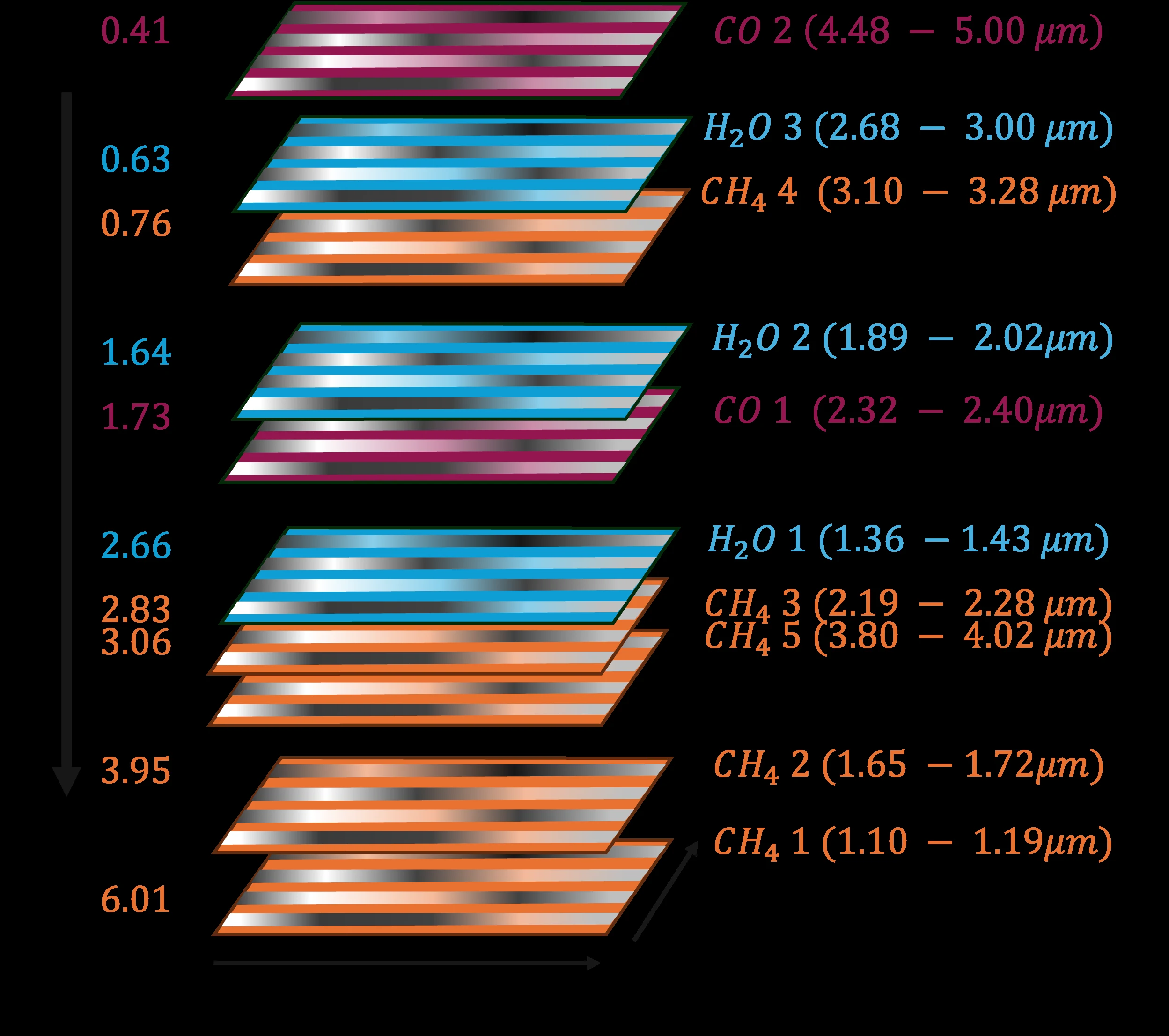
Brown dwarfs are heavier than planets but lighter than stars. Their atmospheres resemble a bubbling pot: clouds of scorching sand and iron droplets rise and fall. The Webb Telescope long monitored the pair WISE 1049AB and, breaking their light into colors, noticed a puzzle: the warmer dwarf's light from methane and carbon monoxide pulses far more strongly than from water, even though all three originate from the same depth. Clouds aren't to blame — turbulent chemical reactions rage in the depths. Like a pot where some spices float faster than others when heated, these reactions speed up and stall, rippling the glow.
Additionally, gigantic waves course through the atmosphere — exactly like those that create weather on Earth, only without oceans or land. This chemical dance could be the key to forecasting climate on distant planets.
Original abstract
as written by the authors arXiv:2511.15667
We present a new analysis of the spectroscopic variability of WISE~J104915.57$$-$$531906.1AB (WISE~1049AB, L7.5+T0.5), observed using the NIRSpec instrument onboard the James Webb Space Telescope (GO 2965 - PI: Biller). We explored the variability of the dominant molecular bands present in their 0.6--5.3~$$\mu$$m spectra (H$$_2$$O, CH$$_4$$, CO), finding that the B component exhibits a higher maximum deviation than the A component in all the wavelength ranges tested. The light curves reveal wavelength-(atmospheric depth) and possibly chemistry-dependent variability. In particular, for the A component, the variability in the light curves at the wavelengths traced by the CH$$_4$$ and CO molecular absorption features is higher than that of H$$_2$$O, even when both trace similar pressure levels. We concluded that clouds alone are unlikely to explain the increased variability of CO and CH$$_4$$ with respect to H$$_2$$O, suggesting that an additional physical mechanism is needed to explain the observed variability. This mechanism is probably due to thermochemical instabilities. Finally, we provide a visual representation of the 3D atmospheric map reconstructed for both components using the molecular band contributions at different pressure levels and the fit of planetary-scale waves.
Similar chemical waves likely rage in Jupiter's atmosphere: we just can't see them directly.