Popular

Webb Spots Chemical Weather on Brown Dwarfs ⚡ экспресс

Original: "The JWST weather report from the nearest brown dwarfs III: Heterogeneous clouds and Thermochemical instabilities as possible drivers of WISE 1049AB's spectroscopic variability"
arXiv:2511.15667 · 2025-11-19 · CC BY 4.0 · ⏱ 1 min · Stellar Exoplanets
The Webb telescope caught chemical weather behind the pulsations of a pair of brown dwarfs: their brightness varies not only due to clouds but also from churning reactions deep inside.
Abstract

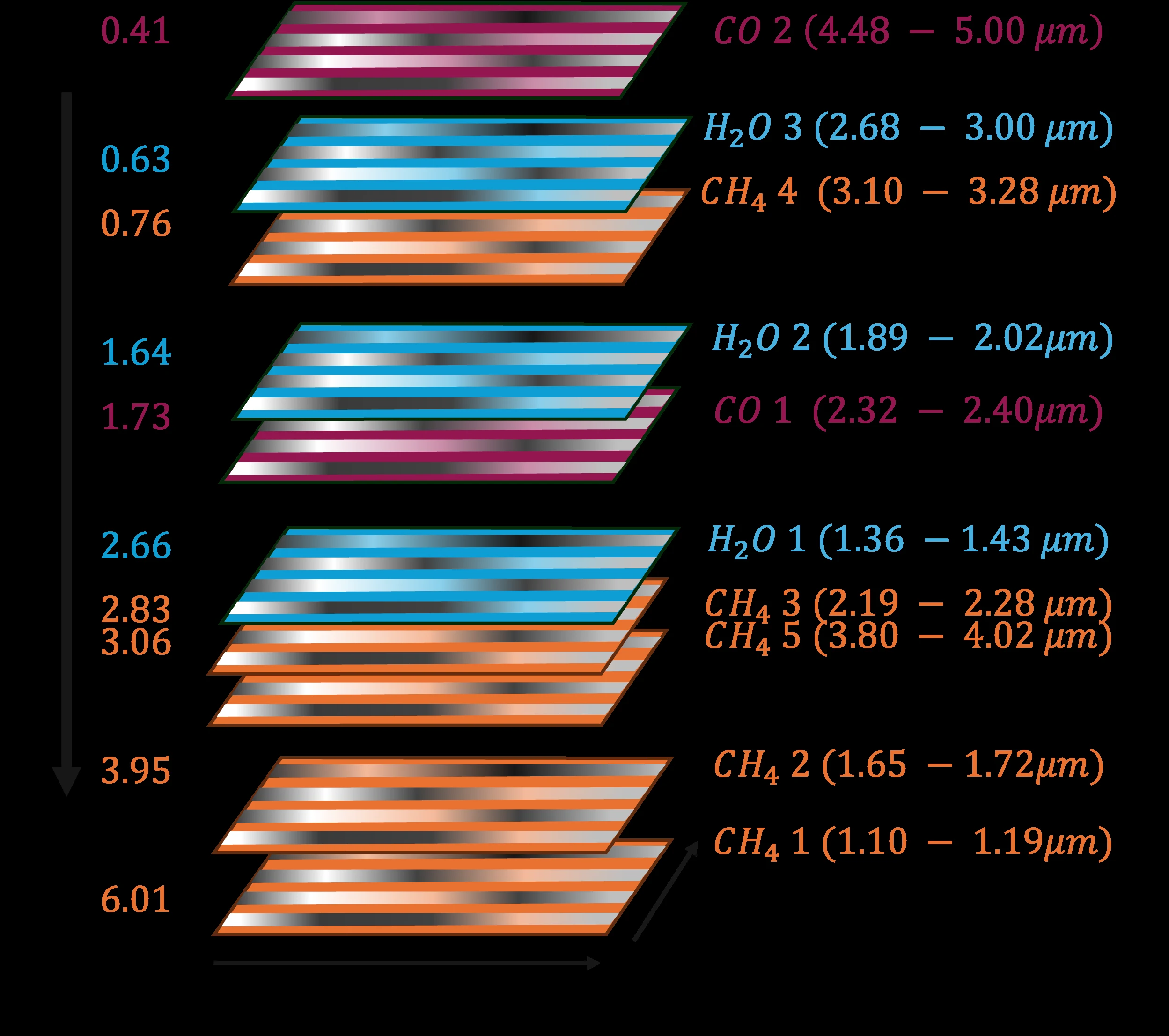
Using NIRSpec on JWST, the spectral variability of the brown dwarf pair WISE 1049AB was studied. Component B shows stronger fluctuations than A. However, for A, the variability in absorption lines of methane (CH₄) and carbon monoxide (CO) is higher than that of water vapor (H₂O), even though they form at similar atmospheric pressure levels. This points not only to clouds but also to thermochemical instabilities — uneven rates of chemical reactions. A three-dimensional map of atmospheric dynamics, accounting for planetary waves, has been visualized.

Links in the knowledge graph 1

📄 Showing the "Simple" version — "Popular" is not ready yet. Add it to favorites to help prioritize it.

Brown dwarfs are heavier than planets but lighter than stars. Their atmospheres resemble a bubbling pot: clouds of scorching sand and iron droplets rise and fall. The Webb Telescope long monitored the pair WISE 1049AB and, breaking their light into colors, noticed a puzzle: the warmer dwarf's light from methane and carbon monoxide pulses far more strongly than from water, even though all three originate from the same depth. Clouds aren't to blame—turbulent chemical reactions rage in the depths. Like a pot where some spices float faster than others when heated, these reactions speed up and stall, rippling the glow.

Additionally, gigantic waves course through the atmosphere—exactly like those that create weather on Earth, only without oceans or land. This chemical dance could be the key to forecasting climate on distant planets.

🎯 Similar chemical waves likely rage in Jupiter's atmosphere—we just can't see them directly.

Scientists
Christian DopplerD. B. McLaughlinDidier QuelozMichel MayorR. A. RossiterAlbert Einstein
Tags
spectroscopy JWST Water
Laws
Doppler effectgravitational lensingMaxwell's equationsPlanck's lawPlanck–Einstein relationWien's displacement law
Original: arXiv:2511.15667 · CC BY 4.0 · bridge42worlds