A Dancing Speck of Dust Tests the Laws of the Quantum World express
A quantum particle can be in two places at once, but large objects never are. Is it noise that creates chaos and increases entropy? Or does nature itself forbid quantum tricks in the macroworld?
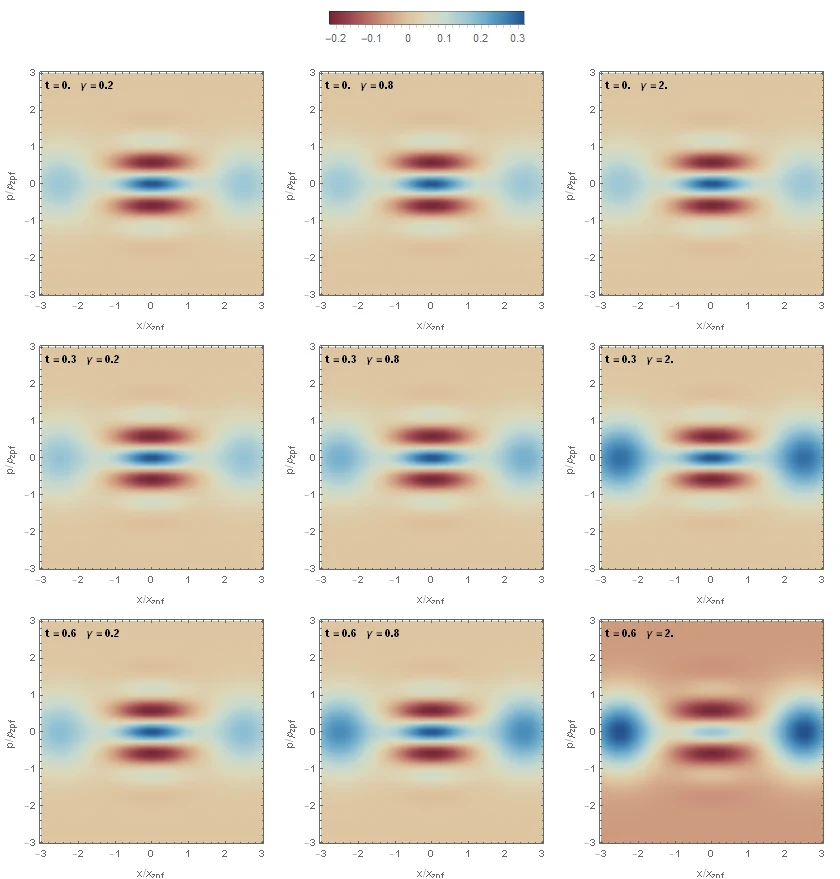
Physicists have devised an experiment: a tiny glass speck levitates in a laser beam. It is made to oscillate so that it occupies two extreme positions at once — a ghostly dance in suspension. Using techniques akin to spectroscopy — analyzing how light interacts with the particle — researchers track how fast the dance fades. All known sources of disturbance — molecular jolts, thermal jitter, pressure from the laser itself — are meticulously calculated. The experiment is so sensitive that even a single photon can throw off the rhythm, so measurements are taken in absolute darkness.
If the oscillations die down faster than expected, it would point to a new law of nature. Bell stressed that only experiment will show where the quantum world ends and the classical one begins. Detecting the effect would mean that standard quantum theory is incomplete. Otherwise, physicists will obtain the strictest bounds on these mysterious processes. As Feynman said, 'nobody really understands quantum mechanics' — but maybe the dance of the speck will open a new chapter in that understanding.
Original abstract
as written by the authors arXiv:2512.02838
The transition from the quantum to the classical realm remains one of the most profound open questions in physics. While quantum theory predicts the existence of macroscopic superpositions, their apparent absence in the everyday world is attributed either to environmental decoherence or to an intrinsic mechanism for wave-function collapse. This work presents a quantitative and experimentally grounded framework for distinguishing these possibilities. We propose a levitated optomechanical platform capable of generating controllable Schrodinger-cat states in the center of mass motion of a dielectric nanosphere. A comprehensive master equation incorporates gas collisions, black-body radiation, and photon-recoil noise, establishing a calibrated environmental baseline. The Continuous Spontaneous Localization (CSL) model is embedded within the same framework, predicting a characteristic saturation of the decoherence rate with superposition size and a quadratic scaling with mass. A Bayesian inference protocol is outlined to discriminate collapse induced excess decoherence from environmental noise. Together these elements provide a concrete experimental blueprint for a decisive test of quantum linearity, either revealing new physics beyond standard quantum mechanics or setting the most stringent bounds to date on objective-collapse parameters.
A light beam holds a particle in a vacuum like invisible tweezers. This technology is used to manipulate living cells — scientists literally sort them as if playing billiards with bacteria.