Popular

A Dancing Speck of Dust Tests the Laws of the Quantum World ⚡ экспресс

Original: "Experimental Blueprint for Distinguishing Decoherence from Objective Collapse"
· Ridha Horchani
arXiv:2512.02838 · 2025-12-02 · CC BY 4.0 · ⏱ 1 min · Quantum Physics
A tiny levitating particle will help unravel why large objects can't be in two places at once.
Abstract

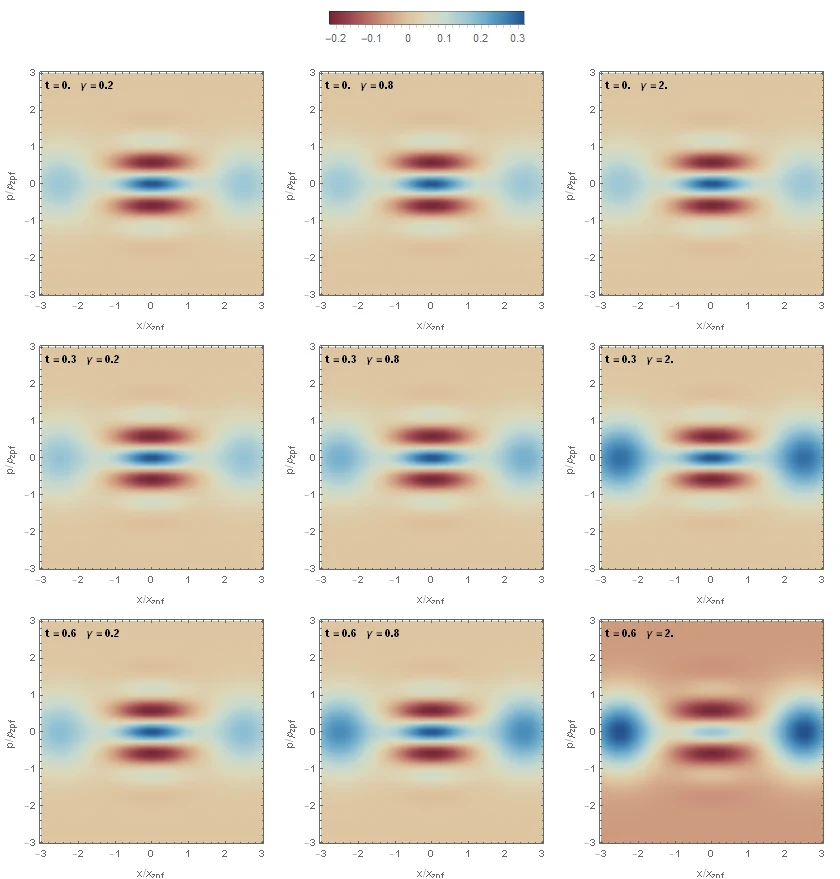
The transition from quantum superposition to classical definiteness remains a mystery. An experiment is proposed: a nanoparticle is suspended in an optical trap, and its motion is split into two states (Schrödinger's cat). All noises—gas, radiation—are carefully accounted for. A model of spontaneous collapse (CSL) is built into the theory, which predicts enhanced decoherence with mass and superposition size. Bayesian analysis will allow separating the contribution of the environment from the hypothetical collapse. A discovery would point to new physics; otherwise, they will set record constraints on collapse. It’s like using a speck of dust to check if nature plays dice.

Links in the knowledge graph 1

📄 Showing the "Simple" version — "Popular" is not ready yet. Add it to favorites to help prioritize it.

A quantum particle can be in two places at once, but large objects never are. Is it noise that creates chaos and increases entropy? Or does nature itself forbid quantum tricks in the macroworld?

One hypothesis suggests that quantum 'fuzziness' disappears on its own, and the heavier the object, the faster it goes. For a speck a hundred times thinner than a human hair, this effect is being probed for the first time.

Physicists have devised an experiment: a tiny glass speck levitates in a laser beam. It is made to oscillate so that it occupies two extreme positions at once — a ghostly dance in suspension. Using techniques akin to spectroscopy — analyzing how light interacts with the particle — researchers track how fast the dance fades. All known sources of disturbance — molecular jolts, thermal jitter, pressure from the laser itself — are meticulously calculated. The experiment is so sensitive that even a single photon can throw off the rhythm, so measurements are taken in absolute darkness.

If the oscillations die down faster than expected, it would point to a new law of nature. Bell stressed that only experiment will show where the quantum world ends and the classical one begins. Detecting the effect would mean that standard quantum theory is incomplete. Otherwise, physicists will obtain the strictest bounds on these mysterious processes. As Feynman said, 'nobody really understands quantum mechanics' — but maybe the dance of the speck will open a new chapter in that understanding.

🎯 A light beam holds a particle in a vacuum like invisible tweezers. This technology is used to manipulate living cells — scientists literally sort them as if playing billiards with bacteria.

Scientists
Christian DopplerD. B. McLaughlinDidier QuelozMichel MayorR. A. RossiterEmmy Noether
Tags
entropy spectroscopy Standard Model
Laws
second law of thermodynamicsDoppler effectNoether's theoremBekenstein-Hawking entropyMaxwell's equationsPlanck's law
Original: arXiv:2512.02838 · CC BY 4.0 · bridge42worlds