Diamond clocks without a thermometer express
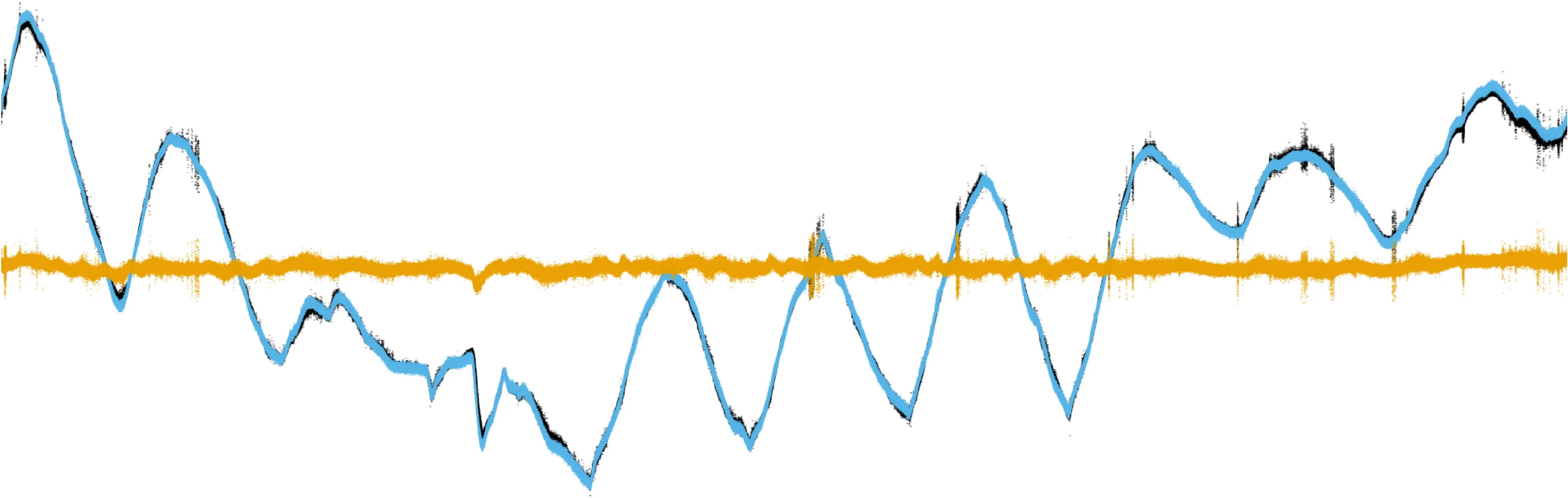
Heat an ordinary quartz watch by ten degrees, and it will start losing seconds each day. Atomic clocks are more precise, but they take up an entire cabinet. Diamond with a tiny defect, a nitrogen vacancy, promises atomic-clock accuracy in the volume of a grain of sand. One catch: this defect is highly sensitive to heat, like a tuning fork that changes pitch with air temperature.
In the new work, the defect was made to sing in two voices at once. One voice is electronic: it depends strongly on heat. The second is nuclear: it barely notices heat. If you measure both and subtract one from the other, the thermal error shrinks by a factor of two hundred. This trick resembles how sailors of old determined longitude: they compared local time with port time, and the difference gave their precise position.
Clocks made from such diamond were tested for ten consecutive days at room temperature, checked against rubidium atomic clocks. The timekeeping stability turned out better than that of any other solid-state clock of this size. And now the main enemies of accuracy are not temperature but weak magnetic fields and laser power fluctuations.
These diamond clocks will not replace large atomic standards, but they could go into smartphones, drones, and satellites where size and robustness matter. A small diamond that is not afraid of heat is a step toward having ultra-precise time always at hand.
Original abstract
as written by the authors arXiv:2601.00157
Frequency references based on solid state spins promise simplicity, compactness, robustness, multifunctionality, ease of integration, and high densities of emitters. Nitrogen-vacancy (NV) centers in diamond are a natural candidate, but the electronic zero-field splitting exhibits a large fractional temperature dependence, which has precluded its use as a stable clock transition. Here we show that this limitation can be overcome by forming a composite frequency reference that combines measurements of the electronic splitting D with the nuclear quadrupole splitting of the $$^{14}$$N nuclear spin intrinsic to the NV center. We further benchmark this composite approach against alternative strategies for mitigating temperature sensitivity. By implementing a specially designed pulse sequence with an eight-phase control scheme that suppresses pulse imperfections, we interleave measurements of D and Q in a high-density NV ensemble and demonstrate a temperature-compensated composite frequency reference. The stability of this composite diamond clock is characterized over a 10-day period at room temperature through a comparison to a Rb vapor-cell clock, yielding a fractional instability below $$5 \times 10^{-9}$$ for an averaging time of $$\tau = 200$$ s and below $$1 \times 10^{-8}$$ at $$\tau = 2 \times 10^5$$ s, corresponding to measured improvements by a factor of 4 and 200, respectively, over a clock based purely on the single frequency D for the same periods. By characterizing the residual sensitivity to magnetic fields, optical power, and radio-frequency drive amplitudes, we find that temperature is no longer the dominant source of instability. These results establish complementary electron- and nuclear-spin transitions in diamond as a viable route to thermally robust frequency metrology, providing a pathway toward compact, multifunctional solid-state clocks and quantum sensors.
The nitrogen vacancy in diamond is so sensitive that it can detect the magnetic field of a single electron from tens of nanometers away.