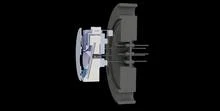
A nuclear optical clock is a proposed ultra-precise timekeeping device that uses a transition between energy levels in an atomic nucleus, rather than in the electron cloud as in conventional atomic clocks. The leading candidate for this is thorium-229, which has a uniquely low-energy nuclear transition that can be excited by laser light. Because nuclear transitions are much less sensitive to external electromagnetic fields than electron transitions, a nuclear clock could achieve stability and accuracy far beyond current atomic clocks, potentially enabling tests of fundamental physics and detection of tiny variations in physical constants.
History
The idea of a nuclear clock was proposed in the early 2000s, with thorium-229 identified as the most promising candidate due to its low-energy transition. Significant progress was made in 2024 when researchers successfully excited the thorium-229 nuclear transition with a laser, a major milestone toward building a working nuclear clock.
How it works
In a nuclear optical clock, a laser is tuned to the exact frequency of a nuclear transition, such as the 8.4 eV transition in thorium-229. The nucleus absorbs the photon and jumps to a higher energy state, and the clock counts these oscillations. The frequency of the transition is extremely stable because the nucleus is shielded by the electron cloud, making it insensitive to environmental perturbations. The challenge is to embed the thorium-229 nuclei in a suitable crystal lattice and to measure the transition frequency with high precision.
In practice
Nuclear optical clocks could be used for ultra-precise timekeeping in GPS and telecommunications, as well as for fundamental physics research, such as searching for variations in the fine-structure constant and detecting gravitational waves.
Fun fact
The thorium-229 nuclear transition is so sensitive to changes in fundamental constants that a nuclear clock could detect if the speed of light changed by just one part in 10^18 over a year.
The pendulum in these clocks doesn't swing from a spring or a weight, but from a tiny kick inside the atomic nucleus. Ordinary atomic clocks keep time by the oscillations of electrons, but here the pendulum is the nucleus itself — a dense ball of protons and neutrons.
The ticking of atomic clocks is like the beat of a metronome, but instead of a pendulum, it's the oscillation of electrons in an atom. Two such clocks — one using an ytterbium ion, the other using strontium atoms — were made to tick side by side, and their rhythms were compared.
General relativity, which describes the structure of the universe, does not forbid closed timelike curves. But Stephen Hawking put forward the 'chronology protection' conjecture: quantum effects should destroy such curves, making time travel to the past impossible.
Two pendulums on a shared string trade motion: push one, and the second starts swinging, and a moment later the first gets a push back. In a thorium-229 atom, energy flows nearly loss-free between the electron shell and the nucleus.
The world's most accurate pendulum isn't a steel rod: it's a tiny atomic nucleus. The isotope thorium-229 has a special excited state: to nudge the nucleus into it, you need surprisingly little energy — about what an ultraviolet laser delivers.
A pendulum that almost nothing can knock off balance (not shaking, not heat, not magnetic fields) because it is hidden in the very heart of the atom. That is the kind of pendulum physicists used when they first switched on a nuclear clock. Previously, the best clocks, optical ones, relied on electron transitions.
The most precise modern clocks count time by the oscillations of electrons in atoms. But their rhythm can be thrown off, like a mechanical watch's spring gets jolted by shaking. Physicists found a more reliable pendulum: the atomic nucleus.
Deep inside the atomic nucleus of thorium-229, there's a stiff lever. To flip it from one position to another, you need to apply force, and that usually takes time. This isotope has two very close energy levels, and the transition between them can be triggered by a laser pulse.
The atomic nucleus is a natural spring of colossal power. When the protons and neutrons inside it rearrange, it enters a special long-lived state — a nuclear isomer. It stores energy like a spring compressed to its limit.
In a benzene molecule, electrons buzz around the nuclei like a swarm of bees around a hive. But this swarm doesn't just hum: it pulses: every 856 attoseconds, the electron cloud completes a full oscillation cycle. The hive itself, the carbon nuclei, rocks more slowly, with a period of 36 femtoseconds.
A pendulum swings with such precision that, had it been counting seconds since the Big Bang, it would have drifted by only half a second by today. That is the stability of the new portable ultraviolet laser — the heart of aluminum atomic clocks.
In the basements of four European institutes stood seven devices: each can be compared to a tuning fork of unimaginable precision. But instead of sound, they emit 'ticks' made of light: oscillations of a laser locked to a specific frequency by atoms of strontium, ytterbium, or mercury.
The nucleus of a thorium-229 atom is like a taut guitar string: it vibrates at a strictly defined frequency. To 'pluck the string', a precise strike is needed — a laser beam of a very specific color.
A clock isn't just hands. Every atomic nucleus is a natural metronome: it oscillates with nearly perfect regularity. If you lift one such metronome a couple of meters, its rhythm speeds up ever so slightly — that's time warping, as predicted by Einstein.
A laser beam as faint as a whisper of light has stirred a thorium-229 nucleus into a higher energy state. Most nuclei demand a blast of energy, but thorium-229 has such a tiny energy gap that even this gentle nudge works.
A quantum computer holds atoms in light traps, like marbles in dimples. To read out the answer, you need to photograph each atom and determine whether it's glowing or not. Previously, analyzing such an image took so long that the computer sat idle. Now, engineers have created a specialized board that looks at the photo and instantly finds all the atoms.
In a molecule resembling chlorophyll and built from carbon, a metal atom at the center acts as a toggle. Shifting it by fractions of a nanometer can make the molecule glow, quench, or boost its brightness a hundredfold.
A customs officer can't take a suitcase apart to see what's inside. They shine X-rays through it and, from the shadows on the screen, tell: here's metal, here's organic matter. In much the same way, an inspector for future nuclear disarmament treaties should be able to check a warhead — without opening it or seeing its secret internals.
Neutrons are better suited for this than X-rays.
A tiny particle floats in a laser beam like a speck of dust in a flashlight's glow. Water molecules constantly jostle it — randomly, from all sides. Usually these bumps are a nuisance: the particle twitches, and precise measurements turn into a lottery. But physicists have figured out how to turn the interference into an advantage.
Ordinary atomic clocks tick when an electron jumps between energy levels. But external fields and jolts can disrupt this rhythm. Highly charged ions, atoms stripped of many electrons, barely notice such disturbances: their electrons sit deep and tight. That makes them ultra-stable 'pendulums.'
The Cf17+ ion is a curium atom that has lost 17 electrons.
An atomic nucleus usually lives in a single energy state, like a ball resting on the floor. But thorium-229 has a rare exception: the nucleus can get stuck on a tiny step above the floor — the so-called isomeric state. This step is so low that it can be nudged by ordinary light, not just hard radiation.
A thermometer that doesn't lie for years. Ordinary resistance thermometers, even very accurate ones, start to err over time: the material ages, contacts oxidize, and readings drift. The new quantum thermometer works differently: it uses the rubidium atoms themselves as a reference.
A laser beam passes through a glass cell containing rubidium vapor, and by how the atoms absorb light, you can determine their temperature. This is like measuring the speed of cars by the blur in a photograph: the faster the atoms move, the wider the absorption line becomes.
Every atom has its own 'voice'—the frequency of light it emits. For isotopes, atoms with different numbers of neutrons, the voices differ slightly. It's like a choir: if you know the score precisely, the slightest false note reveals external interference. The King plot is a way to compare how harmoniously two notes from different isotopes sing together.
A magnetic compass in a test tube sounds like a magic trick, but it's pure physics. In a solution of fumarate (a salt of malic acid), carbon-13 nuclei behave like tiny spinning tops.
Heat an ordinary quartz watch by ten degrees, and it will start losing seconds each day. Atomic clocks are more precise, but they take up an entire cabinet. Diamond with a tiny defect, a nitrogen vacancy, promises atomic-clock accuracy in the volume of a grain of sand.
Conventional atomic clocks are essentially optical counters: they rely on spectroscopy — a method for measuring the frequency of radiation with high precision as electrons jump between energy levels.
Measured dipole moment of tantalum-181: 3.39 × 10⁻³² e·cm — like spotting a one-atom shift across the entire Solar System. An ordinary atomic nucleus is perfectly balanced, like a spinning top. In tantalum, that balance is broken: the positive and negative charges are slightly offset from each other.
A thin film of thorium dioxide, just 10 nanometers thick, is deposited on a steel disk. A laser pulse strikes it, but instead of the expected glow, the detector catches a stream of electrons.