A Hot Quark Soup express
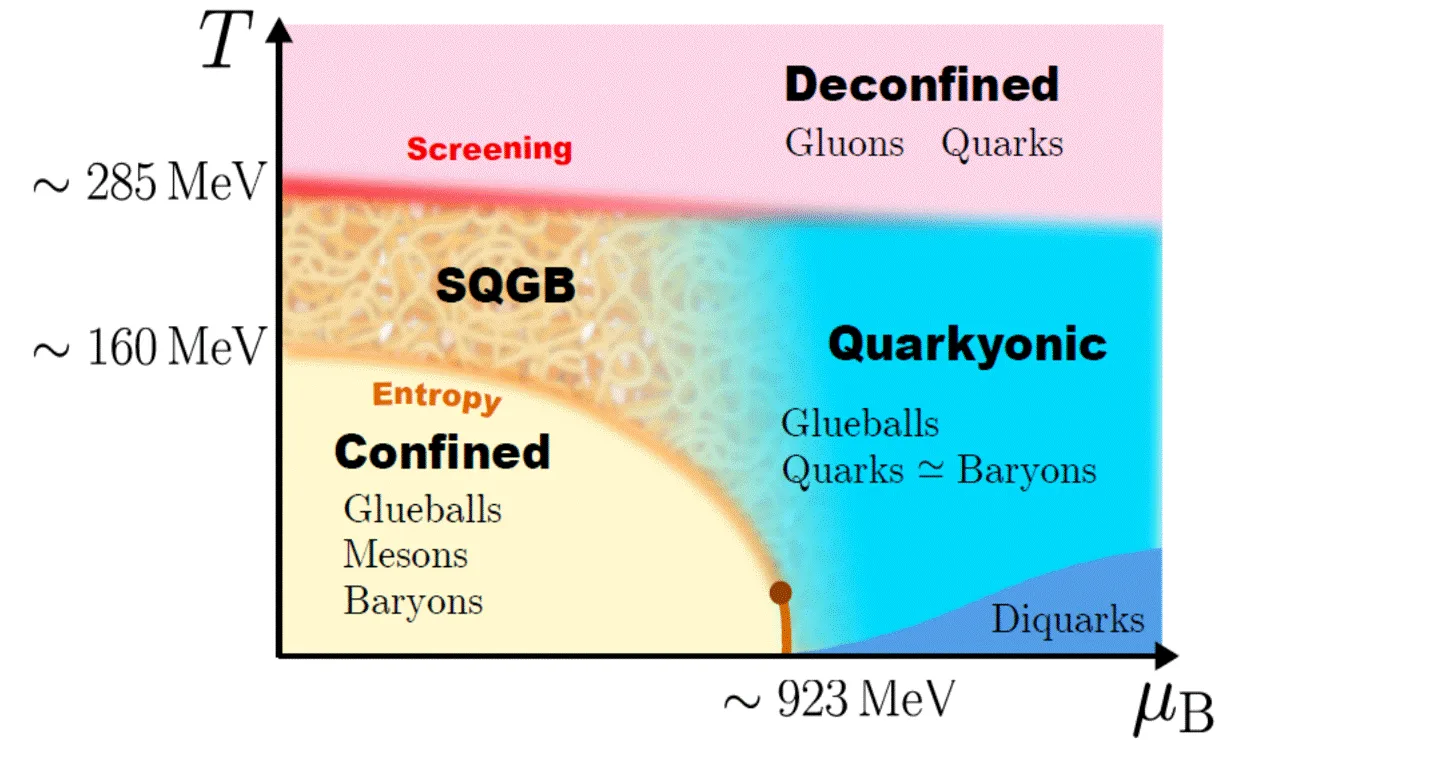
Water in a kettle heats to 100 degrees, and stops being water, turning into steam. Something similar happens to atomic nuclei when they are smashed together at enormous speeds in the Large Hadron Collider. At a high enough temperature, the protons and neutrons that make up nuclei lose their shape and break apart into free quarks and gluons — particles normally locked inside protons. This state is called quark-gluon plasma, and it is thought to be what the entire universe was in the first moments after the Big Bang.
In the new work, physicists analyzed data from collisions of protons and heavy nuclei, lead and xenon, at different energies. They measured how much energy is packed into a unit volume and the temperature of the resulting particle 'soup.' Then they calculated the ratio of energy to the fourth power of temperature. For an ordinary gas of particles, this ratio is constant, but here it behaves differently. At a temperature of about 210 million electronvolts (roughly 2.4 trillion degrees Celsius), the ratio begins to rise sharply. By 230 million electronvolts, it reaches the value predicted for an ideal gas of quarks and gluons, as if the particles suddenly stopped noticing each other and became free.
This sharp rise is a sign of a phase transition. Matter that at lower temperatures behaved like a thick liquid, strongly interacting with itself, suddenly becomes like a nearly ideal gas. It is similar to how ice, when heated, becomes water and then steam, but here the transition happens in tiny fractions of a second and on scales smaller than an atomic nucleus. For the first time, scientists have seen this transition so clearly in collider data, by comparing different types of collisions.
Understanding how quarks and gluons break free helps reconstruct the history of the early universe. A few microseconds after the Big Bang, the quark-gluon plasma cooled and 'froze' into protons and neutrons — the very building blocks that today make up stars, planets, and ourselves. Experiments at the collider allow us to glimpse this very first and hottest moment of matter's existence.
The temperature of the quark-gluon plasma in the experiment is about 100,000 times higher than the temperature at the center of the Sun, but it lasts only about $10^{-23}$ seconds.