Dark Matter Hunters: How to See the Invisible express
Dark matter is an invisible substance that holds galaxies together but emits no light. Catching its particles is like trying to hear a whisper in a noisy hall. Ordinary detectors only pick up loud impacts, while weak signals get drowned out by background noise.
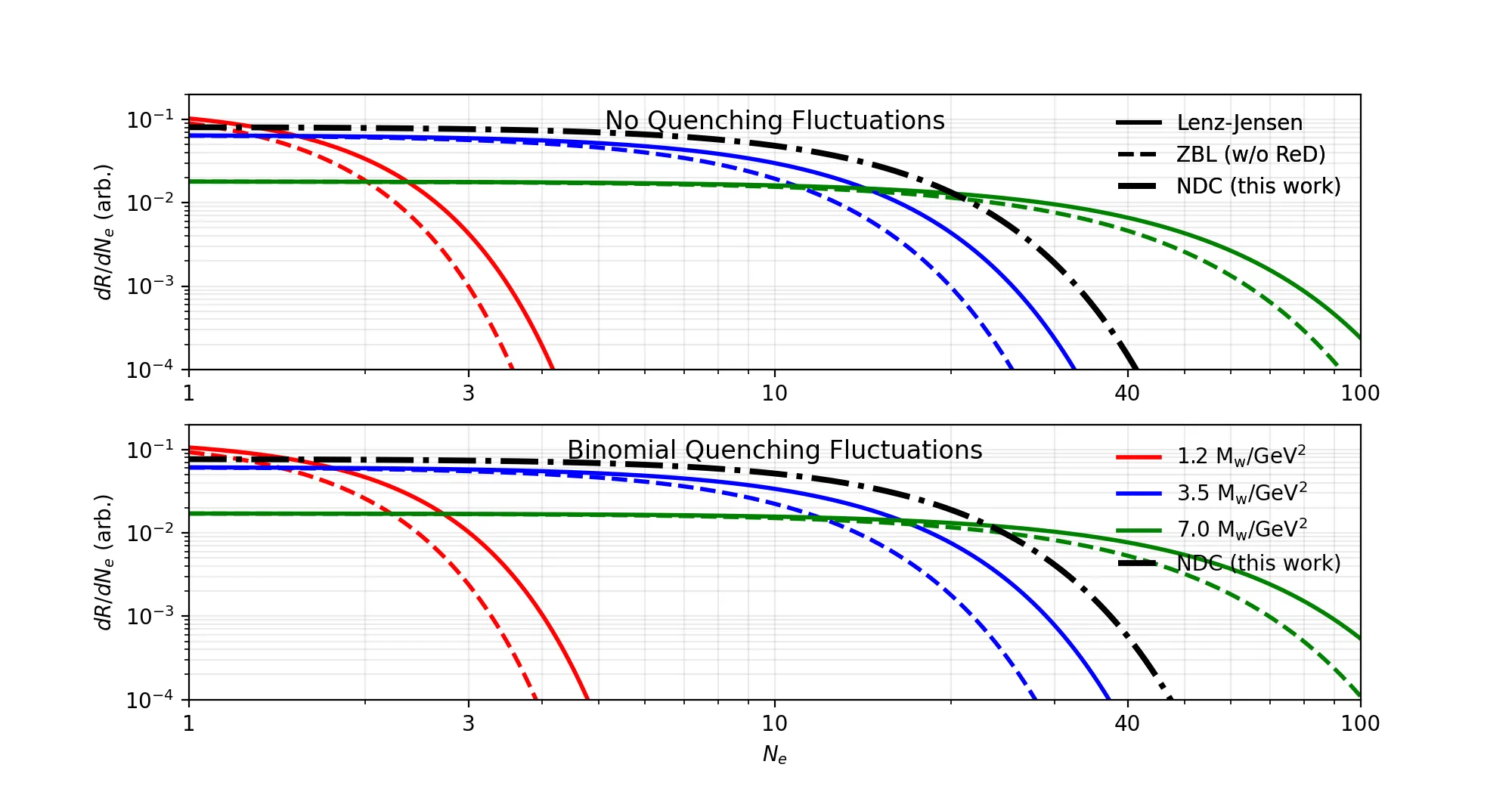
In liquid argon, a dark matter particle colliding with an atomic nucleus produces a spark of light and a cloud of charges. But for a weak nudge, the spark barely glows. Scientists added a correction to the calculations that accounts for how the electric field inside the nucleus enhances the interaction during slow collisions. It's like adjusting a microphone to pick up quiet sounds. Now the detector, equipped with silicon photomultipliers (which count every photon), can spot a nudge a thousand times fainter than before.
Another approach is a detector based on quantum bits. A quantum bit (qubit) is like an ultra-sensitive pendulum that swings with the slightest breeze. Two chips sit side by side: one senses vibrations, the other reads them out. A passing dark matter particle makes atoms in the chip jitter, and the qubit notices. Such a detector can feel an energy of 30 millielectronvolts — a billion times less than the energy needed to lift a speck of dust by a hair's breadth.
These tricks will help hunt for light dark matter particles that previously passed through detectors unnoticed. Perhaps soon we will hear their whisper for the first time.
Original abstract
as written by the authors arXiv:2601.05397
We investigate novel strategies to extend the sensitivity of dark matter direct detection experiments to energy deposits well below the thresholds of conventional detectors. In liquid-argon time-projection chambers equipped with silicon photomultipliers (SiPMs), we show that improved optical readout, combined with a nuclear dielectric constant (NDC) correction to the WIMP nucleus interaction, enhances the response to low-momentum-transfer nuclear recoils. The NDC effectively amplifies the interaction strength at small recoil energies, increasing the expected ionization and scintillation yields without modifying the high-energy behavior constrained by calibration data. When coupled to SiPM based light collection, this mechanism lowers the effective detection threshold to the subKeV regime, significantly improving sensitivity to low-mass WIMPs and other weakly interacting particles. Complementarily, we present the design and projected performance of a qubit-based detector optimized for ultra-low-energy depositions. A novel two-chip architecture is employed to minimize signal dissipation, while quantum parity measurements enable enhanced single-phonon sensitivity. Full simulations of phonon propagation and quasiparticle dynamics demonstrate that energy deposits at the level of $$\gtrsim 30 meV$$ can be detected with nearly unit efficiency and high energy resolution. This capability is expected to advance sensitivity to dark-matter scattering for masses $$m_\chi \gtrsim 0.01 MeV$$ by several orders of magnitude for both light and heavy mediators, and to enable competitive searches for axion and dark-photon absorption in the $$0.04 - 0.2 eV$$ mass range.
An energy of 30 millielectronvolts is so tiny that it would only be enough to shift a single electron by a distance of a few atoms.