Gravitational Waves from the Boiling Universe: A New Precise Method express
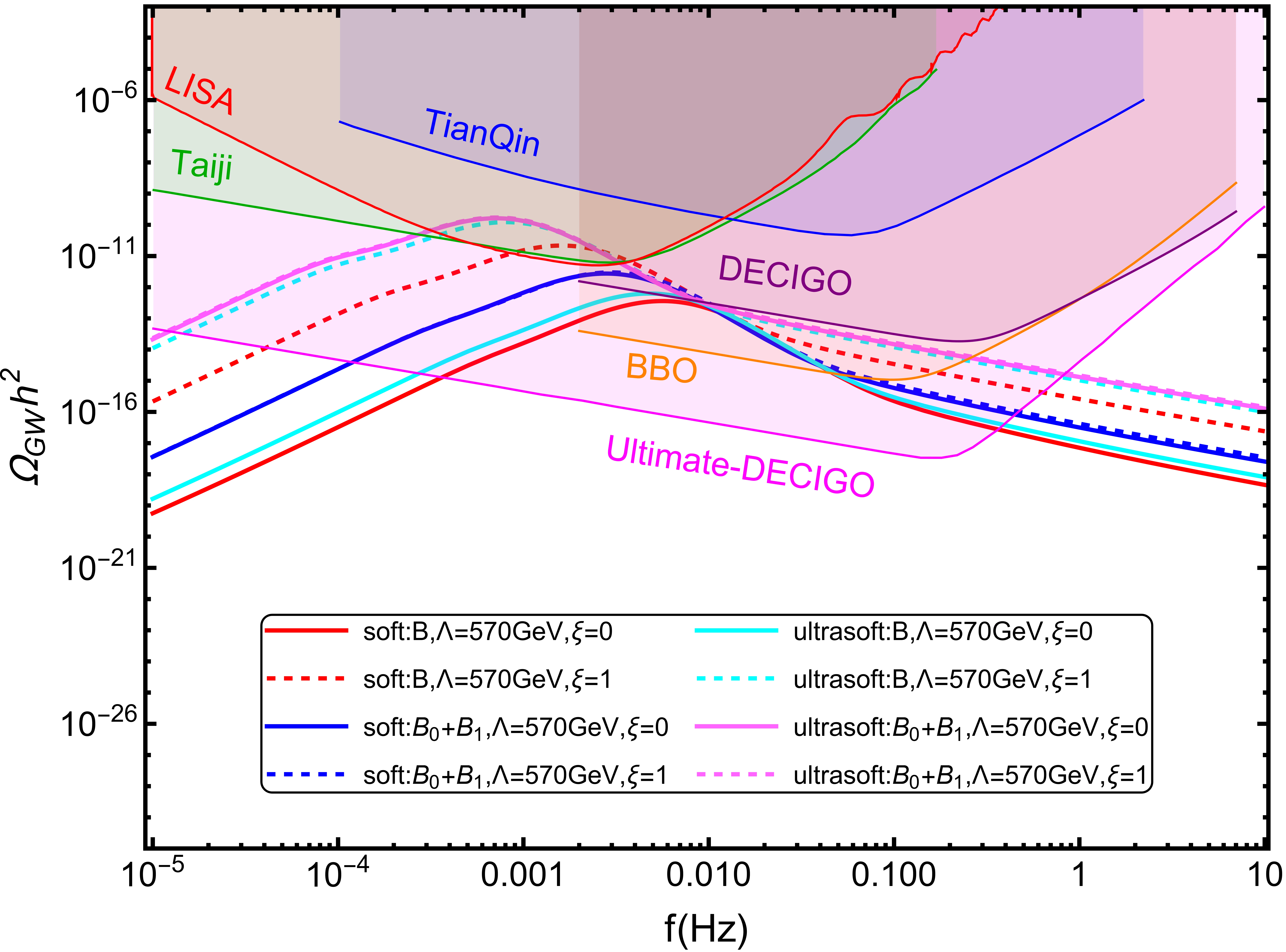
In the infant universe, right after the Big Bang, space was expanding rapidly, and the vacuum resembled a superheated liquid. When 'boiling' began, bubbles of true vacuum emerged. Expanding at the speed of light, they triggered gravitational waves — tremors of space itself that have reached us.
The problem is that old calculations of these waves depended on the choice of coordinates, like a shadow cast by a lamp. The authors applied a mathematical trick from neutrino physics — the Nielsen identity — and got rid of this ambiguity. Now, within the Standard Model of elementary particles, the birth of bubbles is described uniformly.
This method will allow a more accurate reconstruction of the cosmic boiling signal and, perhaps, let us hear the echo of creation.
Original abstract
as written by the authors arXiv:2601.05793v1
The vacuum decay in the early Universe should be gauge-invariant. In this work, we study the gauge dependence of the vacuum decay occurring through a first-order phase transition and the associated gravitational wave production. We investigate the gauge dependence of the bubble nucleation and phase transition parameters within the framework of the Standard model effective field theory in three dimension. By considering the power-counting and utilizing the Nielsen identity at finite temperature, we show that, depending on the power-counting scheme favored by the new physics scale, the perturbative computation methodology allow we get the gauge-independent nucleation rates and phase transition, this enables more accurate predictions of gravitational wave signatures.
If we imagine our Universe as a giant inflatable ball, then gravitational waves from the ancient 'boiling' are microscopic vibrations on its surface, detected by instruments sensitive to displacements thousands of times smaller than an atom.