Popular

Gravitational Waves from the Boiling Universe: A New Precise Method ⚡ экспресс

Original: "Towards Accurate Gravitational Wave Predictions: Gauge-Invariant Nucleation in the Electroweak Phase Transition"
· Jie Liu, Renhui Qin, Ligong Bian
arXiv:2601.05793v1 · 2026-01-09 · CC BY 4.0 · ⏱ 1 min · HEP Phenomenology Cosmology HEP Theory
A new method frees gravitational wave calculations from coordinate arbitrariness, bringing us closer to the echo of cosmic boiling.
Abstract

Vacuum decay via a first-order phase transition in the early Universe must be described without relying on an arbitrary gauge (choice of reference frame in the mathematical description). The study showed that using an effective field theory for the Standard Model in three dimensions and the Nielsen identity, one can obtain gauge-invariant bubble nucleation rates and transition parameters. It’s akin to how bubbles in boiling water look the same from any angle. This approach improves the accuracy of gravitational wave predictions from cosmological phase transitions, which are crucial for the search for new physics.

Links in the knowledge graph 1

📄 Showing the "Simple" version — "Popular" is not ready yet. Add it to favorites to help prioritize it.

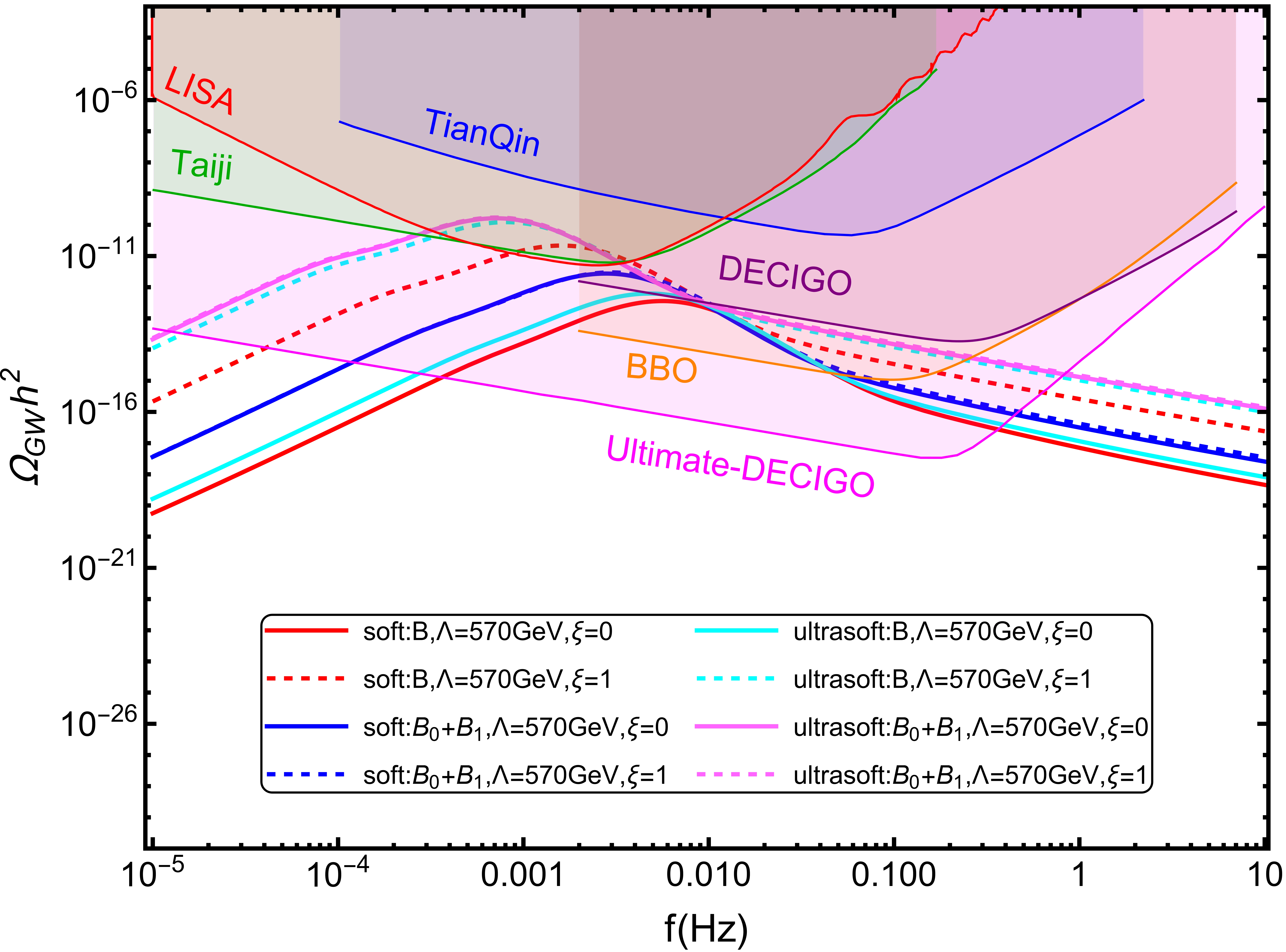
In the infant universe, right after the Big Bang, space was expanding rapidly, and the vacuum resembled a superheated liquid. When 'boiling' began, bubbles of true vacuum emerged. Expanding at the speed of light, they triggered gravitational waves — tremors of space itself that have reached us.

The problem is that old calculations of these waves depended on the choice of coordinates, like a shadow cast by a lamp. The authors applied a mathematical trick from neutrino physics — the Nielsen identity — and got rid of this ambiguity. Now, within the Standard Model of elementary particles, the birth of bubbles is described uniformly.

Curiously, our own vacuum may not be eternal. A quantum bubble of the true state could appear anywhere in the Universe, instantly reshaping its laws. The chance is tiny, but it's not zero.

This method will allow a more accurate reconstruction of the cosmic boiling signal and, perhaps, let us hear the echo of creation.

🎯 If we imagine our Universe as a giant inflatable ball, then gravitational waves from the ancient 'boiling' are microscopic vibrations on its surface, detected by instruments sensitive to displacements thousands of times smaller than an atom.

Scientists
Alan GuthAndrei LindeGeorges LemaîtreJames PeeblesAdam RiessBrian Schmidt
Tags
Standard Model gravitational waves expansion of the universe big bang
Laws
Friedmann equationsHubble's lawNoether's theoremEinstein field equationsPlanck's lawspin–statistics theorem
Original: arXiv:2601.05793v1 · CC BY 4.0 · bridge42worlds