Berry curvature is a geometric property of quantum states that describes how the phase of a wavefunction changes as the system's parameters (like momentum) are varied adiabatically. In momentum space, it acts as an effective magnetic field for electrons, influencing their motion even in the absence of a real magnetic field. This curvature is the local manifestation of the Berry phase, a global geometric phase acquired by a quantum state during a closed loop in parameter space.
History
The concept of the Berry phase was introduced by Michael Berry in 1984, building on earlier work by Pancharatnam (1956) in optics and the adiabatic theorem of Born and Fock (1928). The Berry curvature as a momentum-space field was later developed in the context of condensed matter physics.
How it works
When an electron moves through a crystal, its wavefunction acquires a phase that depends on the path taken in momentum space. The Berry curvature is the curl of the Berry connection, analogous to how a magnetic field is the curl of the vector potential. This effective magnetic field can deflect electrons, leading to phenomena like the anomalous Hall effect and the quantum Hall effect. The total Berry flux through a closed surface in momentum space is quantized, giving rise to topological invariants that classify materials.
In practice
Berry curvature is fundamental to the physics of topological insulators and Weyl semimetals, and it is exploited in spintronics and quantum computing for robust, topologically protected states.
Fun fact
The Berry curvature of a black hole's spacetime can shift the quantum phase of particles, effectively 'twisting' their wavefunctions as they pass near the event horizon.
Electrons in an ultra-clean gallium arsenide film behave like a crowd at a crossroads, where the tilt of the magnetic field sets the direction. At zero tilt, they form a compressible liquid of composite fermions, particles made of an electron and a pair of vortices.
A vortex in a magnetic material is like a whirlpool, but instead of water, the directions of magnetization twist. An electron flying through such a vortex feels not just a magnetic field, but a curvature of space: its path bends as if it were rolling down a funnel with a narrow neck.
A sheet of paper stretches rapidly in all directions. On it are drawn tiny arrow-particles, and the stretching makes them move and interact differently than they would on a stationary table. That's roughly how space behaves in an expanding universe, where curvature isn't just an abstraction but a real factor influencing the very foundations of matter.
Take two thin sheets of a semiconductor. One is saturated with free electrons, like a packed café where every table is taken. The other, by contrast, is full of empty spots—'holes' eager to be filled. When these sheets are brought close together, a spark of attraction jumps between them: electrons and holes begin to feel each other across the thin gap.
Graphene, a sheet of carbon one atom thick, behaves like a calm water surface, until superconductivity appears. Then, unusual waves ripple across it, like the circles from a thrown stone: pairs of electrons move without friction.
In a two-dimensional universe, a black hole looks like a funnel in spacetime. But the authors of the new work went further: they proposed that the space where particle momenta 'live' is also curved, like a saddle.
Cut a spin chain, and particles without an energy gap appear at the edges. They are called zero modes, and they live only at the boundary. Previously, they were counted using complex topological invariants, but now there is a simpler way.
For a long time, the event horizon behaved like a cosmic dictator: everything that crossed its boundary vanished irretrievably from our Universe. But quantum mechanics, like a dissident's voice, whispered: information cannot simply disappear.
Crystals fascinate us with their perfect spatial order: atoms frozen at lattice points, like beads on an invisible string. But what if the same symmetry unfolds in time? Time crystals are systems that, without any external cue, start repeating their states cyclically — clocks wound by nature itself. Inside this tireless rhythm, disorder seems to have no place.
A superfluid flows without friction, like water that never stops. But when you spin it, it doesn't just rotate: each tiny vortex remembers exactly how it was spun. This 'trace' is not a metaphor but a real geometric imprint, which physicists call the Berry phase (the phase acquired by a wave as it travels along a closed path).
Some materials are internally like a Möbius strip: their electronic states are twisted in a special way. Such topological properties are usually manipulated with a powerful magnetic field, as if trying to flatten the strip with a sledgehammer. A group of researchers has found a more delicate tool.
Toss a handful of phosphorus into silicon, and at a certain impurity concentration the material suddenly starts conducting electricity. This is a metal-insulator phase transition, and it happens abruptly. But what exactly changes in the electron wave functions when an insulator becomes a metal?
A translator works in two worlds at once: to an outside observer, they are silent and unobtrusive, but inside their mind, a flurry of activity unfolds along clear lines of meaning. Altermagnets, a recently discovered class of magnetic materials, are much the same.
Gravity is the curvature of spacetime, not just an attraction, as Einstein showed. On such a curved "dance floor", even the hypothetical carriers of gravity — gravitons — move oddly.
A translator gets distracted by every rustle in the hall, and a one-hour meeting stretches into two. That's roughly how ordinary quantum mechanics works: a particle evolves in time, while space serves as the stage. But what if we swapped their roles? Then the particle 'moves' through space, and time becomes a static backdrop.
If you carry a cup of coffee slowly and steadily around a room and then return to the same spot, nothing happens to the drink. But in the quantum world, things are different: a particle that makes such a loop comes back not quite the same. It picks up an elusive 'extra'—the geometric phase, which physicists call the Berry phase.
Sunlight hits a silicon wafer, and a current flows in the circuit. That's the familiar work of a solar cell: light knocks out electrons, and a p–n junction (the boundary between two layers with different conductivities) forces them to move in one direction. But in some crystals, current arises differently — without any junctions, purely from the material's internal structure.
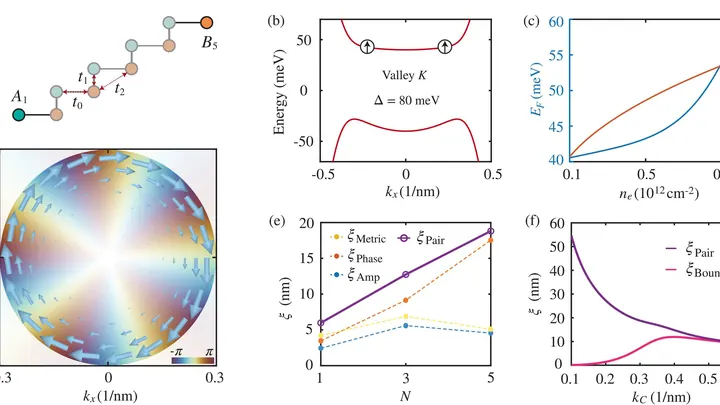
In a superconductor, electrons pair up like dancers holding hands. Usually, the distance between them, the pair size, depends on how fast they move and how strongly they are bound. But sometimes the dance floor almost disappears, and there's nowhere to move. This happens in materials with flat electronic bands: electrons nearly freeze, and the usual rules stop working.
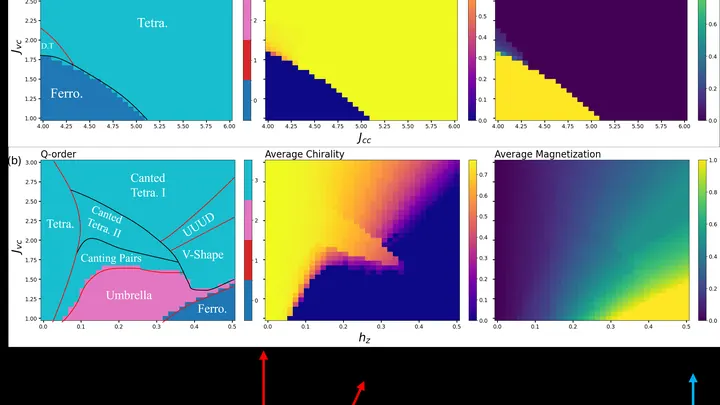
Imagine a triangular grid with tiny magnetic arrows at each node. Electrons, the charge carriers, run across this grid. Usually, the arrows align simply: all pointing the same way (ferromagnet) or alternating in the plane.
A conventional antenna array is like a choir: many voices singing in unison, with the sound amplified in only one direction. To catch a signal from another side, you have to rearrange the whole choir. Now imagine a single voice that can change its timbre so that the sound itself focuses in the desired direction.
A laser beam inside a special crystal spontaneously turns into a “Schrödinger’s cat”—a mixture of two states. Erwin Schrödinger dreamed up this paradox for an atom, but now physicists see it happen with an entire stream of photons.
Light is like a company of soldiers on a parade ground.
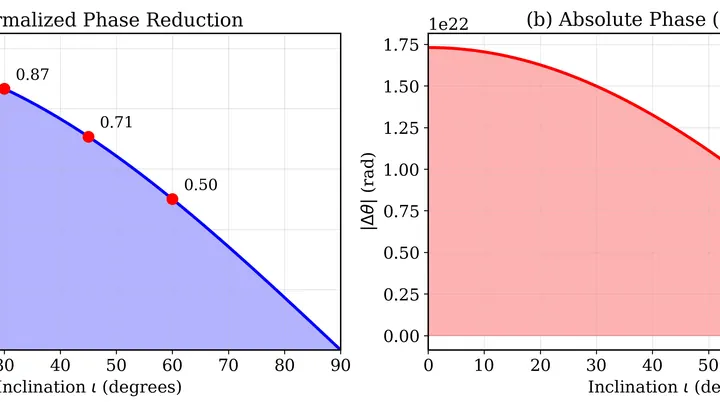
A spinning black hole drags spacetime with it, like a spoon swirling thick honey. This vortex is a manifestation of curved spacetime. But the key point: it can change the quantum rhythm of matter, even where there are no forces.
A chain of red phosphorus atoms is like a train where the cars are atoms and the couplers are chemical bonds. Sometimes the couplers are stronger, sometimes weaker, and that affects how electrons run through the train.
An electron inside a crystal is like a traveler walking through a city with winding streets. Its direction of motion constantly changes depending on where it is. Physicists call this feature the geometric Berry phase, and it determines how a material conducts electricity or responds to a magnetic field.
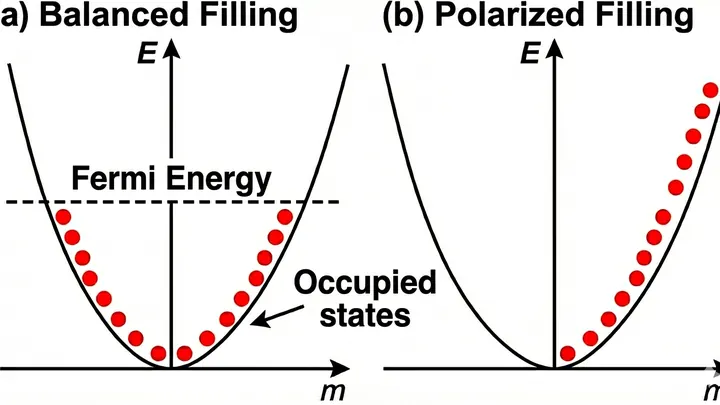
Electrons in a conductor behave like a crowd on an escalator: each one moves on its own, but together they create a flow. If you make them circle around a ring, their angular momentum (a measure of rotation) can couple to a magnetic field, like gears in a clock.
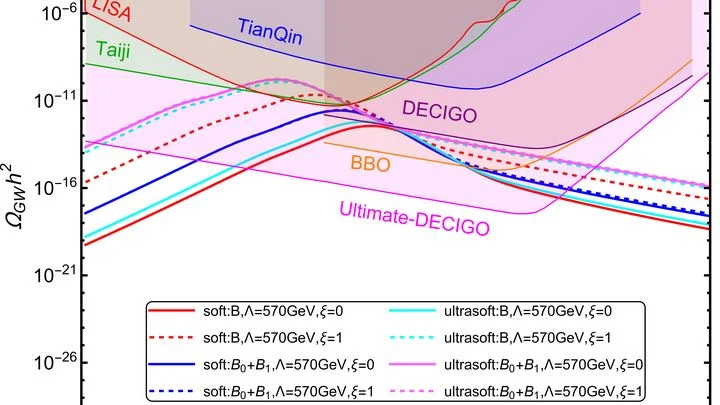
In the infant universe, right after the Big Bang, space was expanding rapidly, and the vacuum resembled a superheated liquid. When 'boiling' began, bubbles of true vacuum emerged. Expanding at the speed of light, they triggered gravitational waves — tremors of space itself that have reached us.
According to the laws of the microworld, an electron obeying the Dirac equation trembles even at complete rest. This is Zitterbewegung — an oscillation with an amplitude of trillionths of a millimeter, like a spinning top on an invisible axis.
Two translators listen to the same symphony. One hears only the fundamental tone: a clean, predictable melody. The other catches the overtones that color every note.