How Giant Planets Kept Their Rapid Spin express
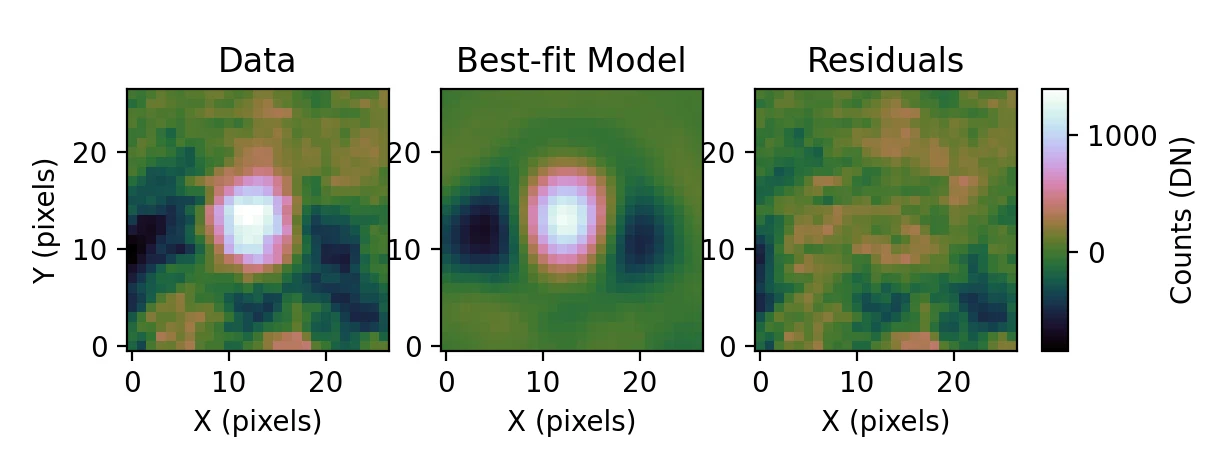
Using the Keck telescope and spectroscopy (light analysis that reveals rotation speed), astronomers measured 32 objects: from giant planets to brown dwarfs — bodies heavier than planets but lighter than stars that never ignited.
Giant planets spin almost at the breakup limit: their gaseous cocoon at birth barely braked them, like ice under a spinning top. Brown dwarfs, however, lost spin quickly: their disk acted like sand. What's more, dwarfs bound to stars braked more than solitary ones; planets spin equally regardless of companionship.
Surprise: objects with masses 5–40 Jupiters kept more spin than heavier ones (40–100 Jupiters). It seems that during formation, crossing some threshold triggers strong braking. Jupiter with its 10-hour day is just a modest example: many giant planets spin even faster, teetering on the edge of self-destruction.
Original abstract
as written by the authors arXiv:2601.05976v3
We present a rotational velocity (vsini) survey of 32 stellar/substellar objects and giant planets using Keck/KPIC high-resolution spectroscopy, including 6 giant planets (2-7 M$$_\mathrm{Jup}$$) and 25 substellar/stellar companions (12-88 M$$_\mathrm{Jup}$$). Adding companions with spin measurements from the literature, we construct a curated spin sample for 43 benchmark stellar/substellar companions and giant planets and 54 free-floating brown dwarfs and planetary mass objects. We compare their spins, parameterized as fractional breakup velocities at 10 Myr, assuming constant angular momentum evolution. We find the first clear evidence that giant planets exhibit distinct spins versus low-mass brown dwarf companions (10 to 40 M$$_\mathrm{Jup}$$) at 4-4.5 $$\sigma$$ significance assuming inclinations aligned with their orbits, while under randomly oriented inclinations the significance is at 1.6-2.1 $$\sigma$$. Our findings hold when considering various assumptions about planets, and the mass ratio below 0.8% gives a clean cut for rotation between giant planets and brown dwarf companions. The higher fractional breakup velocities of planets can be interpreted as less angular momentum loss through circumplanetary disk braking during the planet formation phase. Brown dwarf companions exhibit evidence of slower rotation compared to isolated brown dwarfs, while planets and planetary mass objects show similar spins. Finally, our analysis of specific angular momentum versus age of 221 stellar/substellar objects below 0.1 M$$_{\odot}$$ with spin measurements in the literature indicates that the substellar objects of 5-40 M$$_\mathrm{Jup}$$ retain much higher angular momenta compared to stellar and substellar objects of 40-100 M$$_\mathrm{Jup}$$ after 10 Myr, when their initial angular momenta were set.
A day on Jupiter lasts only 10 hours — faster than any other planet in the Solar System.