Star Duet Spawns Ripples in Spacetime express
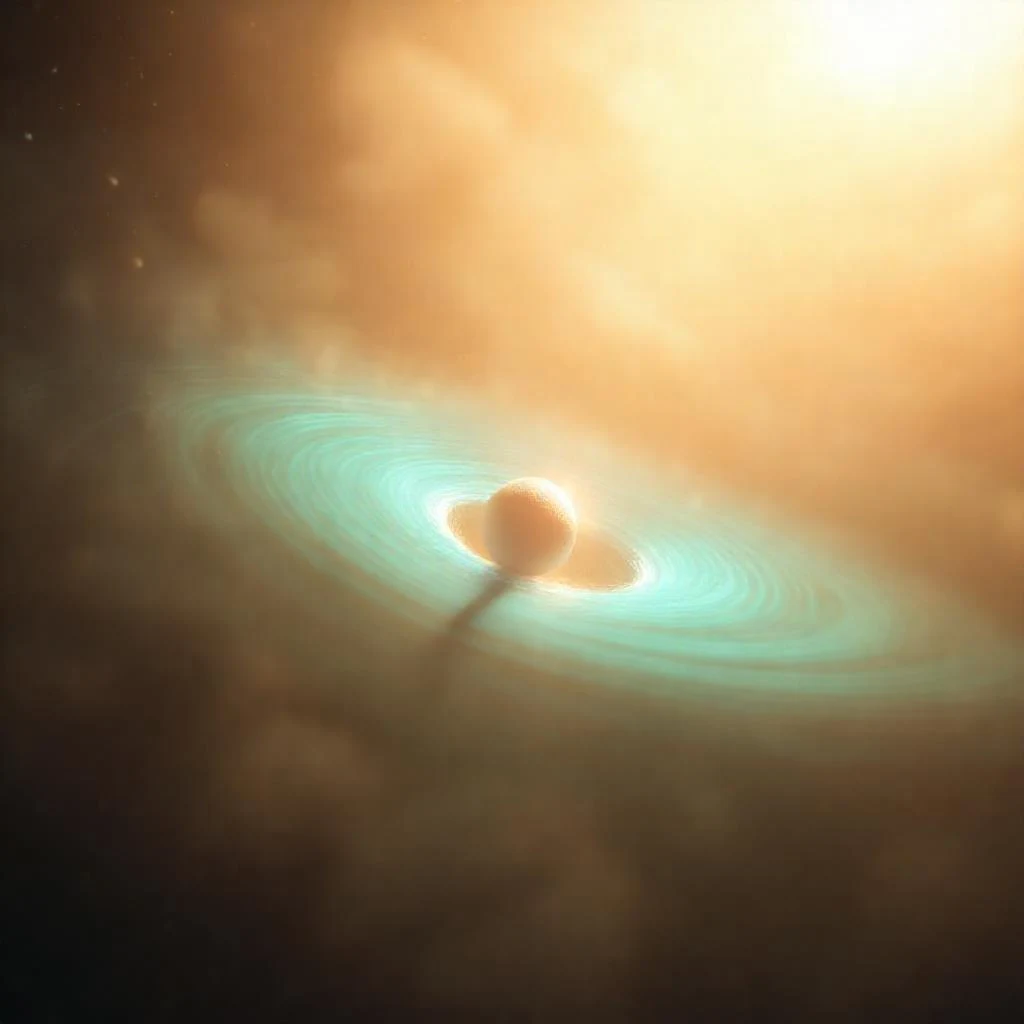
Astronomers have found a pair of stars whose dance speeds up each year. These are white dwarfs — cooled-down remnants of suns the size of Earth. One dancer steals helium from its partner, swirling it into a sparkling ribbon. Their orbit shrinks, and gravitational waves ripple into space — like circles on water.
Every 8.6 minutes, the stars stage mini-eclipses, taking turns blocking each other. Precise brightness measurements showed: once a year, the orbit shortens by a millionth of a second. Over a decade of observations, light analysis confirmed that the disk around the star is helium. The energy carried away by waves outshines dozens of suns.
In millions of years, this duet will merge into a single star — a neutron star or even a black hole. The future LISA detector will hear the final chords of their dance in just four years of observation, as Kip Thorne predicted.
Original abstract
as written by the authors arXiv:2601.07925v4
We report the discovery of ATLAS J101342.5-451656.8 (hereafter ATLAS J1013-4516), an 8.56 minute orbital period mass transferring AM Canum Venaticorum binary with mean Gaia magnitude G=19.51. The system was identified via periodic variability in Asteroid Terrestrial-impact Last Alert System light curves of Gaia white dwarf candidates. Follow-up spectroscopy with the Large Lenslet Array Magellan Spectrograph reveals a helium dominated accretion disk, while high speed ULTRACAM photometry shows pronounced primary and secondary eclipses. We construct a decade long orbital timing baseline using ATLAS and Gaia survey photometry together with high speed observations from ULTRACAM on the NTT and proto Lightspeed on the Magellan Clay telescope. From this baseline we measure an orbital period derivative Pdot = -1.60 +/- 0.07 x 10^-12 seconds per second. Interpreted in the context of stable mass transfer, the magnitude and sign of Pdot indicate orbital evolution governed by the interplay between gravitational wave driven angular momentum losses and mass transfer, directly probing the donor star structural response to mass loss. Assuming angular momentum loss dominated by gravitational radiation, we constrain the component masses and infer the characteristic gravitational wave strain. We predict a four year Laser Interferometer Space Antenna signal to noise ratio greater than 10, establishing ATLAS J1013-4516 as a strong prospective space based gravitational wave source that probes long term orbital evolution in the mass transferring regime.
If an observer were a hundred kilometers from this system, they would see darkness fall every 8.5 minutes — one star briefly hides the other.