A Stellar Duet and the Gravitational Ripples of Spacetime express
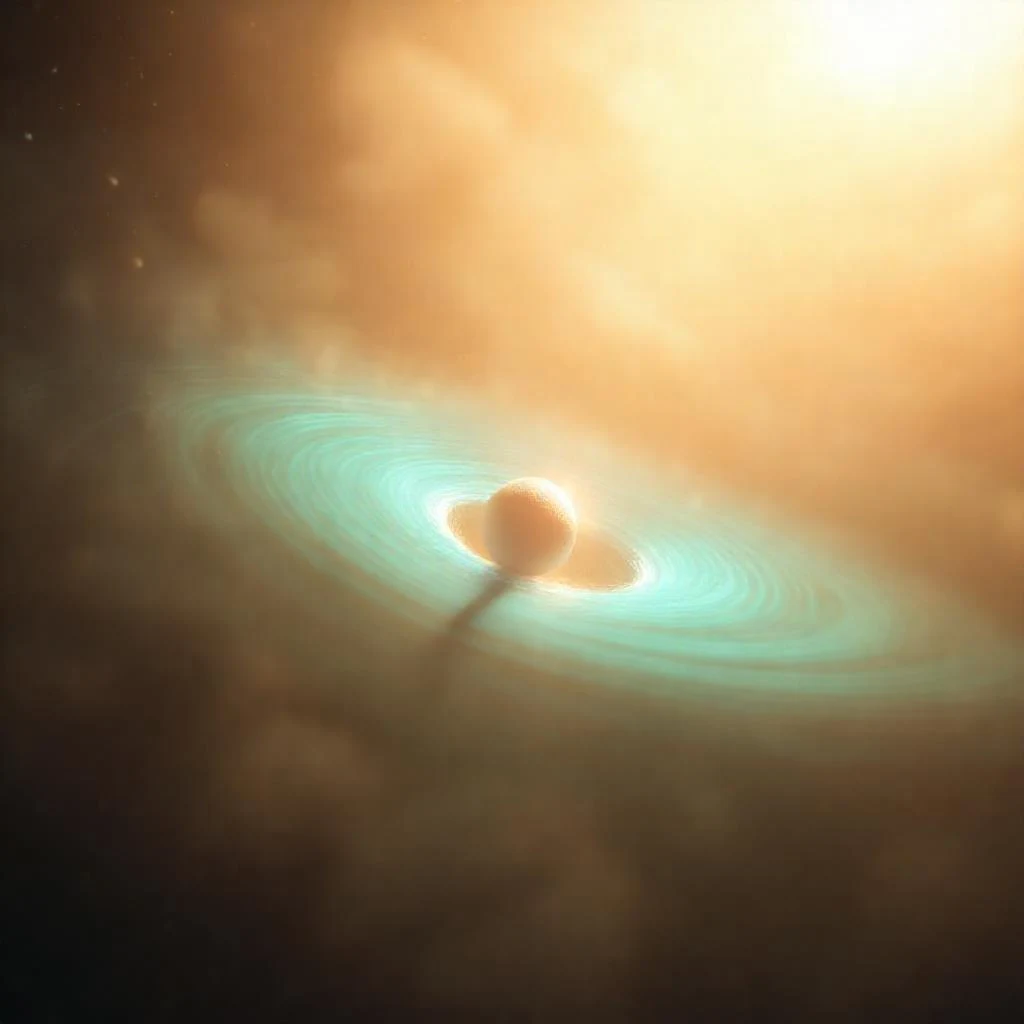
Astronomers have discovered a close pair of stars whose orbital dance is speeding up year after year. These are white dwarfs — superdense, cooled remnants of stars, roughly the size of Earth, where matter is compressed to a degenerate state. One of them, the more massive, is pulling helium from its companion, swirling the stolen material into a glowing accretion disk — a kind of stellar scarf wrapped around the predator. As mass transfers, the pair's orbit shrinks, and the excess energy is carried away as gravitational waves — ripples in the very fabric of spacetime, much like the rings spreading across water when a stone is tossed in.
The system shows regular mini-eclipses: every 8.6 minutes, one star blocks the other from Earth's view. Using high-precision photometry — continuous brightness measurements — scientists have recorded that the orbital period is shrinking by a millionth of a second per year. This tiny acceleration, accumulated over a decade, became the key to the puzzle. In parallel, spectroscopic analysis — splitting light into its component wavelengths — confirmed that the disk material is indeed helium: the spectral lines of this element unambiguously indicate its presence. The energy escaping with gravitational waves is colossal — it exceeds the combined luminosity of dozens of suns, yet remains invisible to ordinary telescopes.
In millions of years, when the orbit finally collapses, the duo will merge into a single compact object. Depending on the total mass, this could be a neutron star — an even denser body where matter consists mostly of neutrons — or even a black hole, a region of spacetime whose gravity does not even let light escape. The future space-based detector LISA, sensitive to low-frequency gravitational waves, will be able to catch the final chords of this dance in just four years of observations, as predicted by Kip Thorne, one of the pioneers of gravitational-wave astronomy.
If an observer were a hundred kilometers from this system, they would see darkness fall every 8.5 minutes — one star briefly hiding the other.