Simple

Star Duet Spawns Ripples in Spacetime ⚡ экспресс

Original: "An eclipsing 8.56 minute orbital period mass-transferring binary"
arXiv:2601.07925v4 · 2026-01-12 · CC BY 4.0 · ⏱ 1 min · Stellar
Astronomers have discovered a cosmic duet whose accelerating dance shakes the fabric of space.
Abstract

Astronomers found a pair of dead stars whirling around each other in just 8.5 minutes — faster than you can read this sentence. One star steals matter from the other, their orbit shrinks, and spacetime ripples are born, like rings from a stone dropped in water. A space detector will soon hear this ringing. Imagine: a distant bell tolling the tale of dying stars.

Links in the knowledge graph 1

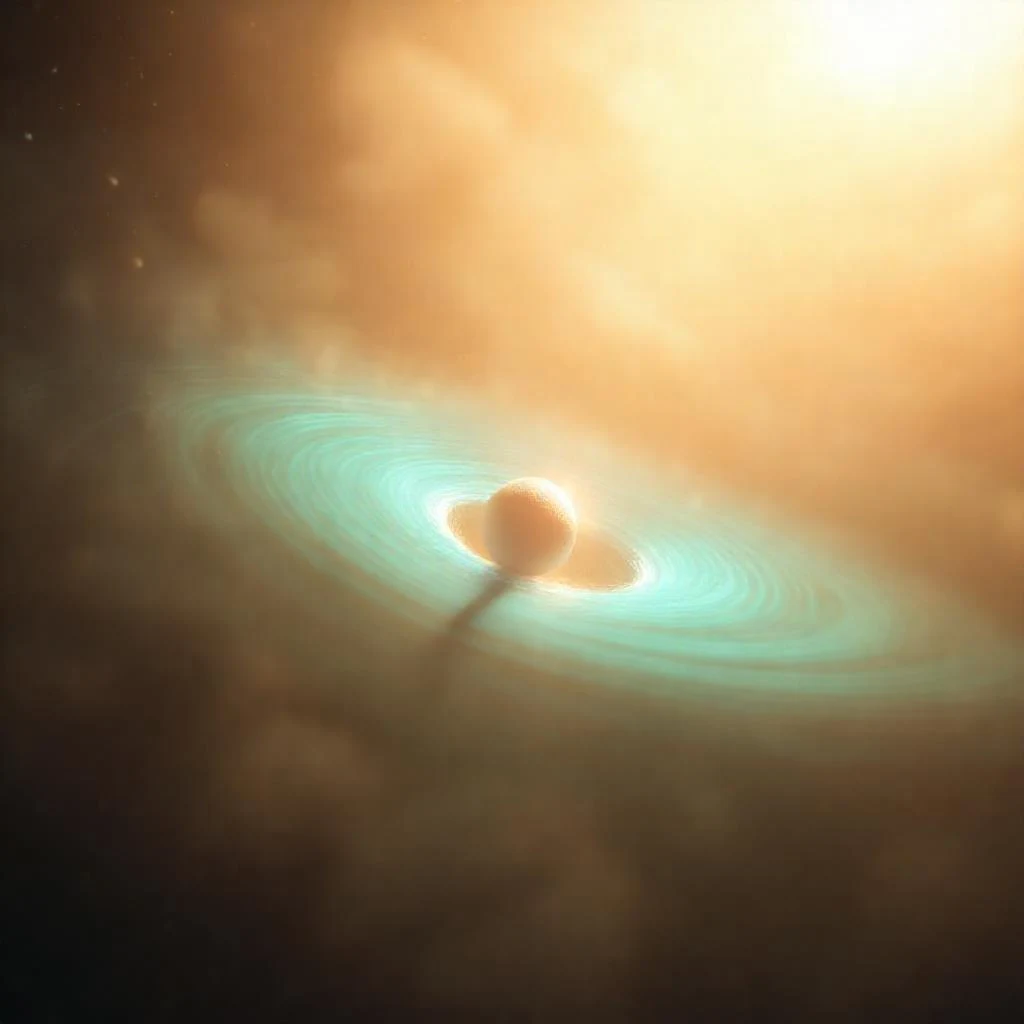
Astronomers have found a pair of stars whose dance speeds up each year. These are white dwarfs — cooled-down remnants of suns the size of Earth. One dancer steals helium from its partner, swirling it into a sparkling ribbon. Their orbit shrinks, and gravitational waves ripple into space — like circles on water.

Every 8.6 minutes, the stars stage mini-eclipses, taking turns blocking each other. Precise brightness measurements showed: once a year, the orbit shortens by a millionth of a second. Over a decade of observations, light analysis confirmed that the disk around the star is helium. The energy carried away by waves outshines dozens of suns.

In millions of years, this duet will merge into a single star — a neutron star or even a black hole. The future LISA detector will hear the final chords of their dance in just four years of observation, as Kip Thorne predicted.

🎯 If an observer were a hundred kilometers from this system, they would see darkness fall every 8.5 minutes — one star briefly hides the other.

\dot{P} = -1.6 \times 10^{-12} \, \text{s/s}
Each second, the orbital period shrinks by 1.6 trillionths of a second.
Scientists
Christian DopplerD. B. McLaughlinDidier QuelozMichel MayorR. A. RossiterBernhard Riemann
Tags
gravitational waves helium spectroscopy photometry
Laws
Doppler effectEinstein field equationsMaxwell's equationsPlanck's lawPlanck–Einstein relationWien's displacement law
Original: arXiv:2601.07925v4 · CC BY 4.0 · bridge42worlds