Bubbles Trapped in Ice express
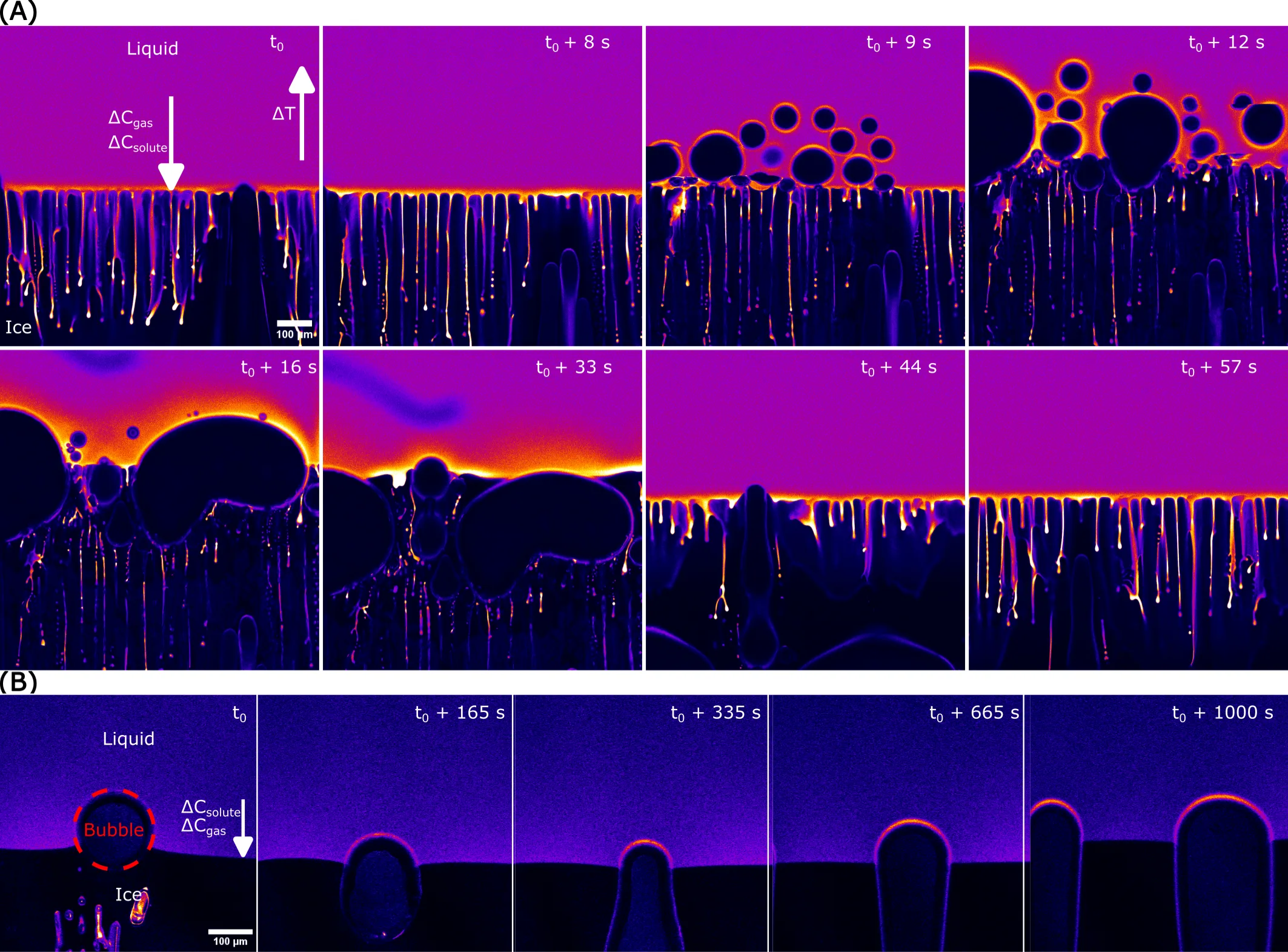
In a glass of soda, bubbles merrily rise to the top. But if you freeze the water, some bubbles end up trapped in the ice. How do they get there? After all, ice grows, pushing gas aside, but it doesn't always manage to.
Scientists took carbonated water (water with dissolved carbon dioxide) and froze it at different rates: from 1 to 20 micrometers per second. That's like the ice front crawling forward at speeds ranging from the thickness of a human hair per minute to the thickness of a hair in three seconds. They changed the temperature smoothly, with a constant gradient of 15 degrees per millimeter.
Under a microscope with fluorescent illumination, they could see gas accumulating into tiny bubbles just ahead of the advancing ice. It turned out that each bubble has its own "thinking time": how many seconds the gas needs to gather into a bubble. If the ice creeps slowly, the bubbles have time to grow and escape. If it's fast, the ice catches up and seals them in.
This isn't just a fun experiment with soda. In metallurgy, gas bubbles inside a casting are a defect that weakens the part. In ice, on the other hand, bubbles preserve ancient air — scientists use them to learn what the climate was like thousands of years ago. Now we can more accurately predict where and how many bubbles will form during solidification.
Carbonated water contains about 3–4 times more dissolved carbon dioxide than regular tap water. When it freezes, this gas is pushed out by the ice and gathers into bubbles, the same effect that makes ice from soda cloudy.
In Kurt Vonnegut's novel "Cat's Cradle," there is ice-nine — a fictional form of ice that freezes everything around it. Our experiment with bubbles in freezing water is a step toward understanding how to control the structure of ice and other materials.